


To live or let die? Epigenetic adaptations to climate change-a review
- PMID: 39139701
- PMCID: PMC11321362
- DOI: 10.1093/eep/dvae009
To live or let die? Epigenetic adaptations to climate change-a review
Erratum in
-
Correction to: To live or let die? Epigenetic adaptations to climate change-a review.Environ Epigenet. 2024 Oct 1;10(1):dvae016. doi: 10.1093/eep/dvae016. eCollection 2024. Environ Epigenet. 2024. PMID: 39355204 Free PMC article.
Abstract
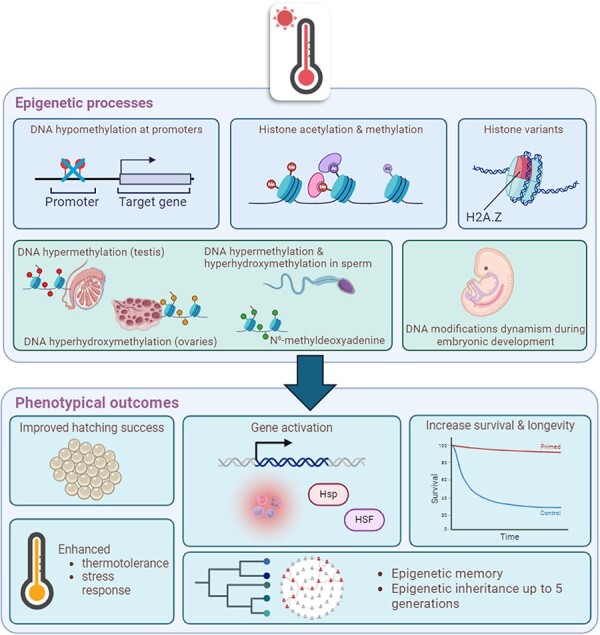
Anthropogenic activities are responsible for a wide array of environmental disturbances that threaten biodiversity. Climate change, encompassing temperature increases, ocean acidification, increased salinity, droughts, and floods caused by frequent extreme weather events, represents one of the most significant environmental alterations. These drastic challenges pose ecological constraints, with over a million species expected to disappear in the coming years. Therefore, organisms must adapt or face potential extinctions. Adaptations can occur not only through genetic changes but also through non-genetic mechanisms, which often confer faster acclimatization and wider variability ranges than their genetic counterparts. Among these non-genetic mechanisms are epigenetics defined as the study of molecules and mechanisms that can perpetuate alternative gene activity states in the context of the same DNA sequence. Epigenetics has received increased attention in the past decades, as epigenetic mechanisms are sensitive to a wide array of environmental cues, and epimutations spread faster through populations than genetic mutations. Epimutations can be neutral, deleterious, or adaptative and can be transmitted to subsequent generations, making them crucial factors in both long- and short-term responses to environmental fluctuations, such as climate change. In this review, we compile existing evidence of epigenetic involvement in acclimatization and adaptation to climate change and discuss derived perspectives and remaining challenges in the field of environmental epigenetics. Graphical Abstract.
© The Author(s) 2024. Published by Oxford University Press.
Conflict of interest statement
None declared.
Figures
References
-
- Ceballos G, García A, Ehrlich PR. The sixth extinction crisis loss of animal populations and species. J Cosmol 2010;8:1821–31.
-
- IPCC . Climate Change 2021 – The Physical Science Basis: Working Group I Contribution to the Sixth Assessment Report of the Intergovernmental Panel on Climate Change. I. P. on C. C. IPCC (ed), Cambridge University: Cambridge University Press, 2021.
-
- Dziba L, Nyingi W, Oguge N et al. Chapter 4 - Direct and indirect drivers of change in biodiversity and nature’s contributions to people. In: Intergovernmental Science-Policy Platform on Biodiversity and Ecosystem Services. The regional assesment report on biodiversity and ecosystem services for the Americas. Bonn: IPBES, 2019, 660.
Publication types
LinkOut - more resources
Full Text Sources
Miscellaneous
