


A Possible White Matter Compensating Mechanism in the Brain of Relatives of People Affected by Psychosis Inferred from Repeated Long-Term DTI Scans
- PMID: 39144792
- PMCID: PMC11205972
- DOI: 10.1093/schizbullopen/sgac055
A Possible White Matter Compensating Mechanism in the Brain of Relatives of People Affected by Psychosis Inferred from Repeated Long-Term DTI Scans
Abstract
Background and hypothesis: An existing model suggests that some brain features of relatives of people affected by psychosis can be distinguished from both the probands and a control group. Such findings can be interpreted as representing a compensating mechanism.
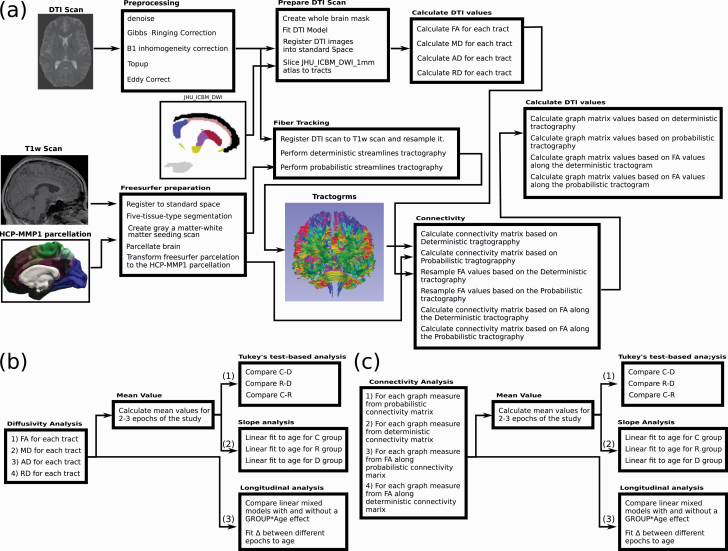
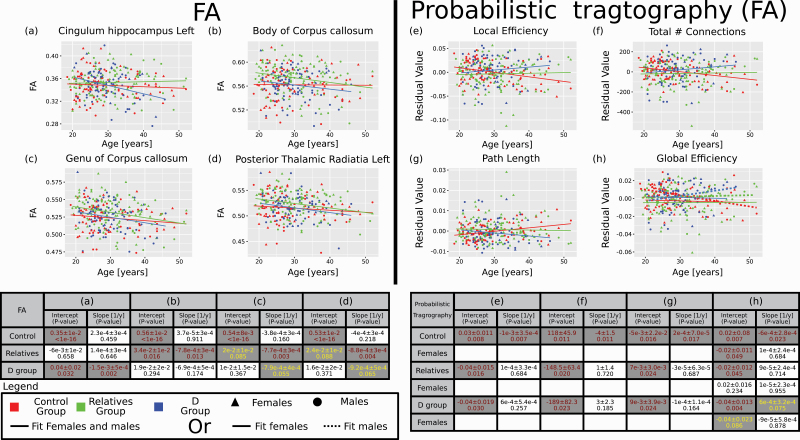
Study design: We studied white matter features using diffusion tensor imaging in a cohort of 82 people affected by psychosis, 122 of their first-degree relatives, and 89 control subjects that were scanned between two to three times with an interval of approximately 3 years between consecutive scans. We measured both fractional anisotropy and other standard diffusivity measures such as axial diffusivity. Additionally, we calculated standard connectivity measures such as path length based on probabilistic or deterministic tractography. Finally, by averaging the values of the different measures over the two or three consecutive scans, we studied epoch-averagely the difference between these three groups.
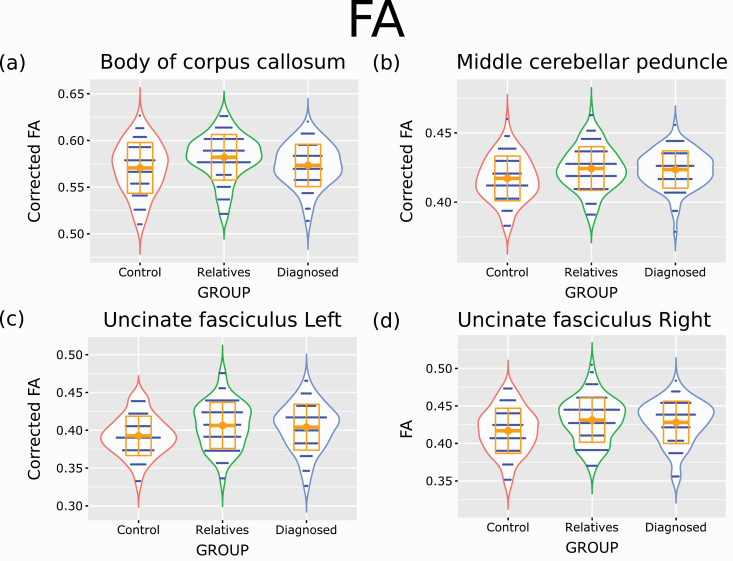
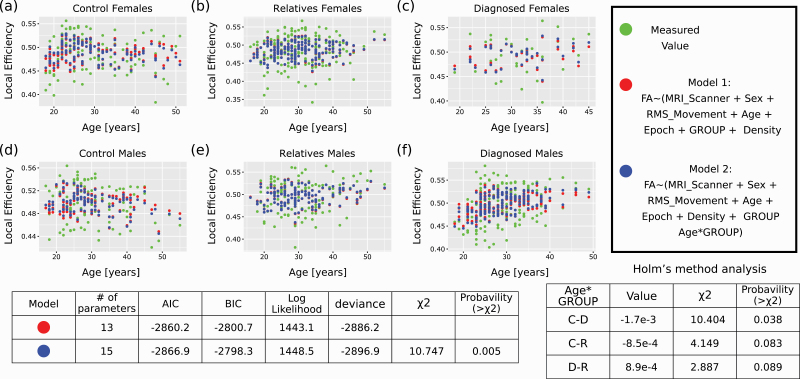
Study results: For several tracts and several connectivity measures, the relatives showed distinct features from both the probands and the control groups. In those cases, the relatives did not necessarily score between the probands and the control group. An aggregate analysis in the form of a group-dependent score for the different modes of the analysis (e.g., for fractional anisotropy) supported this observation.
Conclusions: We interpret these results as evidence supporting a compensation mechanism in the brain of relatives that may be related to resilience that some of them exhibit in the face of the genetic risk they have for being affected by psychosis.
Keywords: connectivity; diffusion tensor imaging; familial risk; first-degree relatives; psychosis; resilience.
© The Author(s) 2022. Published by Oxford University Press on behalf of the University of Maryland's school of medicine, Maryland Psychiatric Research Center.
Conflict of interest statement
All authors declare no conflict of interests.
Figures
References
-
- Skudlarski P, Schretlen DJ, Thaker GK, et al. . Diffusion tensor imaging white matter endophenotypes in patients with schizophrenia or psychotic bipolar disorder and their relatives. Am J Psychiatry. 2013;170(8):886–898. - PubMed
-
- Hilker R, Helenius D, Fagerlund B, et al. . Heritability of schizophrenia and schizophrenia spectrum based on the Nationwide Danish Twin Register. Biol Psychiatry. 2018;83(6):492–498. - PubMed
-
- Kyaga S, Lichtenstein P, Boman M, Hultman C, Långström N, Landén M. Creativity and mental disorder: family study of 300 000 people with severe mental disorder. Br J Psychiatry. 2011;199(5):373–379. - PubMed
LinkOut - more resources
Full Text Sources
