


GLP-1 receptor agonist-based therapies and cardiovascular risk: a review of mechanisms
- PMID: 39145614
- PMCID: PMC11466209
- DOI: 10.1530/JOE-24-0046
GLP-1 receptor agonist-based therapies and cardiovascular risk: a review of mechanisms
Abstract
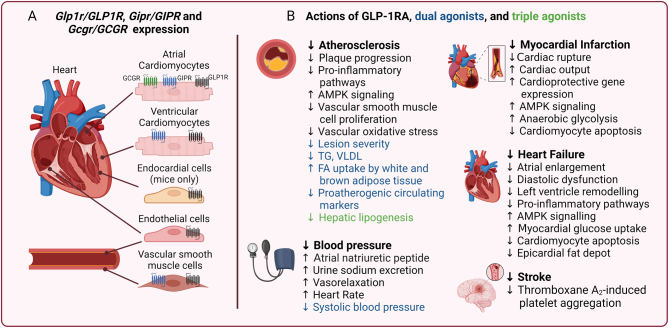
Cardiovascular outcome trials (CVOTs) in people living with type 2 diabetes mellitus and obesity have confirmed the cardiovascular benefits of glucagon-like peptide 1 receptor agonists (GLP-1RAs), including reduced cardiovascular mortality, lower rates of myocardial infarction, and lower rates of stroke. The cardiovascular benefits observed following GLP-1RA treatment could be secondary to improvements in glycemia, blood pressure, postprandial lipidemia, and inflammation. Yet, the GLP-1R is also expressed in the heart and vasculature, suggesting that GLP-1R agonism may impact the cardiovascular system. The emergence of GLP-1RAs combined with glucose-dependent insulinotropic polypeptide and glucagon receptor agonists has shown promising results as new weight loss medications. Dual-agonist and tri-agonist therapies have demonstrated superior outcomes in weight loss, lowered blood sugar and lipid levels, restoration of tissue function, and enhancement of overall substrate metabolism compared to using GLP-1R agonists alone. However, the precise mechanisms underlying their cardiovascular benefits remain to be fully elucidated. This review aims to summarize the findings from CVOTs of GLP-1RAs, explore the latest data on dual and tri-agonist therapies, and delve into potential mechanisms contributing to their cardioprotective effects. It also addresses current gaps in understanding and areas for further research.
Keywords: cardiovascular; hormone action; incretins; metabolism; nutrition.
Conflict of interest statement
The authors declare that there is no conflict of interest that could be perceived as prejudicing the impartiality of the research reported.
Figures
References
-
- Adriaenssens AE, Biggs EK, Darwish T, Tadross J, Sukthankar T, Girish M, Polex-Wolf J, Lam BY, Zvetkova I, Pan W, et al.2019Glucose-dependent insulinotropic polypeptide receptor-expressing cells in the hypothalamus regulate food intake. Cell Metabolism 30987–996.e6. (10.1016/j.cmet.2019.07.013) - DOI - PMC - PubMed
-
- Almutairi M, Gopal K, Greenwell AA, Young A, Gill R, Aburasayn H, Al Batran R, Chahade JJ, Gandhi M, Eaton F, et al.2021The GLP-1 receptor agonist liraglutide increases myocardial glucose oxidation rates via indirect mechanisms and mitigates experimental diabetic cardiomyopathy. Canadian Journal of Cardiology 37140–150. (10.1016/j.cjca.2020.02.098) - DOI - PubMed
-
- Aravindhan K Bao W Harpel MR Willette RN Lepore JJ & Jucker BM. 2015Cardioprotection resulting from glucagon-like peptide-1 administration involves shifting metabolic substrate utilization to increase energy efficiency in the rat heart. PLoS One 10e0130894. (10.1371/journal.pone.0130894) - DOI - PMC - PubMed
-
- Aronne LJ, Sattar N, Horn DB, Bays HE, Wharton S, Lin WY, Ahmad NN, Zhang S, Liao R, Bunck MC, et al.2024Continued treatment with tirzepatide for maintenance of weight reduction in adults with obesity: the surmount-4 randomized clinical trial. JAMA 33138–48. (10.1001/jama.2023.24945) - DOI - PMC - PubMed
-
- Ast J, Arvaniti A, Fine NHF, Nasteska D, Ashford FB, Stamataki Z, Koszegi Z, Bacon A, Jones BJ, Lucey MA, et al.2020Super-resolution microscopy compatible fluorescent probes reveal endogenous glucagon-like peptide-1 receptor distribution and dynamics. Nature Communications 11467. (10.1038/s41467-020-14309-w) - DOI - PMC - PubMed
Publication types
MeSH terms
Substances
LinkOut - more resources
Full Text Sources
Medical
