. 2024 Sep:107:105293.
doi: 10.1016/j.ebiom.2024.105293. Epub 2024 Aug 14.

The calcium-sensing-receptor (CaSR) in adipocytes contributes to sex-differences in the susceptibility to high fat diet induced obesity and atherosclerosis

Affiliations

The calcium-sensing-receptor (CaSR) in adipocytes contributes to sex-differences in the susceptibility to high fat diet induced obesity and atherosclerosis

Svenja Adam et al. EBioMedicine. 2024 Sep.

Abstract

Background: Female mice are more resistant to obesogenic effects of a high-fat diet (HFD), compared to male mice. Although the underlying mechanisms are poorly understood, sex hormones seem to play an important role. Interestingly, the activity of the oestrogen receptor-α (ERα) is affected by the calcium-sensing-receptor (CaSR). Therefore, we investigated sex-differences upon diet-induced obesity and the role of adipocyte-specific CaSR herein.

Methods: Adipocyte-specific Casr deficient mice (AdipoqCre+Casrflox) and control mice (Casrflox) were injected with AAV8-PCSK9 to make them prone to develop atherosclerosis and fed an obesity-inducing diet for 12 weeks.

Findings: Female mice have lower visceral white adipose tissue (vWAT) mass compared to male mice, while this sex-difference is abolished upon adipocyte-specific Casr deficiency. Furthermore, while females showed elevated levels of inflammatory cytokines and CD3+CD8+ T cell accumulation in vWAT, compared to males, adipocyte-specific Casr deficiency abrogated this sex-phenotype and demonstrated an inhibition of inflammatory signalling pathways. The expression of Erα, as well as associated genes involved in adipocyte differentiation, was increased in female mice in a mostly adipocyte-specific Casr dependent manner. Interestingly, circulating lipid levels were reduced in female compared to male mice, which correlated with decreased atherosclerotic plaque formation. These systemic effects were abrogated upon adipocyte-specific Casr deficiency.

Interpretation: Our findings indicate that female mice show a more pronounced vWAT dysfunction compared to males upon obesity. This sex effect is abolished upon adipocyte-specific Casr deficiency. In contrast, females show diminished atherosclerotic plaque formation compared to males, an effect that was abrogated by adipocyte-specific Casr deficiency.

Funding: This work was supported by a grant from the Interdisciplinary Center for Clinical Research within the faculty of Medicine at the RWTH Aachen University, by the Corona Foundation, by the Deutsche Forschungsgemeinschaft (DFG), the BMBF and Free State of Bavaria and the DZHK.

Keywords: Adipocytes; Atherosclerosis; Calcium-sensing receptor; Inflammation; Obesity; Sex-differences.


Conflict of interest statement

Declaration of interests None.

Figures

Fig. 1
Fig. 1
Female mice show reduced body and adipose tissue weight and improved glucose and insulin handling compared to male mice, while adipocyte-specific Casr deficiency eliminates these sex-differences. (a) Representation of workflow. Induction of knockout by i.p. injection of tamoxifen for 5 consecutive days, followed by AAV-PCSK9 i.v. injection and 12 weeks obesity-inducing diet (DIO) feeding. (b–d) Quantification of (b) body weight gain over time, (c) baseline body weight and (d) end-point body weight (n = 8–9 for males; n = 4–7 for females). (e–f) Quantification of (e) vWAT weight (n = 8–9 for males; n = 4–6 for females) and (f) liver weight (n = 8–9 for males; n = 4–6 for females) normalized to total body weight. (g–i) Analysis of vWAT by (g) HE staining (Scale bar = 10 μm) and quantification of (h) adipocyte surface and (i) adipocyte diameter (n = 8–9 for males; n = 4–7 for females). (j–m) Blood glucose levels during (j and k) a (j) glucose tolerance test (GTT) with (k) quantification of the AUC as well as (l and m) an (l) insulin tolerance test (ITT) with (m) quantification of the AUC (n = 7–9 for males; n = 4–7 for females). Graphs represent mean ± SEM. ∗P < 0.05; ∗∗P < 0.01; ∗∗∗P < 0.001. AUC: area under the curve.
Fig. 2
Fig. 2
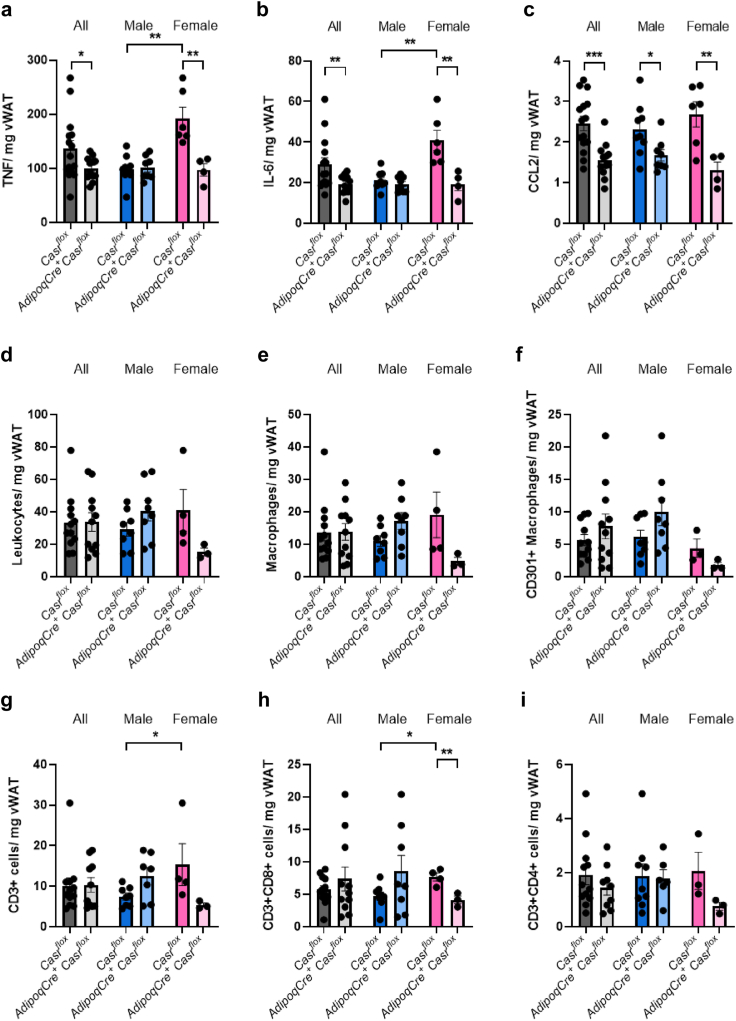
Female mice demonstrate elevated vWAT inflammation and T cell infiltration, compared to male mice. (a–c) Quantification of inflammatory cytokines (a) TNF (n = 8–9 for males; n = 4–6 for females), (b) IL-6 (n = 8–9 for males; n = 4–6 for females) and (c) CCL2 (n = 8–9 for males; n = 4–6 for females) in vWAT normalized to 1 mg vWAT. (d–i) Quantification of leukocyte presence in vWAT analysed using flow cytometry, showing (d) total leukocyte, (e) macrophage, (f) CD301+ macrophage, (g) CD3+ T cell, (h) CD3+CD8+ T cell and (i) CD3+CD4+ T cell counts. Graphs represent mean ± SEM. ∗P < 0.05; ∗∗P < 0.01; ∗∗∗P < 0.001. vWAT: visceral white adipose tissue.
Fig. 3
Fig. 3
Adipocyte-specific Casr deficiency reduces expression of genes related to adipocyte differentiation and adipogenesis in vWAT. Fold change of gene expression of (a) oestrogen receptor α (Era), (b) peroxisome proliferator-activated receptor γ (Pparγ), (c) adipocyte protein 2 (aP2), (d) lipoprotein lipase (lpl), (e) CCAAT/enhancer binding protein α (C/ebpa), (f) cluster of differentiation 36 (Cd36), (g) adipocyte triglyceride lipase (Atgl) and (h) hormone-sensitive lipase (Hsl) in vWAT (n = 8–9 for males; n = 3–7 for females). (i and j) Quantification of (i) total cholesterol and (j) triglyceride content in vWAT lysates (normalized to vWAT weight; n = 8–9 for males; n = 4–7 for females). Bar graphs represent mean ± SEM. ∗P < 0.05; ∗∗P < 0.01; ∗∗∗P < 0.001. vWAT: visceral white adipose tissue.
Fig. 4
Fig. 4
Inflammatory kinase activity in the vWAT is upregulated in female mice in a CaSR dependent manner. (a) Serine–threonine kinase (STK) and (b) Phosphotyrosine kinase (PTK) activity in the vWAT. Only significantly regulated kinases are shown. (a and b) Top rows show sex-differences, where red indicates increased and blue decreased kinase activity in female compared to male control mice. Bottom rows show differences between female adipocyte-specific Casr deficient mice compared to female control mice, where red indicates increased and blue decreased kinase activity. vWAT: visceral white adipose tissue. Presented data is an average of 4 individual samples per genotype and per gender.
Fig. 5
Fig. 5
Female mice are protected against obesity-associated atherosclerosis in an adipocyte-specific Casr manner. (a–b) Blood plasma lipid levels of (a) cholesterol (n = 8–9 for males; n = 4–6 for females) and (b) triglycerides (n = 8–9 for males; n = 4–7 for females). (c) Representative images of H&E-staining in the aortic root of Casrflox and AdipoqCre+Casrflox mice and quantification of relative plaque size (% of total aortic root area) (n = 7–8 for males; n = 4–6 for females). Scale bar: 500 μm. (d–e) Correlation analysis of plasma lipid levels and atherosclerotic plaque size (n = 5–7 for males; n = 4–7 for females; colour codes correspond with bar-graphs in panels A–C). Bar graphs represent mean ± SEM. ∗P < 0.05; ∗∗P < 0.01.

References

    1. van der Heijden R.A., Sheedfar F., Morrison M.C., et al. High-fat diet induced obesity primes inflammation in adipose tissue prior to liver in C57BL/6j mice. Aging (Albany NY) 2015;7(4):256–268. - PMC - PubMed
    1. Finucane M.M., Stevens G.A., Cowan M.J., et al. National, regional, and global trends in body-mass index since 1980: systematic analysis of health examination surveys and epidemiological studies with 960 country-years and 9.1 million participants. Lancet. 2011;377(9765):557–567. - PMC - PubMed
    1. Knopp R.H., Paramsothy P., Retzlaff B.M., et al. Gender differences in lipoprotein metabolism and dietary response: basis in hormonal differences and implications for cardiovascular disease. Curr Atheroscler Rep. 2005;7(6):472–479. - PubMed
    1. Menegoni F., Galli M., Tacchini E., Vismara L., Cavigioli M., Capodaglio P. Gender-specific effect of obesity on balance. Obesity. 2009;17(10):1951–1956. - PubMed
    1. Gerdts E., Regitz-Zagrosek V. Sex differences in cardiometabolic disorders. Nat Med. 2019;25(11):1657–1666. - PubMed

MeSH terms