


Ergonomics in Dermatologic Laser Procedures
- PMID: 39148959
- PMCID: PMC11324194
Ergonomics in Dermatologic Laser Procedures
Abstract
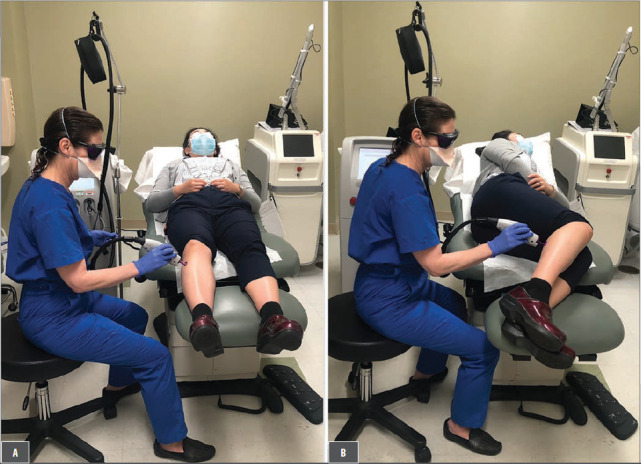
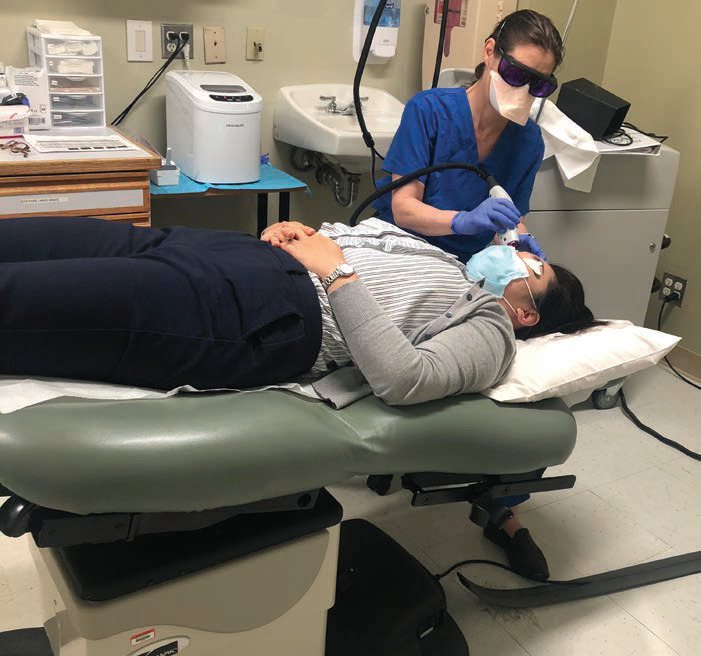
Due to working in static positions and use of repetitive movements over long periods of time, dermatologists are at increased risk of work-related musculoskeletal injury. Historically, studies on procedural ergonomics have focused on dermatologic surgery, however, laser procedures can also have a significant cumulative effect on physician posture. Here, we aim to highlight ergonomic challenges specific to dermatologic laser procedures and suggest areas of improvement in operating room organization, patient positioning, physician mechanics, and instrumentation. For the operating room, it is beneficial to store several devices in the same room, have central placement of electrical outlets, and to position the devices on the same side of the bed as the laser operator. When considering patient positioning, a Trendelenburg bed position can be helpful for vascular lesions on the head, and frequent repositioning of the patient can prevent uncomfortable bending of the operator and laser arm for circumferential lesions. Physicians should maintain a working position with a neutral spine and wrist position, moving the patient and bed as needed to reduce muscle tension. Lastly, laser instrumentation in the future could be improved upon with lightweight consoles and hand pieces, long multi-articulated device arms, and lightweight laser goggles with adjustable head straps. With the use of organizational, ergonomic positioning, and teamwork strategies, we can reduce the risk of musculoskeletal injury for our laser operators.
Keywords: Ergonomics; dermatology; laser; musculoskeletal injury.
Copyright © 2024. Matrix Medical Communications. All rights reserved.
Conflict of interest statement
DISCLOSURES: Dr. Kelly receives grant money from Michaelson Diagnostics and Lutronic, has served as a consultant for Sciton and FDZJ and has research supported by ASLMS; NIH and Sturge Weber Foundation, collects consulting fees from Shanghai Fudan-Zhangjiang Bio-pharmaceutical Co., Sciton, and IQVIA, and is on the LSM editorial board.
Figures
References
-
- Chan J, Kim DJ, Kassira-Carley S et al. Ergonomics in dermatologic surgery: lessons learned across related specialties and opportunities for improvement. Dermatol Surg. 2020;46(6):763–772. Jun. - PubMed
-
- Rogers DW, Jobes HM, Hinshaw JR et al. Ergonomics of medical lasers: operator’s viewpoint. J Clin Laser Med Surg. 1992;10(3):199–206. - PubMed
-
- Boucek C, Freeman JA, Bircher NG et al. Impairment of anesthesia task performance by laser protection goggles. Anesth Analg. 1993;77(6):1232–1237. - PubMed
-
- Wilczyński S, Koprowski R, Wiernek BK et al. Image-guided automatic triggering of a fractional CO2 laser in aesthetic procedures. Comput Biol Med. 2016;76:1–6. - PubMed
Publication types
LinkOut - more resources
Full Text Sources