


NCME-Net: Nuclear cataract mask encoder network for intelligent grading using self-supervised learning from anterior segment photographs
- PMID: 39149020
- PMCID: PMC11324988
- DOI: 10.1016/j.heliyon.2024.e34726
NCME-Net: Nuclear cataract mask encoder network for intelligent grading using self-supervised learning from anterior segment photographs
Abstract
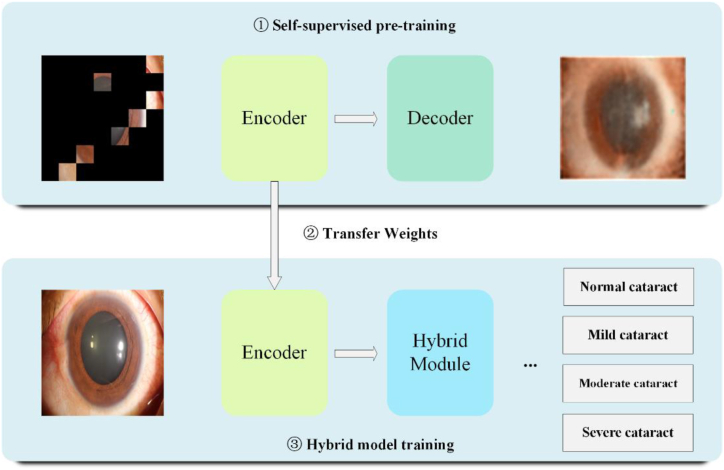
Cataracts are a leading cause of blindness worldwide, making accurate diagnosis and effective surgical planning critical. However, grading the severity of the lens nucleus is challenging because deep learning (DL) models pretrained using ImageNet perform poorly when applied directly to medical data due to the limited availability of labeled medical images and high interclass similarity. Self-supervised pretraining offers a solution by circumventing the need for cost-intensive data annotations and bridging domain disparities. In this study, to address the challenges of intelligent grading, we proposed a hybrid model called nuclear cataract mask encoder network (NCME-Net), which utilizes self-supervised pretraining for the four-class analysis of nuclear cataract severity. A total of 792 images of nuclear cataracts were categorized into the training set (533 images), the validation set (139 images), and the test set (100 images). NCME-Net achieved a diagnostic accuracy of 91.0 % on the test set, a 5.0 % improvement over the best-performing DL model (ResNet50). Experimental results demonstrate NCME-Net's ability to distinguish between cataract severities, particularly in scenarios with limited samples, making it a valuable tool for intelligently diagnosing cataracts. In addition, the effect of different self-supervised tasks on the model's ability to capture the intrinsic structure of the data was studied. Findings indicate that image restoration tasks significantly enhance semantic information extraction.
Keywords: Cataract; Deep learning; Hybrid model; Self-supervision.
© 2024 The Authors.
Conflict of interest statement
The authors declare that they have no known competing financial interests or personal relationships that could have appeared to influence the work reported in this paper.
Figures


References
-
- Flaxman S.R., Bourne R.R.A., Resnikoff S., Ackland P., Braithwaite T., Cicinelli M.V., Das A., Jonas J.B., Keeffe J., Kempen J.H., Leasher J., Limburg H., Naidoo K., Pesudovs K., Silvester A., Stevens G.A., Tahhan N., Wong T.Y., Taylor H.R. Vision, loss expert group of the global burden of disease study. Global causes of blindness and distance vision impairment 1990-2020: a systematic review and meta-analysis. The lancet. Global health. 2017;5(12):e1221–e1234. - PubMed
-
- Pascolini D., Mariotti S.P. Global estimates of visual impairment. The British journal of ophthalmology 2012. 2010;96(5):614–618. - PubMed
-
- GBD Blindness and vision impairment collaborators, & vision loss expert group of the global burden of disease study. Causes of blindness and vision impairment in 2020 and trends over 30 years, and prevalence of avoidable blindness in relation to VISION 2020: the right to sight: an analysis for the global burden of disease study. Lancet Global Health. 2019;9(2):e144–e160. 2021. - PMC - PubMed
LinkOut - more resources
Full Text Sources
