


Phenotypic assessment of Cox10 variants and their implications for Leigh Syndrome
- PMID: 39152498
- PMCID: PMC11328382
- DOI: 10.1186/s13104-024-06879-5
Phenotypic assessment of Cox10 variants and their implications for Leigh Syndrome
Abstract
Objectives: Cox10 is an enzyme required for the activity of cytochrome c oxidase. Humans who lack at least one functional copy of Cox10 have a form of Leigh Syndrome, a genetic disease that is usually fatal in infancy. As more human genomes are sequenced, new alleles are being discovered; whether or not these alleles encode functional proteins remains unclear. Thus, we set out to measure the phenotypes of many human Cox10 variants by expressing them in yeast cells.
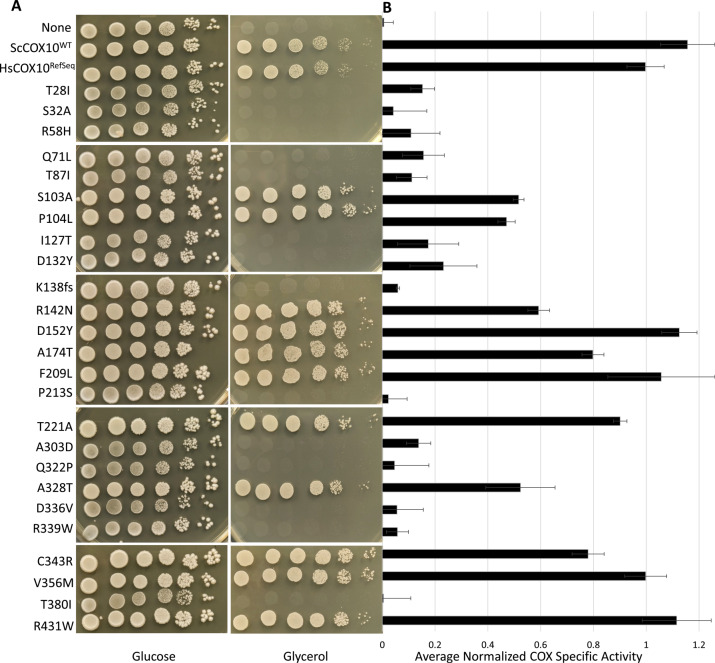
Results: We successfully expressed the reference sequence and 25 variants of human Cox10 in yeast. We quantitated the ability of these variants to support growth on nonfermentable media and directly measured cytochrome c oxidase activity. 11 of these Cox10 variants supported approximately half or more the cytochrome c oxidase activity compared to the reference sequence. All of the strains containing those 11 variants also grew robustly using a nonfermentable carbon source. Cells expressing the other variants showed low cytochrome c oxidase activity and failed to grow on nonfermentable media.
Keywords: Saccharomyces cerevisiae; Cox10; Cytochrome c oxidase; Leigh syndrome.
© 2024. The Author(s).
Conflict of interest statement
The authors declare no competing interests.
Figures
References
-
- Pitceathly RDS, Taanman JW, Rahman S, Meunier B, Sadowski M, Cirak S, et al. COX10 mutations resulting in complex multisystem mitochondrial disease that remains stable into adulthood. JAMA Neurol. 2013;70(12):1556–61. - PubMed
MeSH terms
Substances
LinkOut - more resources
Full Text Sources
Molecular Biology Databases
Research Materials
