


AI-based derivation of atrial fibrillation phenotypes in the general and critical care populations
- PMID: 39153412
- PMCID: PMC11381622
- DOI: 10.1016/j.ebiom.2024.105280
AI-based derivation of atrial fibrillation phenotypes in the general and critical care populations
Abstract
Background: Atrial fibrillation (AF) is the most common heart arrhythmia worldwide and is linked to a higher risk of mortality and morbidity. To predict AF and AF-related complications, clinical risk scores are commonly employed, but their predictive accuracy is generally limited, given the inherent complexity and heterogeneity of patients with AF. By classifying different presentations of AF into coherent and manageable clinical phenotypes, the development of tailored prevention and treatment strategies can be facilitated. In this study, we propose an artificial intelligence (AI)-based methodology to derive meaningful clinical phenotypes of AF in the general and critical care populations.
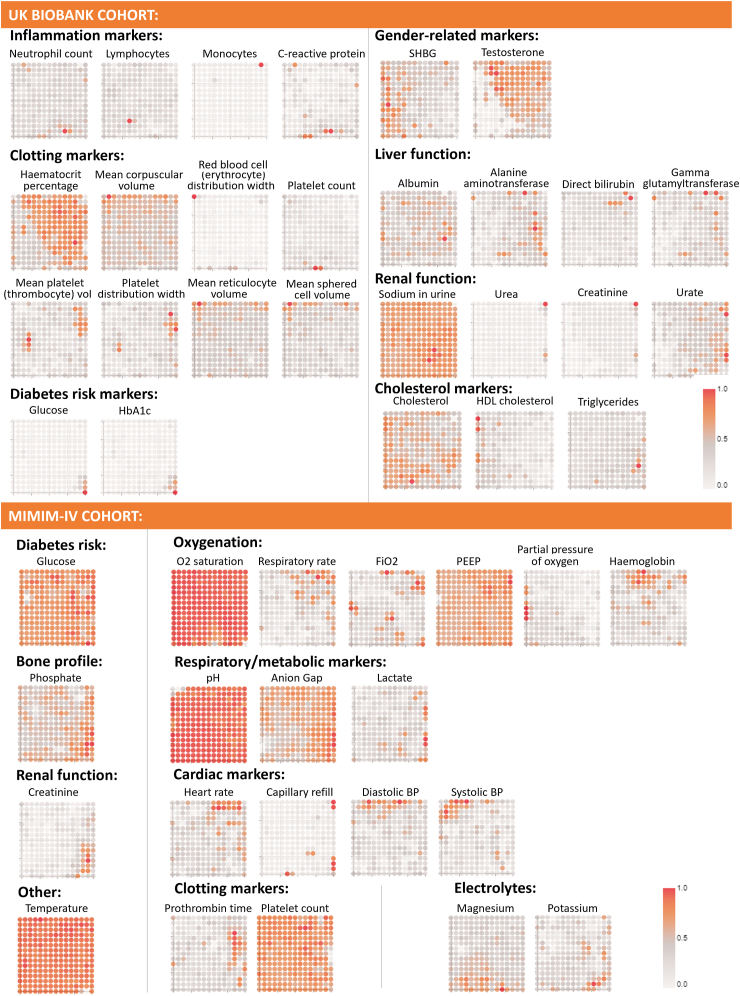
Methods: Our approach employs generative topographic mapping, a probabilistic machine learning method, to identify micro-clusters of patients with similar characteristics. It then identifies macro-cluster regions (clinical phenotypes) in the latent space using Ward's minimum variance method. We applied it to two large cohort databases (UK-Biobank and MIMIC-IV) representing general and critical care populations.
Findings: The proposed methodology showed its ability to derive meaningful clinical phenotypes of AF. Because of its probabilistic foundations, it can enhance the robustness of patient stratification. It also produced interpretable visualisation of complex high-dimensional data, enhancing understanding of the derived phenotypes and their key characteristics. Using our methodology, we identified and characterised clinical phenotypes of AF across diverse patient populations.
Interpretation: Our methodology is robust to noise, can uncover hidden patterns and subgroups, and can elucidate more specific patient profiles, contributing to more robust patient stratification, which could facilitate the tailoring of prevention and treatment programs specific to each phenotype. It can also be applied to other datasets to derive clinically meaningful phenotypes of other conditions.
Funding: This study was funded by the DECIPHER project (LJMU QR-PSF) and the EU project TARGET (10113624).
Keywords: Atrial fibrillation; Clinical phenotypes; Clustering; Generative topographic mapping; MIMIC-IV; Machine learning; Probabilistic modelling; Stratification; UK-Biobank.
Copyright © 2024 The Authors. Published by Elsevier B.V. All rights reserved.
Conflict of interest statement
Declaration of interests All authors declare no competing interests.
Figures



References
-
- Zhang J., Johnsen S.P., Guo Y., Lip G.Y.H. Epidemiology of atrial fibrillation. Card Electrophysiol Clin. 2021;13(1):1–23. - PubMed
-
- Lip G.Y.H., Genaidy A., Tran G., Marroquin P., Estes C., Sloop S. Improving stroke risk prediction in the general population: a comparative assessment of common clinical rules, a new multimorbid index, and machine-learning-based algorithms. Thromb Haemost. 2021;122(1):142–150. - PubMed
-
- Romiti G.F., Proietti M., Bonini N., et al. Clinical complexity domains, anticoagulation, and outcomes in patients with atrial fibrillation: a report from the GLORIA-AF registry phase II and III. Thromb Haemost. 2022;122(12):2030–2041. - PubMed
MeSH terms
LinkOut - more resources
Full Text Sources
Medical
