


Using lake sediments to assess the long-term impacts of anthropogenic activity in tropical river deltas
- PMID: 39156121
- PMCID: PMC11324390
- DOI: 10.1177/20530196231204334
Using lake sediments to assess the long-term impacts of anthropogenic activity in tropical river deltas
Abstract
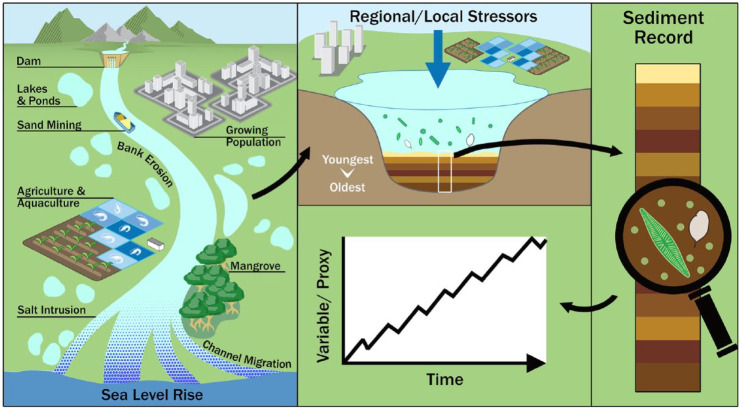
Tropical river deltas, and the social-ecological systems they sustain, are changing rapidly due to anthropogenic activity and climatic change. Baseline data to inform sustainable management options for resilient deltas is urgently needed and palaeolimnology (reconstructing past conditions from lake or wetland deposits) can provide crucial long-term perspectives needed to identify drivers and rates of change. We review how palaeolimnology can be a valuable tool for resource managers using three current issues facing tropical delta regions: hydrology and sediment supply, salinisation and nutrient pollution. The unique ability of palaeolimnological methods to untangle multiple stressors is also discussed. We demonstrate how palaeolimnology has been used to understand each of these issues, in other aquatic environments, to be incorporated into policy. Palaeolimnology is a key tool to understanding how anthropogenic influences interact with other environmental stressors, providing policymakers and resource managers with a 'big picture' view and possible holistic solutions that can be implemented.
Keywords: multiple stressors; palaeolimnology; resource management; river deltas; tropics.
© The Author(s) 2023.
Conflict of interest statement
The author(s) declared no potential conflicts of interest with respect to the research, authorship, and/or publication of this article.
Figures
References
-
- Adams H, Adger WN, Nicholls RJ, et al. (2018) Ecosystem services linked to livelihoods and well-being in the Ganges-Brahmaputra-Meghna Delta. In: Nicholls RJ, Hutton CW, Adger WN. (eds) Ecosystem Services for Well-Being in Deltas: Integrated Assessment for Policy Analysis. Cham: Springer International Publishing, pp.29–48.
-
- Adekola O, Mitchell G. (2011) The Niger delta wetlands: Threats to ecosystem services, their importance to dependent communities and possible management measures. International Journal of Biodiversity Science Ecosystems Services & Management 7: 50–68.
-
- Alexson EE, Reavie ED, Axler RP, et al. (2018) Paleolimnology of a freshwater estuary to inform area of concern nutrient delisting efforts. Journal of Paleolimnology 59: 373–395.
-
- Anderson NJ, Bugmann H, Dearing JA, et al. (2006) Linking palaeoenvironmental data and models to understand the past and to predict the future. Trends in Ecology & Evolution 21: 696–704. - PubMed
-
- Auerbach LW, Goodbred SL, Jr, Mondal DR, et al. (2015) Flood risk of natural and embanked landscapes on the Ganges–Brahmaputra tidal delta plain. Nature Climate Change 5: 153–157.
Publication types
LinkOut - more resources
Full Text Sources
Miscellaneous