


Alginate-Based UV Sensor: A Simple and Inexpensive Tool for Educational Purposes
- PMID: 39157435
- PMCID: PMC11328127
- DOI: 10.1021/acs.jchemed.4c00291
Alginate-Based UV Sensor: A Simple and Inexpensive Tool for Educational Purposes
Abstract
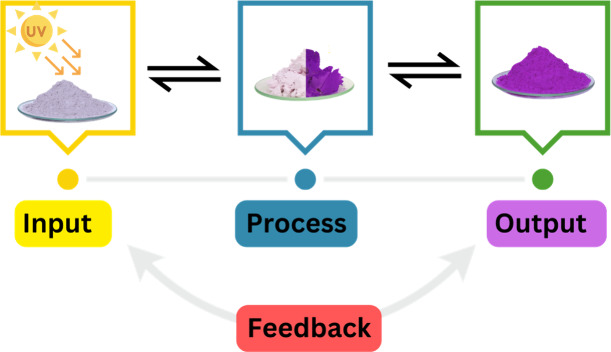
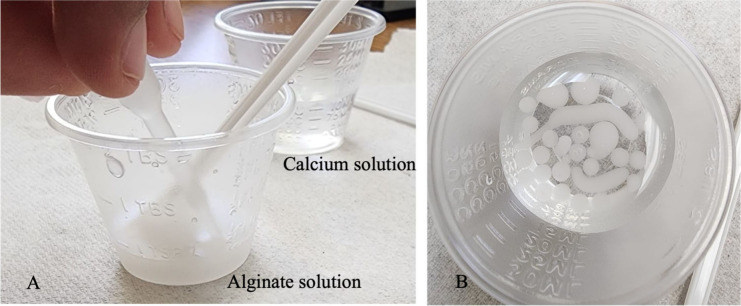
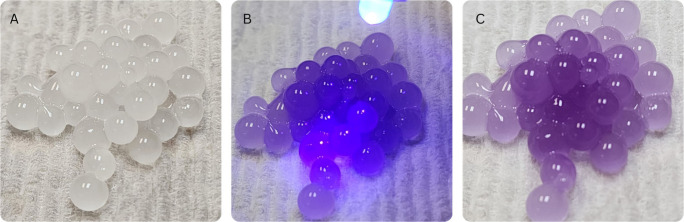
This document presents a simple yet highly effective demonstration for creating UV radiation sensors using alginate molecules. This demonstration can easily be aligned with the Next Generation Science Standards (NGSS) for classroom use. Moreover, the demonstration requires only a few easily obtainable materials, and the process involved is straightforward. When exposed to UV light or sunlight, the spheres' color changes, offering a fascinating observation that is sure to capture the imagination of students of all ages. This encourages curiosity and inspires further exploration of the scientific world. It is easily understandable and suitable for people of all ages. This experiment represents a valuable addition to the scientific community's educational tools, and its potential to inspire a new generation of scientists is truly limitless.
© 2024 The Authors. Published by American Chemical Society and Division of Chemical Education, Inc.
Conflict of interest statement
The authors declare no competing financial interest.
Figures


References
-
- US EPA . Health and Environmental Effects of Ozone Layer Depletion. 2015.
-
- Artemis - NASA; NASA, https://www.nasa.gov/humans-in-space/artemis/ (accessed 2024–07–08).
-
- Ultraviolet (UV) radiation. Europa.eu. https://climate-adapt.eea.europa.eu/en/observatory/evidence/health-effec... (accessed 2024–06–24).
-
- Sensor. Oxfordlearnersdictionaries.com. https://www.oxfordlearnersdictionaries.com/definition/english/sensor (accessed 2023–12–08).
LinkOut - more resources
Full Text Sources