


Ubiquitination of NS1 Confers Differential Adaptation of Zika Virus in Mammalian Hosts and Mosquito Vectors
- PMID: 39159062
- PMCID: PMC11497017
- DOI: 10.1002/advs.202408024
Ubiquitination of NS1 Confers Differential Adaptation of Zika Virus in Mammalian Hosts and Mosquito Vectors
Abstract
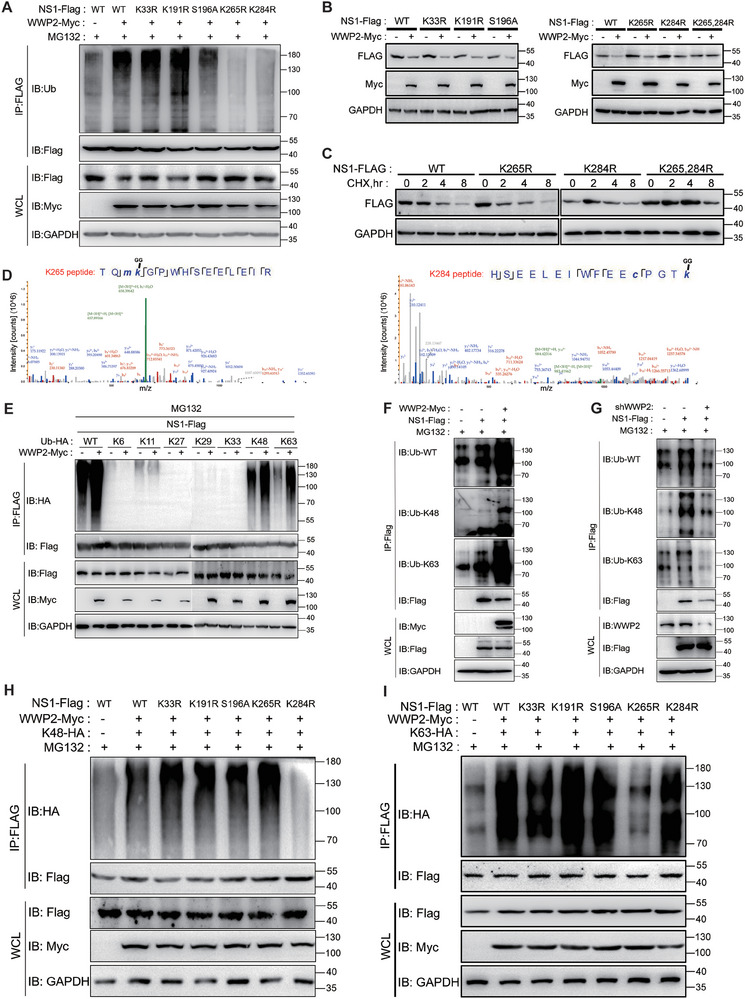
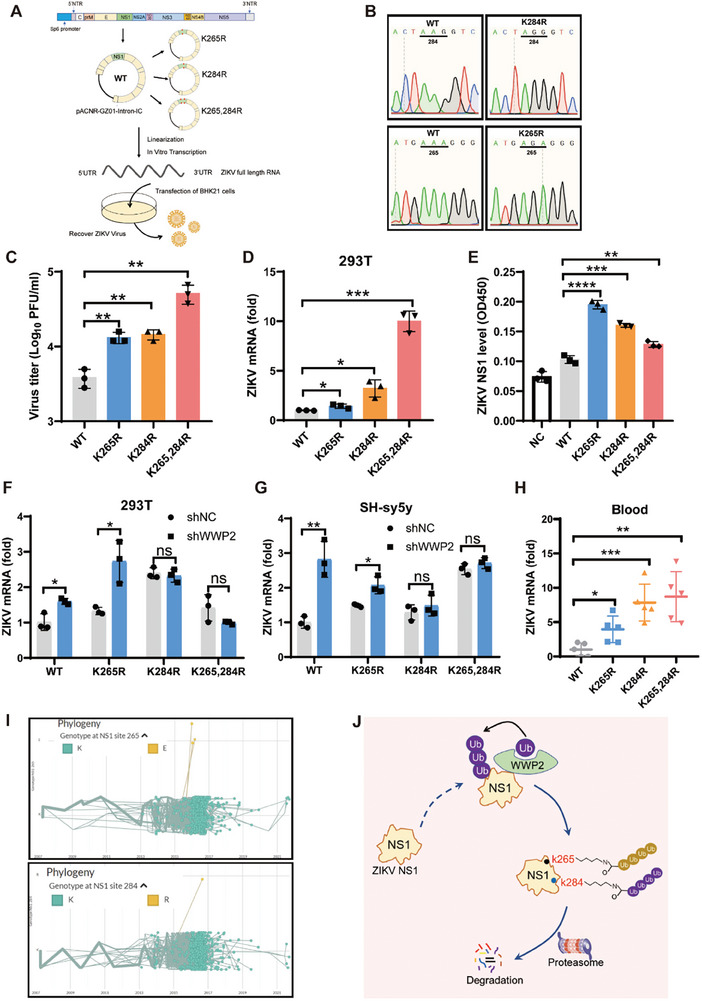
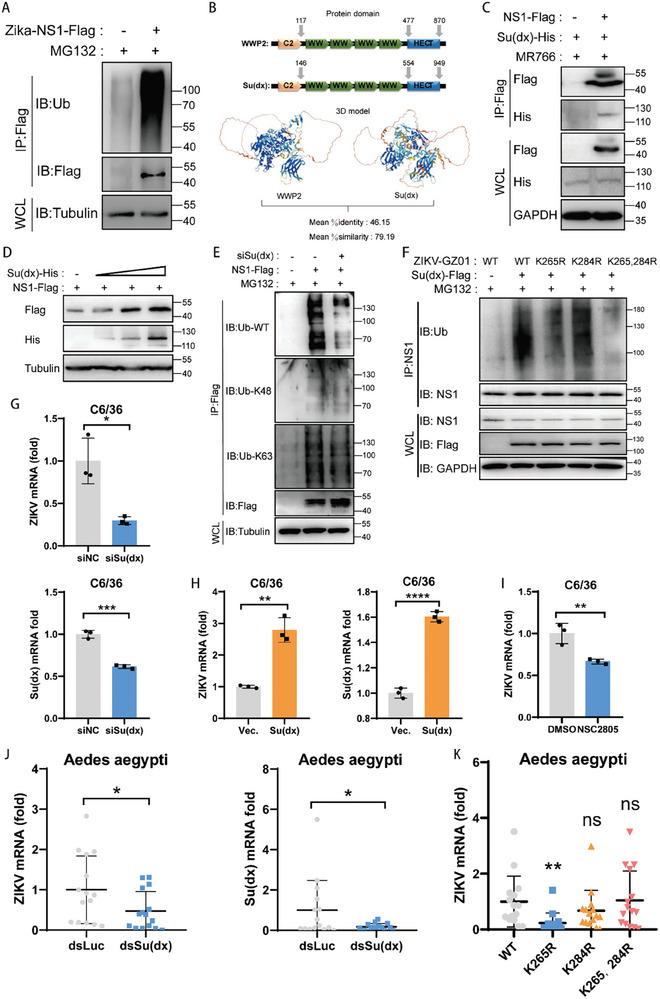
Arboviruses, transmitted by medical arthropods, pose a serious health threat worldwide. During viral infection, Post Translational Modifications (PTMs) are present on both host and viral proteins, regulating multiple processes of the viral lifecycle. In this study, a mammalian E3 ubiquitin ligase WWP2 (WW domain containing E3 ubiquitin ligase 2) is identified, which interacts with the NS1 protein of Zika virus (ZIKV) and mediates K63 and K48 ubiquitination of Lys 265 and Lys 284, respectively. WWP2-mediated NS1 ubiquitination leads to NS1 degradation via the ubiquitin-proteasome pathway, thereby inhibiting ZIKV infection in mammalian hosts. Simultaneously, it is found Su(dx), a protein highly homologous to host WWP2 in mosquitoes, is capable of ubiquitinating NS1 in mosquito cells. Unexpectedly, ubiquitination of NS1 in mosquitoes does not lead to NS1 degradation; instead, it promotes viral infection in mosquitoes. Correspondingly, the NS1 K265R mutant virus is less infectious to mosquitoes than the wild-type (WT) virus. The above results suggest that the ubiquitination of the NS1 protein confers different adaptations of ZIKV to hosts and vectors, and more importantly, this explains why NS1 K265-type strains have become predominantly endemic in nature. This study highlights the potential application in antiviral drug and vaccine development by targeting viral proteins' PTMs.
Keywords: E3 ligase WWP2; NS1; Zika virus; flavivirus; mosquito; ubiquitination.
© 2024 The Author(s). Advanced Science published by Wiley‐VCH GmbH.
Conflict of interest statement
The authors declare no conflict of interest.
Figures

References
-
- Wu P., Yu X., Wang P., Cheng G., Expert Rev. Mol. Med. 2019, 21, e1. - PubMed
-
- a) Santos A. L., Lindner A. B., Oxid. Med. Cell Longev. 2017, 2017, 5716409; - PMC - PubMed
- b) Rahnefeld A., Klingel K., Schuermann A., Diny N. L., Althof N., Lindner A., Bleienheuft P., Savvatis K., Respondek D., Opitz E., Ketscher L., Sauter M., Seifert U., Tschöpe C., Poller W., Knobeloch K. P., Voigt A., Circulation 2014, 130, 1589; - PubMed
- c) Zhang T., Ye Z., Yang X., Qin Y., Hu Y., Tong X., Lai W., Ye X., Sci. Rep. 2017, 7, 43691. - PMC - PubMed
MeSH terms
Substances
Grants and funding
- Priority Academic Program Development of Jiangsu Higher Education Institutions
- 81971917/National Natural Science Foundation of China
- 32170142/National Natural Science Foundation of China
- 2023-I2M-2-010/CAMS Initiation Fund for Medical Sciences
- 2022-I2M-2-004/CAMS Initiation Fund for Medical Sciences
LinkOut - more resources
Full Text Sources
Medical
Miscellaneous