Review
. 2024 Oct 1;36(5):353-361.
doi: 10.1097/GCO.0000000000000983. Epub 2024 Aug 17.

Medical management of endometriosis

Affiliations
Review

Medical management of endometriosis

Anais Alonso et al. Curr Opin Obstet Gynecol. .

Abstract

Purpose of review: While laparoscopic surgery plays a key role in the management of endometriosis, symptoms commonly recur, and repeat surgery comes with increased risk. Medical management, including hormonal and nonhormonal treatment, is vital in managing painful symptoms. This review summarizes recent evidence regarding various medical management options available to treat pelvic pain associated with endometriosis.

Recent findings: Efficacy of dienogest vs. combined oral contraceptive on pain associated with endometriosis: randomized clinical trial.Once daily oral relugolix combination therapy vs. placebo in patients with endometriosis-associated pain: two replicate phase 3, randomised, double-blind, studies (SPIRIT 1 and 2).A randomized, double-blind, placebo-controlled pilot study of the comparative effects of dienogest and the combined oral contraceptive pill in women with endometriosis.Two-year efficacy and safety of relugolix combination therapy in women with endometriosis-associated pain: SPIRIT open-label extension study.

Summary: All symptomatic women with suspected endometriosis who are not desiring immediate fertility can be offered suppressive treatment to control symptoms and slow the progression of disease. First-line treatments include the combined oral contraceptive pill and progestogens. Second-line treatments include gonadotropin-releasing hormone agonists and antagonists but current guidelines recommend that these should be reserved for people whose symptoms fail to be controlled by first-line agents. The use of complementary and alternative medicines is also increasing in both volume and number of agents used.


Conflict of interest statement

A.A. holds shares in CSL and Ecofibre. S.M.L. has received grants or honoraria from Bayer, AbbVie, Ethicon and Pfizer. J.A. reports funding through the Medical Research Future Fund (Australian Government), Australasian Gynaecological Endoscopy and Surgery (AGES) Society and Endometriosis Australia for research programs. He is a Chairman of the National Endometriosis Clinical and Scientific Trials network (Government funded), and a member of the Endometriosis Advisory Group Member to the Australian government and Steering committee for the National Action Plan for Endometriosis. He is a member of the Internation Federation of Gynaecology and Obstetrics (FIGO) Committee on Menstrual Disorders and Related Health Impacts and Co Editor-in-Chief of the Journal of Minimally Invasive Gynecology. He is on the scientific advisory board for Hologic and Gedeon Richter and has been a consultant/speaker for Bayer, MSD, Stryker, Karl Storz, Allergan, Vifor, and Organon. K.G. has no conflicts of interest.

Figures

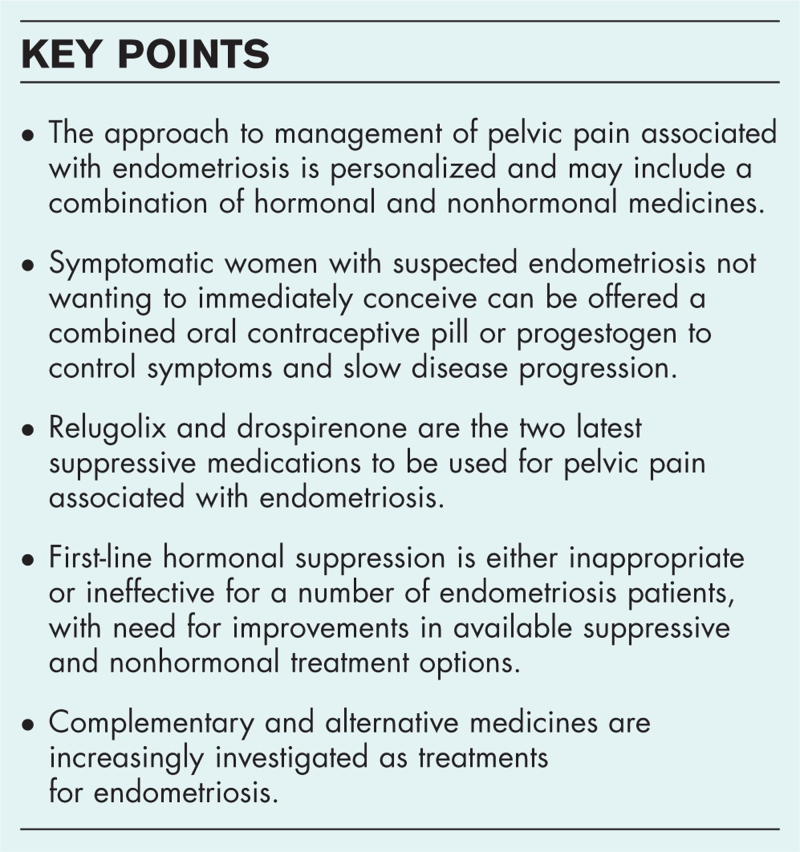
Box 1
Box 1
no caption available
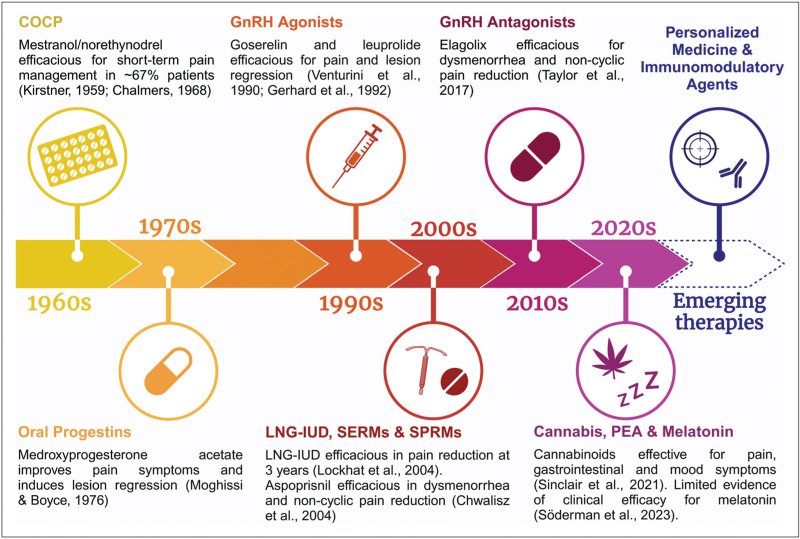
FIGURE 1
FIGURE 1
Timeline with key milestones in the historical development of treatments for endometriosis and emerging therapeutic approaches. Created with BioRender.com. COCP, combined oral contraceptive pill; GnRH, gonadotropin-releasing hormone; LNG-IUD, levonorgestrel intrauterine device; PEA, palmitoylethanolamide; SERM, selective estrogen receptor modulator; SPRM, selective progesterone receptor modulator.
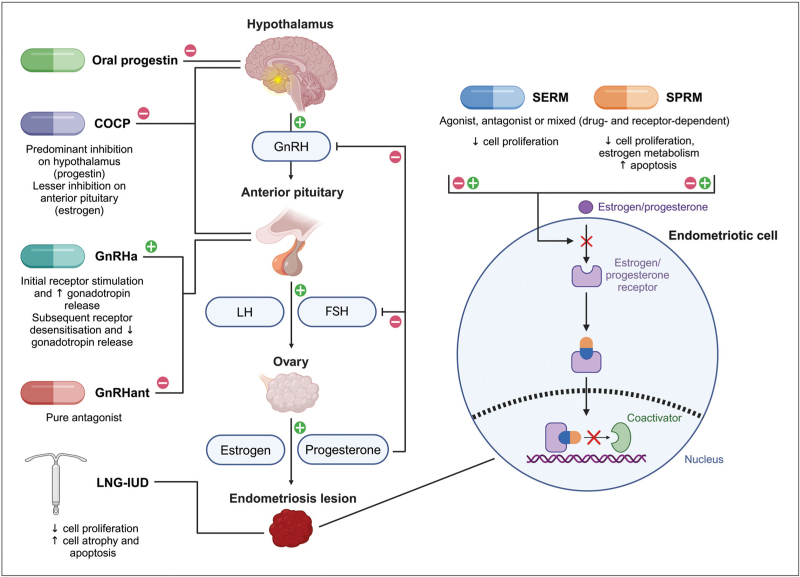
FIGURE 2
FIGURE 2
Mechanism of action of the suppressive medications discussed in this article. Gonadotropin-releasing hormone agonists and antagonists, the combined oral contraceptive pill and oral progestins act on the hypothalamic-pituitary-ovarian axis, while the levonorgestrel intrauterine device exerts local effects on endometriosis lesions. Selective estrogen and progesterone receptor modulators interact with their respective nuclear receptors within endometriotic cells. Adapted from “Hypothalamic-Pituitary-Ovarian Axis” and “Tamoxifen Signaling in Breast Cancer”, by BioRender.com (2024). Retrieved from: https://app.biorender.com/biorender-templates. COCP, combined oral contraceptive pill; FSH, follicle-stimulating hormone; GnRHa, gonadotropin-releasing hormone agonist; GnRHant, gonadotropin-releasing hormone antagonist; LH, luteinizing hormone; LNG-IUD, levonorgestrel intrauterine device; SERM, selective estrogen receptor modulator; SPRM, selective progesterone receptor modulator.
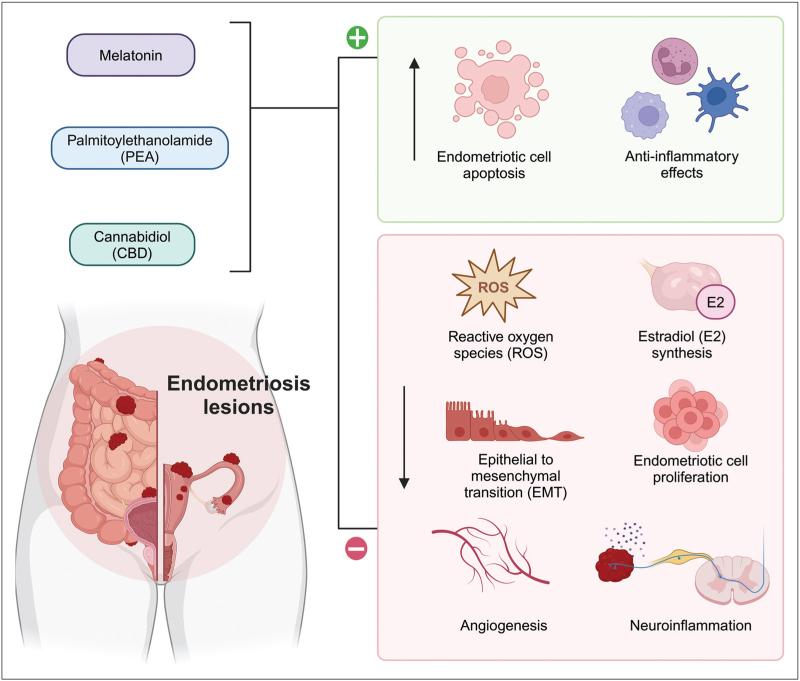
FIGURE 3
FIGURE 3
Mechanism of action of complementary and alternative medicines under investigation for endometriosis treatment. Cannabidiol (CBD), melatonin, and fatty acid amide palmitoylethanolamide (PEA) bind to membrane-bound receptors and act as agonists of peroxisome proliferator-activated receptor alpha (PPAR-α) in neurons and immune cells to exert systemic anti-inflammatory effects, reduce estradiol production and mediate afferent pain signals in the central nervous system. Within the endometriotic niche, these agents inhibit production of reactive oxygen species (ROS), reducing angiogenesis, cell proliferation, and epithelial to mesenchymal transition (EMT). Created with BioRender.com.

References

    1. Rowlands IJ, Abbott JA, Montgomery GW, et al. Prevalence and incidence of endometriosis in Australian women: a data linkage cohort study. BJOG 2021; 128:657–665. - PubMed
    1. Royal Australian and New Zealand College of Obstetricians and Gynaecologists. Australian clinical practice guideline for the diagnosis and management of endometriosis. Melbourne (AU); 2021.
    1. European Society of Human Reproduction and Embryology. Endometriosis. 2022.
    1. Abbott JA, Hawe J, Clayton RD, Garry R. The effects and effectiveness of laparoscopic excision of endometriosis: a prospective study with 2-5 year follow-up. Hum Reprod 2003; 18:1922–1927. - PubMed
    1. Armour M, Sinclair J, Ng CHM, et al. Endometriosis and chronic pelvic pain have similar impact on women, but time to diagnosis is decreasing: an Australian survey. Sci Rep 2020; 10:16253. - PMC - PubMed

MeSH terms