Review
. 2024 Oct;44(10):1189-1208.
doi: 10.1002/cac2.12602. Epub 2024 Aug 19.

FGFR3 alterations in bladder cancer: Sensitivity and resistance to targeted therapies

Affiliations
Review

FGFR3 alterations in bladder cancer: Sensitivity and resistance to targeted therapies

Maxim Noeraparast et al. Cancer Commun (Lond). 2024 Oct.

Abstract

In this review, we revisit the pivotal role of fibroblast growth factor receptor 3 (FGFR3) in bladder cancer (BLCA), underscoring its prevalence in both non-muscle-invasive and muscle-invasive forms of the disease. FGFR3 mutations in up to half of BLCAs play a well-established role in tumorigenesis, shaping distinct tumor initiation patterns and impacting the tumor microenvironment (TME). Emphasizing the importance of considering epithelial-mesenchymal transition profile and TME status, we revisit their relevance in predicting responses to immune checkpoint inhibitors in FGFR3-mutated BLCAs. This writing highlights the initially promising yet transient efficacy of the FGFR inhibitor Erdafitinib on FGFR3-mutated BLCA, stressing the pressing need to unravel resistance mechanisms and identify co-targets for future combinatorial studies. A thorough analysis of recent preclinical and clinical evidence reveals resistance mechanisms, including secondary mutations, epigenetic alterations in pathway effectors, phenotypic heterogeneity, and population-specific variations within FGFR3 mutational status. Lastly, we discuss the potential of combinatorial treatments and concepts like synthetic lethality for discovering more effective targeted therapies against FGFR3-mutated BLCA.

Keywords: Bladder Cancer; Erdafitinib; FGFR inhibition; FGFR3 mutations; Resistance to Erdafitinib; Tumor Microenvironment.


Conflict of interest statement

The authors declare no conflict of interest.

Figures
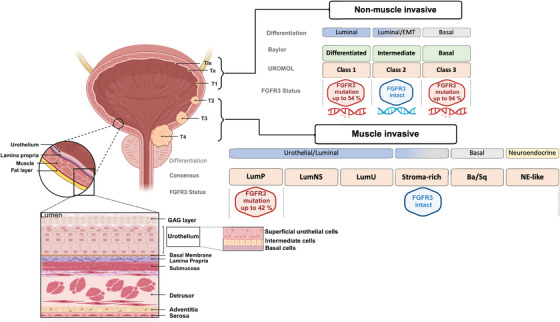
FIGURE 1
FIGURE 1
Two Categories of bladder cancer (BLCA) are attributed to Baylor, UROMOL, and Consensus subtyping systems, highlighting their correlation with different stages of local advancement and FGFR3 status. Differentiation‐based color scheme showing features associated with the respective classification. Baylor and UROMOL define NMIBC: Luminal (blue), Luminal‐to‐basal (blue‐grey), and Basal (grey). MIBC is defined by consensus class: Urothelial‐to‐Luminal (blue), Luminal‐to‐basal (blue‐grey), Basal (grey), and neuroendocrine (light yellow). FGFR3 status among subtypes is highlighted in blue (intact FGFR3) or red (mutated FGFR3), with the frequency of FGFR3 alterations in %. Abbreviations: Ba/Sq, basal/squamous; FGFR3, Fibroblast Growth Factor Receptor LumP , luminal papillary, LumNS ,  luminal nonspecified, LumU, luminal unstable, MIBC,  muscle‐invasive bladder cancer, NE,  neuroendocrine, NMIBC, non‐muscle‐invasive bladder cancer,. Figure generated in Biorender.
FIGURE 2
FIGURE 2
Schematic displays the FGFR3 amino acid residues subjected to mutational occurrence in BLCA. Querying 4732 BLCA samples in 19 studies. Based on the query, the figure was generated in cBioPortal and modified for clarity. Abbreviations: BLCA, Bladder Cancer; cBioPortal, cBioPortal for Cancer Genomics; FGFR3, Fibroblast Growth Factor Receptor 3.
FIGURE 3
FIGURE 3
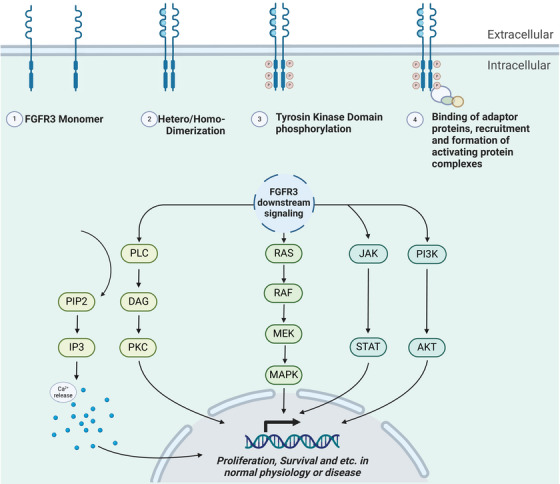
Oversimplified illustration of FGFR3 signaling. Upon Fibroblast Growth Factors (FGFs) binding to the extracellular domain of FGFRs, these receptors, such as FGFR3, go through conformational changes, which subsequently trigger their dimerization and transphosphorylation of the intracellular C‐terminal tyrosine kinase domains. Different tyrosine residues at the intracellular C‐terminal fragment of the FGFR can trigger distinctive downstream signaling pathways. When FGFRs become active, they may, via their essential adaptor, FRS2α, recruit complexes from the RAS or PI3K/AKT pathways, initiating signaling output through the ERK or AKT pathway. Active FGFRs may also play a role in activating the JAK/STAT pathway. Furthermore, FGFRs, by activating PLCγ, induce the hydrolysis conversion of phosphatidylinositol‐4,5‐biphosphate (PIP2) into inositol triphosphate (IP3), resulting in Calcium ion influx or via diacylglycerol (DAG), trigger the protein kinase C (PKC) signaling. Note that FGFR3 is also shown to be involved in nonliganded activation, which is not acknowledged in this schematic. The figure was generated in Biorender. Abbreviations: AKT, Protein Kinase B; DAG, Diacylglycerol; ERK: Extracellular Signal‐Regulated Kinase; FGFs, Fibroblast Growth Factors; FGFRs, Fibroblast Growth Factor Receptors; FGFR3, Fibroblast Growth Factor Receptor 3; FRS2α, Fibroblast Growth Factor Receptor Substrate 2α; IP3, Inositol Triphosphate; JAK/STAT, Janus Kinase/Signal Transducer and Activator of Transcription; PIP2, Phosphatidylinositol‐4,5‐bisphosphate; PI3K, Phosphoinositide 3‐ Kinase; PLCγ: Phospholipase C Gamma; PKC, Protein Kinase C; RAS, Rat Sarcoma.

References

    1. Tran L, Xiao J‐F, Agarwal N, Duex JE, Theodorescu D. Advances in bladder cancer biology and therapy. Nat Rev Cancer. 2021;21:104‐21. 10.1038/s41568-020-00313-1 - DOI - PMC - PubMed
    1. Dyrskjøt L, Hansel DE, Efstathiou JA, Knowles MA, Galsky MD, Teoh J, et al. Bladder cancer. Nat Rev Dis Prim. 2023;9:58. 10.1038/s41572-023-00468-9 - DOI - PMC - PubMed
    1. Ascione CM, Napolitano F, Esposito D, Servetto A, Belli S, Santaniello A, et al. Role of FGFR3 in bladder cancer: Treatment landscape and future challenges. Cancer Treat Rev. 2023;115:102530. 10.1016/j.ctrv.2023.102530 - DOI - PubMed
    1. The American Cancer Society medical and editorial content team . Can bladder cancer be found early? Am Cancer Soc. 2016:1‐25.
    1. Siegel RL, Miller KD, Jemal A. Cancer statistics, 2019. CA Cancer J Clin. 2019;69:7‐34. 10.3322/caac.21551 - DOI - PubMed

MeSH terms