Individual and contextual factors associated with measles infection in Malaysia: a multilevel analysis
- PMID: 39164020
- PMCID: PMC11563724
- DOI: 10.24171/j.phrp.2024.0156
Individual and contextual factors associated with measles infection in Malaysia: a multilevel analysis
Abstract
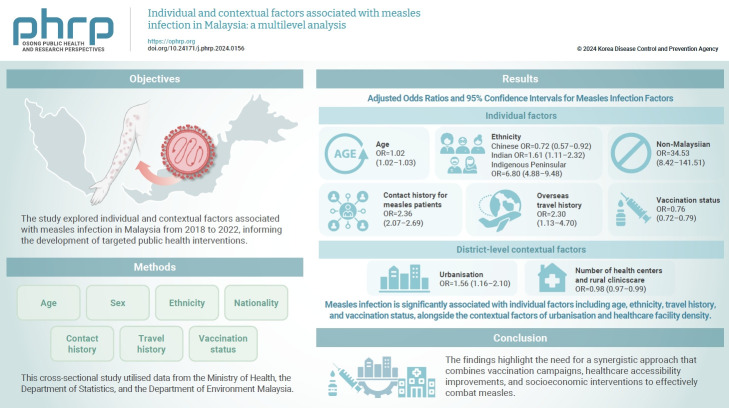
Background: Despite effective vaccination strategies, measles remains a global public health challenge. The study explored individual and contextual factors associated with measles infection in Malaysia from 2018 to 2022, informing the development of targeted public health interventions.
Methods: This cross-sectional study utilised data from the Ministry of Health, the Department of Statistics, and the Department of Environment Malaysia. Multilevel logistic regression analysis was employed to examine individual-level factors, including age, sex, ethnicity, nationality, contact history, travel history, and vaccination status. Concurrently, contextual factors were assessed, encompassing district-level determinants such as population density, median household income, urbanisation, the number of health and rural clinics, vaccination rates, fine particulate matter less than 2.5 μm (PM2.5) levels, relative humidity, and temperature, to determine their impact on measles infection risk.
Results: Measles infection was significantly associated with various individual factors. These included age (adjusted odds ratio [aOR], 1.02; 95% confidence interval [CI], 1.02-1.03), ethnicity, non-Malaysian nationality (aOR, 34.53; 95% CI, 8.42- 141.51), prior contact with a measles case (aOR, 2.36; 95% CI, 2.07-2.69), travel history (aOR, 2.30; 95% CI, 1.13-4.70), and vaccination status (aOR, 0.76; 95% CI, 0.72-0.79). Among contextual factors, urbanisation (aOR, 1.56; 95% CI, 1.16- 2.10) and the number of clinics (aOR, 0.98; 95% CI, 0.97-0.99) were significant determinants.
Conclusion: This multilevel logistic regression analysis illuminates the complexities of measles transmission, advocating public health interventions tailored to individual and contextual vulnerabilities. The findings highlight the need for a synergistic approach that combines vaccination campaigns, healthcare accessibility improvements, and socioeconomic interventions to effectively combat measles.
Keywords: Measles; Multilevel analysis; Risk factor.
Conflict of interest statement
The authors have no conflicts of interest to declare.
References
-
- World Health Organization (WHO) (CH) WHO; 2023. Global measles threat continues to grow as another year passes with millions of children unvaccinated [Internet] [cited 2024 May 3]. Available from: https://www.who.int/news/item/16-11-2023-global-measles-threat-continues....
-
- World Health Organization (WHO) (CH) . Global Routine Immunization Strategies and Practices (GRISP): a companion document to the Global Vaccine Action Plan (GVAP) WHO; 2016.
-
- Sitepu FY, Depari E, Mudatsir M, et al. Being unvaccinated and contact with measles cases as the risk factors of measles outbreak, North Sumatera, Indonesia. Clin Epidemiol Glob Health. 2020;8:239–43.
-
- Watanabe A, Shimada T, Takahashi T, et al. Correlates of laboratory-confirmed measles in Japan, 2011-2015. Vaccine. 2019;37:1756–62. - PubMed
LinkOut - more resources
Full Text Sources