


Crisis of objectivity: using a personalized network model to understand maladaptive sensemaking in a patient with psychotic, affective, and obsessive-compulsive symptoms
- PMID: 39165762
- PMCID: PMC11334081
- DOI: 10.3389/fpsyg.2024.1383717
Crisis of objectivity: using a personalized network model to understand maladaptive sensemaking in a patient with psychotic, affective, and obsessive-compulsive symptoms
Abstract
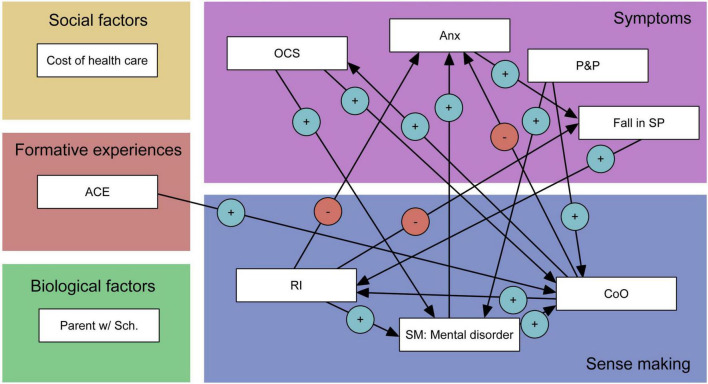
Introduction: Psychiatric comorbidities have proven a consistent challenge. Recent approaches emphasize the need to move away from categorical descriptions of symptom clusters towards a dimensional view of mental disorders. From the perspective of phenomenological psychopathology, this shift is not enough, as a more detailed understanding of patients' lived experience is necessary as well. One phenomenology-informed approach suggests that we can better understand the nature of psychiatric disorders through personalized network models, a comprehensive description of a person's lifeworld in the form of salient nodes and the relationships between them. We present a detailed case study of a patient with multiple comorbidities, maladaptive coping mechanisms, and adverse childhood experiences.
Methods: The case was followed for a period of two years, during which we collected multiple streams of data, ranging from phenomenological interviews, neuropsychological assessments, language analysis, and semi-structured interviews (Examination of Anomalous Self Experience and Examination of Anomalous World Experience). We analytically constructed a personalized network model of his lifeworld.
Results: We identified an experiential category "the crisis of objectivity" as the core psychopathological theme of his lifeworld. It refers to his persistent mistrust towards any information that he obtains that he appraises as originating in his subjectivity. We can developmentally trace the crisis of objectivity to his adverse childhood experience, as well as him experiencing a psychotic episode in earnest. He developed various maladaptive coping mechanisms in order to compensate for his psychotic symptoms. Interestingly, we found correspondence between his subjective reports and other sources of data.
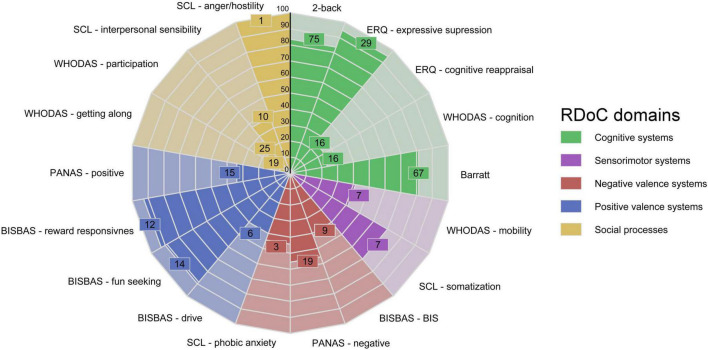
Discussion: Hernan exhibits difficulties in multiple Research Domain Criteria constructs. While we can say that social sensorimotor, positive valence, and negative valence systems dysfunctions are likely associated with primary deficit (originating in his adverse childhood experience), his cognitive symptoms may be tied to his maladaptive coping mechanisms (although, they might be related to his primary disorder as well).
Keywords: RDoC; enactive psychiatry; obsessive compulsive disorder; personalized network model; psychiatric comorbidity; qualitative phenomenology; schizoaffective disorder.
Copyright © 2024 Oblak, Kuclar, Horvat Golob, Holnthaner, Battelino, Skodlar and Bon.
Conflict of interest statement
The authors declare that the research was conducted in the absence of any commercial or financial relationships that could be construed as a potential conflict of interest.
Figures
References
-
- Aardema F., Emmelkamp P. M. G., O’Connor K. P. (2005). Inferential confusion, cognitive change and treatment outcome in obsessive-compulsive disorder. Clin. Psychol. Psychother. 12 337–345. 10.1002/cpp.464 - DOI
-
- Ahern C., Fassnacht D. B., Kyrios M. (2019). “Obsessions and phobias,” in The Oxford handbook of phenomenological psychopathology, eds Stanghellini G., Broome M., Raballo A., Fernandez A. V., Fusar-Poli P., Rosfort R. (Oxford: Oxford University Press; ), 576–583. 10.1093/oxfordhb/9780198803157.013.61 - DOI
-
- Barrios F. A., Olalde-Mathieu V. E. (2021). Replication data for: Psychometric properties of the emotion regulation questionnaire [dataset]. Harvard Dataverse 10.7910/DVN/7S6FWB - DOI
LinkOut - more resources
Full Text Sources
