


Ecological consequences of body size reduction under warming
- PMID: 39166384
- PMCID: PMC11337126
- DOI: 10.1098/rspb.2024.1250
Ecological consequences of body size reduction under warming
Abstract
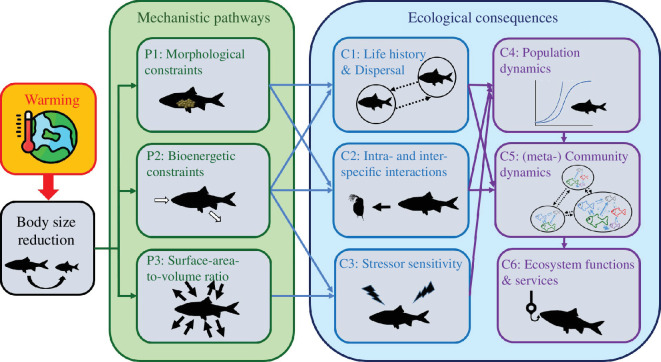
Body size reduction is a universal response to warming, but its ecological consequences across biological levels, from individuals to ecosystems, remain poorly understood. Most biological processes scale with body size, and warming-induced changes in body size can therefore have important ecological consequences. To understand these consequences, we propose a unifying, hierarchical framework for the ecological impacts of intraspecific body size reductions due to thermal plasticity that explicitly builds on three key pathways: morphological constraints, bioenergetic constraints and surface-to-volume ratio. Using this framework, we synthesize key consequences of warming-induced body size reductions at multiple levels of biological organization. We outline how this trait-based framework can improve our understanding, detection and generalization of the ecological impacts of warming.
Keywords: bioenergetics; body size shift; ectotherms; predictive ecology; surface-to-volume ratio; temperature-size rule.
Conflict of interest statement
We declare we have no competing interests.
Figures
References
-
- Ohlberger J. 2013. Climate warming and ectotherm body size: from individual physiology to community ecology. Funct. Ecol. 27 , 991–1001. ( 10.1111/1365-2435.12098) - DOI
Publication types
MeSH terms
Grants and funding
LinkOut - more resources
Full Text Sources
