


The correlation of CT-derived muscle density, skeletal muscle index, and visceral adipose tissue with nutritional status in severely injured patients
- PMID: 39167212
- PMCID: PMC11666640
- DOI: 10.1007/s00068-024-02624-6
The correlation of CT-derived muscle density, skeletal muscle index, and visceral adipose tissue with nutritional status in severely injured patients
Abstract
Background: This study explored if computerized tomography-derived body composition parameters (CT-BCPs) are related to malnutrition in severely injured patients admitted to the Intensive Care Unit (ICU).
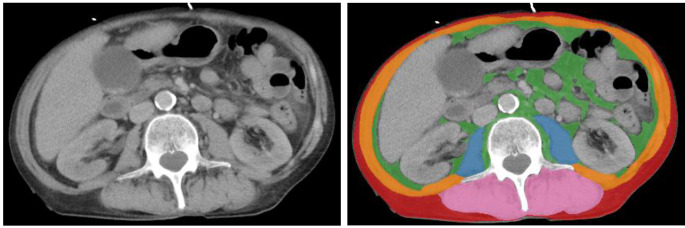
Methods: This prospective cohort study included severely injured (Injury Severity Score ≥ 16) patients, admitted to the ICU of three level-1 trauma centers between 2018 and 2022. Abdominal CT scans were retrospectively analyzed to assess the CT-BCPs: muscle density (MD), skeletal muscle index (SMI), and visceral adipose tissue (VAT). The Subjective Global Assessment was used to diagnose malnutrition at ICU admission and on day 5 of admission, and the modified Nutrition Risk in Critically ill at admission was used to assess the nutritional risk.
Results: Seven (11%) of the 65 analyzed patients had malnutrition at ICU admission, increasing to 23 patients (35%) on day 5. Thirteen (20%) patients had high nutritional risk. CT-BCPs were not related to malnutrition at ICU admission and on day 5. Patients with high nutritional risk at admission had lower MD (median (IQR) 32.1 HU (25.8-43.3) vs. 46.9 HU (37.7-53.3); p < 0.01) and higher VAT (median 166.5 cm2 (80.6-342.6) vs. 92.0 cm2 (40.6-148.2); p = 0.01) than patients with low nutritional risk.
Conclusion: CT-BCPs do not seem related to malnutrition, but low MD and high VAT may be associated with high nutritional risk. These findings may prove beneficial for clinical practice, as they suggest that CT-derived parameters may provide valuable information on nutritional risk in severely injured patients, in addition to conventional nutritional assessment and screening tools.
Level of evidence: Level III, Prognostic/Epidemiological.
Keywords: Critical care; Multicenter; Nutrition; Nutritional status; Trauma.
© 2024. The Author(s).
Conflict of interest statement
Declarations. Ethical approval: The study was conducted according to the guidelines of the Declaration of Helsinki and approved by the local Institutional Review Boards. Informed consent was obtained from the patients or their legal representative at the day of ICU admission or as soon as possible after that day. Competing interests: WV is a co-founder of Quantib-U.
Figures
References
Publication types
MeSH terms
LinkOut - more resources
Full Text Sources
Medical
Research Materials
