


Case Reports
doi: 10.1007/s12105-024-01671-0.
Palisading Adenocarcinoma
Affiliations
- PMID: 39167327
- PMCID: PMC11339196
- DOI: 10.1007/s12105-024-01671-0
Item in Clipboard
Case Reports
Palisading Adenocarcinoma
Head Neck Pathol.
.
Abstract
Palisading adenocarcinoma is a morphologically distinct salivary gland neoplasm that has been recently described with predilection to the sublingual gland. We report our experience with this neoplasm to corroborate and enrich the literature and further clarify its phenotype.
Keywords: Palisading adenocarcinoma; Sublingual gland.
© 2024. The Author(s).
Conflict of interest statement
The authors declare no competing interests.
Figures

At low power, the tumor is hypercellular, well-circumscribed and encapsulated

The tumor shows no evidence of invasion into surrounding parenchyma (a), and is comprised of two cell components, a predominant palisading component arranged frequently in pseudo-rosettes, and scattered ductal component with eosinophilic cytoplasm and lumens (arrows) (b). The predominant cells are polygonal, arranged in trabeculae and pseudo-rosette around hyalinized centers (c), while the ductal component is seen frequently in clusters with occasional mucous cells (inset) (d)
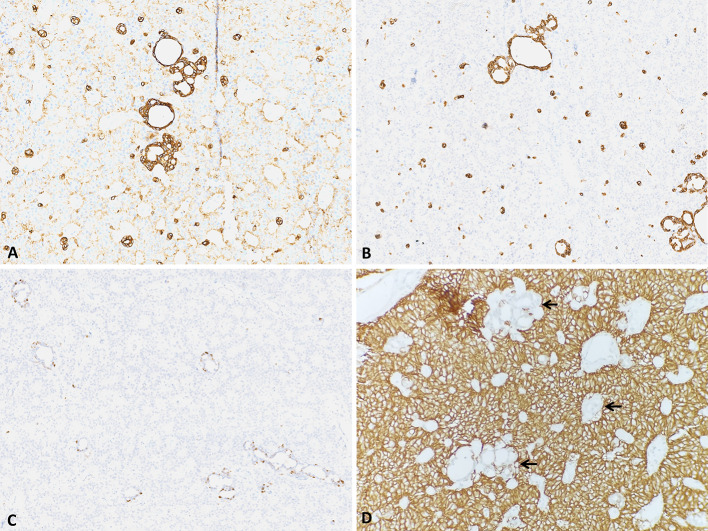
Cam5.2 is strong in ducts and variably positive in the predominant cells (a), CK5/6 is strongly positive only in ducts (b), P63 is positive in a periductal pattern (c), and CD56 is diffusely and strongly positive only in the polygonal cells, while negative-to-equivocal in the ducts (arrow) (d)
References
Publication types
MeSH terms
Substances
LinkOut - more resources
Full Text Sources
