Clinical Trial
. 2024 Oct 1;160(10):1066-1074.
doi: 10.1001/jamadermatol.2024.2701.

Tyrosine Kinase 2 Inhibition With Zasocitinib (TAK-279) in Psoriasis: A Randomized Clinical Trial

Affiliations
Clinical Trial

Tyrosine Kinase 2 Inhibition With Zasocitinib (TAK-279) in Psoriasis: A Randomized Clinical Trial

April W Armstrong et al. JAMA Dermatol. .

Abstract

Importance: New, effective, and well-tolerated oral therapies are needed for treating psoriasis. Zasocitinib, a highly selective allosteric tyrosine kinase 2 (TYK2) inhibitor, is a potential new oral treatment for this disease.

Objective: To assess the efficacy, safety, and tolerability of zasocitinib in patients with moderate to severe plaque psoriasis.

Design, setting, and participants: This phase 2b, randomized, double-blind, placebo-controlled, multiple-dose randomized clinical trial was conducted from August 11, 2021, to September 12, 2022, at 47 centers in the US and 8 in Canada. The study included a 12-week treatment period and a 4-week follow-up period. Key eligibility criteria for participants included age 18 to 70 years; a Psoriasis Area and Severity Index (PASI) score of 12 or greater; a Physician's Global Assessment score of 3 or greater; and a body surface area covered by plaque psoriasis of 10% or greater. Of 287 patients randomized, 259 (90.2%) received at least 1 dose of study treatment.

Intervention: Patients were randomly assigned (1:1:1:1:1) to receive zasocitinib at 2, 5, 15, or 30 mg or placebo orally, once daily, for 12 weeks.

Main outcomes and measures: The primary efficacy end point was the proportion of patients achieving 75% or greater improvement in PASI score (PASI 75) at week 12. Secondary efficacy end points included PASI 90 and 100 responses. Safety was also assessed.

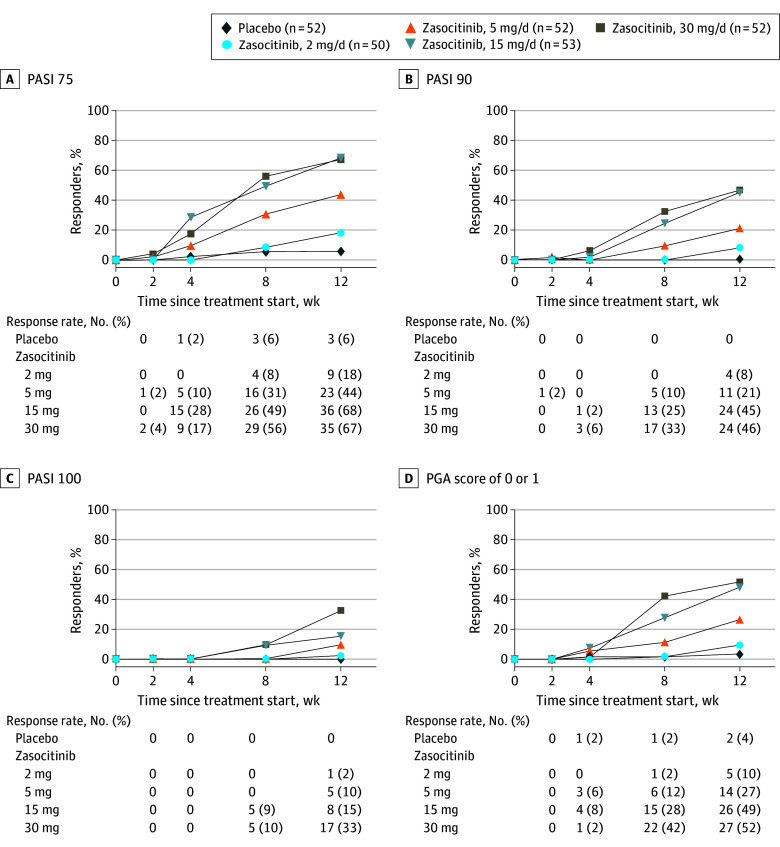
Results: In total, 259 patients were randomized and received treatment (mean [SD] age, 47 [13] years; 82 women [32%]). At week 12, PASI 75 was achieved for 9 (18%), 23 (44%), 36 (68%), and 35 (67%) patients receiving zasocitinib at 2, 5, 15, and 30 mg, respectively, and 3 patients (6%) receiving placebo. PASI 90 responses were consistent with PASI 75. PASI 100 demonstrated a dose response at all doses, with 17 patients (33%) achieving PASI 100 with zasocitinib, 30 mg. Treatment-emergent adverse events occurred for 23 patients (44%) receiving placebo and 28 (53%) to 31 (62%) patients receiving the 4 different doses of zasocitinib, with no dose dependency and no clinically meaningful longitudinal differences in laboratory parameters.

Conclusions and relevance: This randomized clinical trial found that potent and selective inhibition of TYK2 with zasocitinib at oral doses of 5 mg or more once daily resulted in greater skin clearance than placebo over 12 weeks.

Trial registration: ClinicalTrials.gov Identifier: NCT04999839.


Conflict of interest statement

Conflict of Interest Disclosures: Dr Armstrong reported grants from AbbVie, ASLAN, BMS, Dermavant Sciences, Dermira, Eli Lilly, Galderma, Incyte, Janssen, Leo Pharma, Meiji Seika Pharma Co, Modernizing Medicine, Nimbus Therapeautics, Novartis, Ortho Dermatologics, Pfizer, Sanofi Genzyme, UCB, and Ventyx Biosciences; personal fees from AbbVie, ASLAN, Almirall, Amgen, Arcutis, Beiersdorf, BMS, Dermavant, EPI Health, Janssen, LEO Pharma, Mindera, Nimbus, Organon & Co, Sanofi, Sun Pharma, Takeda, Ventyx Biosciences, Incyte, Regeneron, and UCB; and data safety monitoring board service for Boehringer Ingelheim and Parexel during the conduct of the study. Dr Gooderham reported nonfinancial support from Takeda during the conduct of the study as well as personal fees from AbbVie, Amgen, Arcutis, Bristol Myers Squibb, Boehringer Ingelheim, Eli Lilly, Galderma, Incyte, Janssen, Leo Pharma, Meiji, Dermavant, Moonlake, Nektar, Nimbus, Novartis, Pfizer, Regeneron, Sanofi, Sun Pharma, Tarsus, Takeda, UCB, Union, Ventyx, and Apogee outside the submitted work. Dr Lynde reported being a principal investigator for AbbVie, Amgen, Akros, Arcutis, Bausch Health, Bayer, BioJAMP, Boehringer Ingelheim, Bristol Myers Squibb, Celgene, Celltrion, CeraVe, Bioderma, Cipher, Concert, Dermavant, Eli Lilly, Devonian, Evelo, Galderma, GSK, InCyte, Intega Skin, Janssen, Kyowa Kirin, La Roche Posay, Leo Pharma, L’Oreal, Medexus, Merck, MoonLake, Nao, Nimbus, Novartis, P&G, PediaPharm, Pfizer, Regeneron, Roche, Sanofi Genzyme, Sandoz, Sentrex, SunPharma, Takeda, TEVA, Tribute, UCB, Valeant, Viatris, and Volo Health during the conduct of the study as well as personal fees from AbbVie, Amgen, Aralez, Bausch Health, Bayer, Bioderma , BioJAMP, Boehringer Ingelheim, Bristol Myers Squibb, Celgene, Celltrion, CeraVe, Cipher, Dermavant, Eli Lilly, Fresnius Kabi, Gakderna, GSK, InCyte, Innovaderm, Intega Skin, Janssen, Kyowa Kirin, La Roche Posay, Leo Pharma, L’Oreal, Medexus, MedX, Merck, Naos, Novartis, P&G, PediaPharm, Pfizer, Regeneron, Roche, Sanofi Genzyme, Sandoz, Sentrex, Skinceuticals, SunPharma, Takeda, TEVA, Tribute, UCB, Valeant, Viatris, and VOLO Health outside the submitted work. Dr Maari reported a research grant from Nimbus Pharmaceutical. Dr Green reported grants from Takeda during the conduct of the study as well as grants from Amgen, Arcutis, Dermavant, BMS, Alumis, HIghlittl, Takeda, Galderma, OrthoDerm, UCB, and Janssen outside the submitted work. Dr Franchimont reported being employed by and holding equity in Nimbus during the conduct of the study as well as being a former employee of and shareholder in Biogen, holding stock and shares in and board service for OMass Therapeutics, personal fees from Bain Capital and Atara Biotherapeutics, and board service for Rome Therapeutics outside the submitted work; additionally, their spouse is an employee and shareholder of Alexion. Dr Gangolli reported employment for and stock ownership in Nimbus during the conduct of the study as well as stock ownership in Bristol Myers Squibb and AstraZeneca outside the submitted work. Dr Blau reported personal fees from Takeda Pharmaceuticals outside the submitted work. Dr Zhao reported being an employee of Takeda outside the submitted work. Dr W. Zhang reported personal fees from Takeda during the conduct of the study and outside the submitted work. Dr Srivastava reported being an employee of and shareholder in Nimbus Therapeutics during the conduct of the study and outside the submitted work. Dr Heap reported stock holdings and employment with Takeda Pharmaceuticals. Dr Papp reported committee/board service for AbbVie, Acelyrin, Akros, Alumis, Amgen, Arcutis, Bausch Health, Boehringer Ingelheim, BMS, Can-Fite Biopharma, Celltrion, Concert, Dermavant, Dermira, Dice Pharmaceuticals, Eli Lilly, Evelo Biosciences, Forbion, Galderma, Horizon Therapeutics, Incyte, Janssen, Kymab, Kyowa Hakko Kirin , Leo, Meiji Seika Pharma, Mitsubishi Pharma, Nimbus, Novartis, Pfizer, Reistone, Sanofi-Aventis, Sandoz, Sun Pharma, Takeda, Tarsus Pharmaceuticals, UCB, and Zai Lab Co during the conduct of the study. No other disclosures were reported.

Figures

Figure 1.
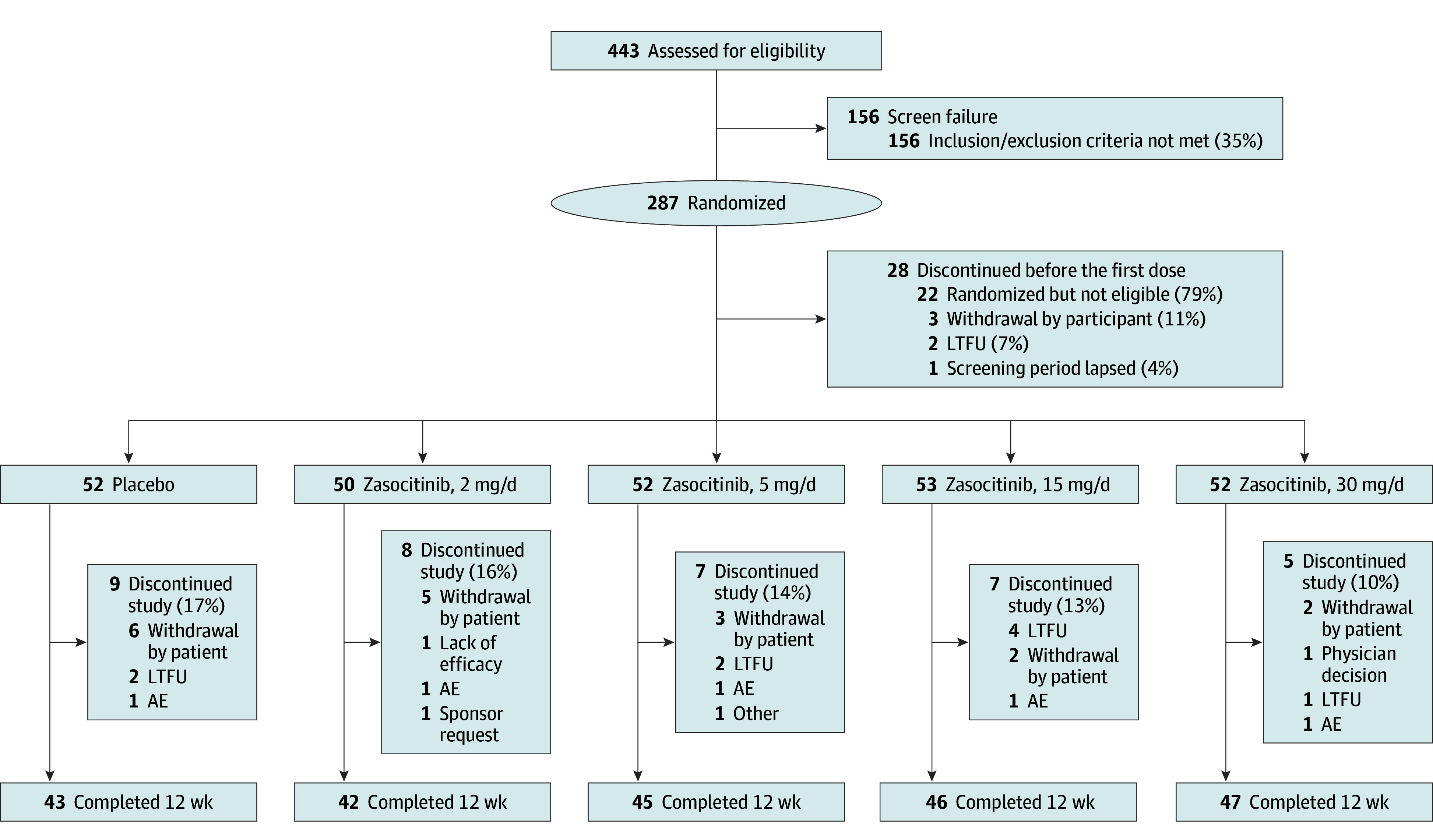
Figure 1.. Patient Disposition
AE, adverse event; LTFU, lost to follow-up.
Figure 2.
Figure 2.. Time Course of Efficacy Responses
A, Proportion of patients with at least a 75% improvement from baseline in the Psoriasis Area and Severity Index (PASI) score (PASI 75; primary end point). B, Proportion of patients with at least a 90% improvement in the PASI score (PASI 90). C, Proportion of patients with a 100% improvement in the PASI score (PASI 100). D, Percentages of patients with a Physician’s Global Assessment (PGA) score of 0 or 1 (on a scale from 0 to 4, with higher scores indicating greater disease severity). Patients with missing values at each point and patients with assessments collected on the day of, or after the start of, a prohibited medication that was considered a major protocol deviation were imputed as nonresponders.

References

    1. Armstrong A, Bohannan B, Mburu S, et al. . Impact of psoriatic disease on quality of life: interim results of a global survey. Dermatol Ther (Heidelb). 2022;12(4):1055-1064. doi:10.1007/s13555-022-00695-0 - DOI - PMC - PubMed
    1. Armstrong AW, Schupp C, Wu J, Bebo B. Quality of life and work productivity impairment among psoriasis patients: findings from the National Psoriasis Foundation survey data 2003-2011. PLoS One. 2012;7(12):e52935. doi:10.1371/journal.pone.0052935 - DOI - PMC - PubMed
    1. Papp KA, Gniadecki R, Beecker J, et al. . Psoriasis prevalence and severity by expert elicitation. Dermatol Ther (Heidelb). 2021;11(3):1053-1064. doi:10.1007/s13555-021-00518-8 - DOI - PMC - PubMed
    1. Hawkes JE, Chan TC, Krueger JG. Psoriasis pathogenesis and the development of novel targeted immune therapies. J Allergy Clin Immunol. 2017;140(3):645-653. doi:10.1016/j.jaci.2017.07.004 - DOI - PMC - PubMed
    1. Sbidian E, Chaimani A, Garcia-Doval I, et al. . Systemic pharmacological treatments for chronic plaque psoriasis: a network meta-analysis. Cochrane Database Syst Rev. 2017;12(12):CD011535. doi:10.1002/14651858.CD011535.pub2 - DOI - PMC - PubMed

Publication types

Substances

Associated data