


Clinical and Imaging Features Associated With Fast Infarct Growth During Interhospital Transfers of Patients With Large Vessel Occlusions
- PMID: 39173104
- PMCID: PMC11343586
- DOI: 10.1212/WNL.0000000000209814
Clinical and Imaging Features Associated With Fast Infarct Growth During Interhospital Transfers of Patients With Large Vessel Occlusions
Abstract
Background and objectives: Acute ischemic stroke patients with a large vessel occlusion (LVO) who present to a primary stroke center (PSC) often require transfer to a comprehensive stroke center (CSC) for thrombectomy. Not much is known about specific characteristics at the PSC that are associated with infarct growth during transfer. Gaining more insight into these features could aid future trials with cytoprotective agents targeted at slowing infarct growth. We aimed to identify baseline clinical and imaging characteristics that are associated with fast infarct growth rate (IGR) during interhospital transfer.
Methods: We included patients from the CT Perfusion to Predict Response to Recanalization in Ischemic Stroke Project, a prospective multicenter study. Patients with an anterior circulation LVO who were transferred from a PSC to a CSC for consideration of thrombectomy were eligible if imaging criteria were fulfilled. A CT perfusion (CTP) needed to be obtained at the PSC followed by an MRI at the CSC, before consideration of thrombectomy. The interhospital IGR was defined as the difference between the infarct volumes on MRI and CTP, divided by the time between the scans. Multivariable logistic regression was used to determine characteristics associated with fast IGR (≥5 mL/h).
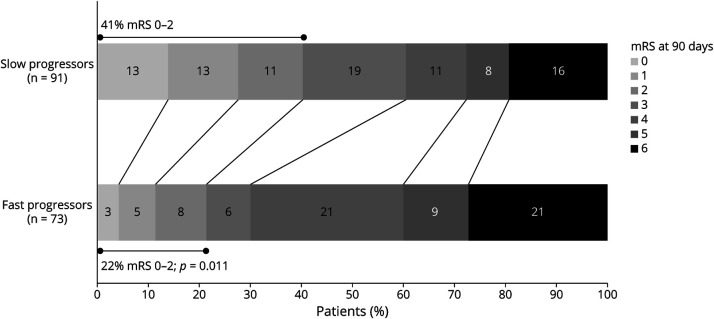
Results: A total of 183 patients with a median age of 74 years (interquartile range 61-82), of whom 99 (54%) were male and 82 (45%) were fast progressors, were included. At baseline, fast progressors had a higher NIH Stroke Scale score (median 16 vs 13), lower cerebral blood volume index (median 0.80 vs 0.89), more commonly poor collaterals on CT angiography (35% vs 13%), higher hypoperfusion intensity ratios (HIRs) (median 0.51 vs 0.34), and larger core volumes (median 11.80 mL vs 0.00 mL). In multivariable analysis, higher HIR (adjusted odds ratio [aOR] for every 0.10 increase 1.32 [95% CI 1.10-1.59]) and larger core volume (aOR for every 10 mL increase 1.54 [95% CI 1.20-2.11]) remained independently associated with fast IGR.
Discussion: Fast infarct growth during interhospital transfer of acute stroke patients is associated with imaging markers of poor collaterals on baseline imaging. These markers are promising targets for patient selection in cytoprotective trials aimed at reducing interhospital infarct growth.
Conflict of interest statement
A. Wouters, P. Seners, N. Yuen, and M. Mlynash report no disclosures relevant to the manuscript. J.J. Heit reports consulting fees from Medtronic and MicroVention, and is a member of the medical and scientific advisory board for iSchemaView. S. Kemp, J. Demeestere, and S. Christensen report no disclosures relevant to the manuscript. G.W. Albers reports stock holdings in iSchemaView; and compensation from Biogen, iSchemaView and Genentech for consultant services. R. Lemmens reports compensation from iSchemaView for other services. M.G. Lansberg reports no disclosures relevant to the manuscript. Go to
Figures


References
-
- Khazen O, Bao J, Gajjar AA, et al. Incidence of mechanical thrombectomy among stroke patients brought directly to a comprehensive stroke center versus transfer from a primary stroke center in upstate New York. Interv Neuroradiol. 2023;2023:159101992311777. doi: 10.1177/15910199231177763 - DOI - PMC - PubMed
-
- Weisenburger-Lile D, Blanc R, Kyheng M, et al. Direct admission versus secondary transfer for acute stroke patients treated with intravenous thrombolysis and thrombectomy: insights from the endovascular treatment in ischemic stroke registry. Cerebrovasc Dis. 2019;47(3-4):112-120. doi: 10.1159/000499112 - DOI - PubMed
-
- Sun CHJ, Connelly K, Nogueira RG, et al. ASPECTS decay during inter-facility transfer predicts patient outcomes in endovascular reperfusion for ischemic stroke: a unique assessment of dynamic physiologic change over time. J Neurointerv Surg. 2015;7(1):22-26. doi: 10.1136/neurintsurg-2013-011048 - DOI - PubMed
Publication types
MeSH terms
LinkOut - more resources
Full Text Sources
Medical
