Perinatal Outcomes of Pregnancies with Borderline Oligohydramnios at Term
- PMID: 39173605
- PMCID: PMC11793092
- DOI: 10.1159/000541008
Perinatal Outcomes of Pregnancies with Borderline Oligohydramnios at Term
Abstract
Introduction: Limited evidence exists on borderline oligohydramnios. Our objective was to determine perinatal outcomes in uncomplicated term pregnancies with borderline oligohydramnios.
Methods: This retrospective analysis compared adverse perinatal outcomes among pregnancies during 2018-2022, between those with borderline oligohydramnios defined as amniotic fluid index (AFI) of 5.1-8.0 cm, those with oligohydramnios (AFI ≤5 cm), and those with normal AFI (8.1-25 cm). The latter matched one-to-one to the borderline oligohydramnios group and served as the control group. The outcomes compared included birthweight, cesarean delivery due to fetal distress, the presence of meconium-stained amniotic fluid, Apgar scores, neonatal intensive care unit admission, and the occurrence of small-for-gestational-age (SGA) neonates.
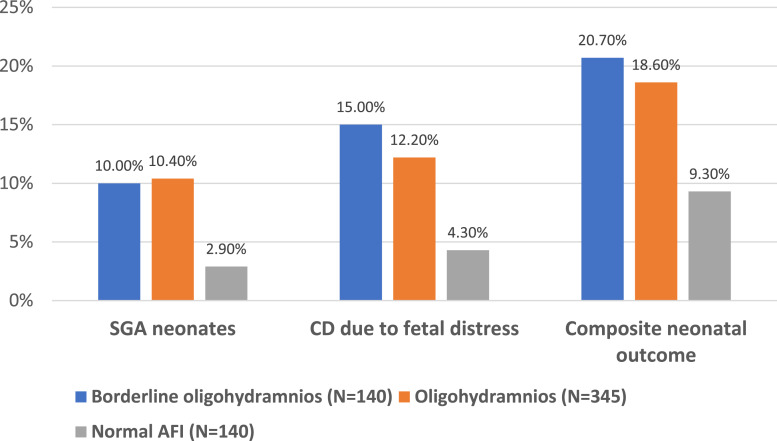
Results: During the study period, 140 women had borderline oligohydramnios and 345 had oligohydramnios; the control group included 140 women. Borderline oligohydramnios was associated with increased rates of delivering SGA neonates (adjusted odds ratio [aOR] = 3.6, 95% confidence interval [CI] 1.1-11.6, p = 0.034) and cesarean delivery due to fetal distress (aOR = 3.0, 95% CI 1.1-8.3, p = 0.032). Rates of composite neonatal outcome (including at least one of the following: cesarean delivery due to fetal distress, meconium-stained amniotic fluid, 5-min Apgar score <7, umbilical artery pH <7.15, or neonatal intensive care unit admission) were higher in both the borderline oligohydramnios (20.7%) and oligohydramnios (18.6%) groups compared to the control group (9.3%) (p = 0.019).
Conclusions: Pregnancies with borderline oligohydramnios were associated with increased risks of delivering SGA neonates and requiring cesarean delivery due to fetal distress. These findings support considering closer antepartum surveillance for these pregnancies, especially for identifying abnormal fetal growth.
Introduction: Limited evidence exists on borderline oligohydramnios. Our objective was to determine perinatal outcomes in uncomplicated term pregnancies with borderline oligohydramnios.
Methods: This retrospective analysis compared adverse perinatal outcomes among pregnancies during 2018-2022, between those with borderline oligohydramnios defined as amniotic fluid index (AFI) of 5.1-8.0 cm, those with oligohydramnios (AFI ≤5 cm), and those with normal AFI (8.1-25 cm). The latter matched one-to-one to the borderline oligohydramnios group and served as the control group. The outcomes compared included birthweight, cesarean delivery due to fetal distress, the presence of meconium-stained amniotic fluid, Apgar scores, neonatal intensive care unit admission, and the occurrence of small-for-gestational-age (SGA) neonates.
Results: During the study period, 140 women had borderline oligohydramnios and 345 had oligohydramnios; the control group included 140 women. Borderline oligohydramnios was associated with increased rates of delivering SGA neonates (adjusted odds ratio [aOR] = 3.6, 95% confidence interval [CI] 1.1-11.6, p = 0.034) and cesarean delivery due to fetal distress (aOR = 3.0, 95% CI 1.1-8.3, p = 0.032). Rates of composite neonatal outcome (including at least one of the following: cesarean delivery due to fetal distress, meconium-stained amniotic fluid, 5-min Apgar score <7, umbilical artery pH <7.15, or neonatal intensive care unit admission) were higher in both the borderline oligohydramnios (20.7%) and oligohydramnios (18.6%) groups compared to the control group (9.3%) (p = 0.019).
Conclusions: Pregnancies with borderline oligohydramnios were associated with increased risks of delivering SGA neonates and requiring cesarean delivery due to fetal distress. These findings support considering closer antepartum surveillance for these pregnancies, especially for identifying abnormal fetal growth.
Keywords: Amniotic fluid index; Borderline oligohydramnios; Perinatal outcome; Small for gestational age; Term pregnancy.
© 2024 The Author(s). Published by S. Karger AG, Basel.
Conflict of interest statement
The authors have no relevant financial or non-financial interests.
Figures
References
-
- Brace RA. Physiology of amniotic fluid volume regulation. Clin Obstet Gynecol. 1997;40(2):280–9. - PubMed
-
- Locatelli A, Zagarella A, Toso L, Assi F, Ghidini A, Biffi A. Serial assessment of amniotic fluid index in uncomplicated term pregnancies: prognostic value of amniotic fluid reduction. J Matern Fetal Neonatal Med. 2004;15(4):233–6. - PubMed
-
- American College of Obstetricians and Gynecologists’ Committee on Obstetric Practice Society for Maternal-Fetal Medicine . Medically indicated late-preterm and early-term deliveries; ACOG committee opinion, number 831. Obst Gynecol. 2021;138(1):e35–9. - PubMed
-
- Shaw LE. Management of oligohydramnios. Publishing NHS Wales; 2022. https://wisdom.nhs.wales/health-board-guidelines/swansea-bay-maternity-f... (accessed March 1, 2024).
-
- Magann EF, Chauhan SP, Hitt WC, Dubil EA, Morrison JC. Borderline or marginal amniotic fluid index and peripartum outcomes: a review of the literature. J Ultrasound Med. 2011;30(4):523–8. - PubMed
MeSH terms
LinkOut - more resources
Full Text Sources