


Comparing temporal changes and predictors of different types of mental health and socio-emotional wellbeing outcomes during COVID-19: an overlapping panel study of Spanish residents
- PMID: 39174930
- PMCID: PMC11342473
- DOI: 10.1186/s12889-024-19817-8
Comparing temporal changes and predictors of different types of mental health and socio-emotional wellbeing outcomes during COVID-19: an overlapping panel study of Spanish residents
Abstract
Objectives: Few panel studies have investigated how different types of mental health (MH) and socio-emotional wellbeing (SEW) outcomes have changed during the pandemic and if their burden has been equally distributed at the population-level. We aimed to examine temporal changes in these outcomes and their socio-ecological predictors using panel data.
Study design: Longitudinal population-based survey with overlapping panels.
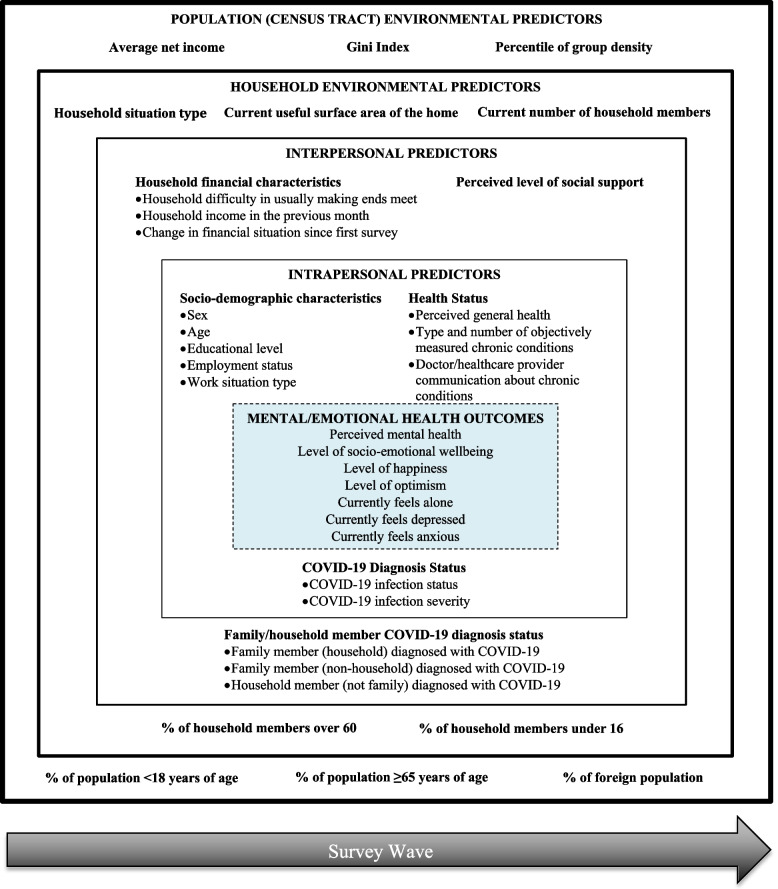
Methods: Analyses were carried out using four measurements of data from the Health and Social Survey (April 2020 to April 2021). Participants included Andalusian (Spanish) residents aged 16 years or older who participated in all four measurements (n = 1223). Seven dichotomous MH and SEW outcomes, as well as several socio-ecological predictors informed by a conceptual model, were examined in descriptive and multivariate analyses.
Results: Unadjusted odds of regular/bad perceived mental health (vs. excellent/very good/good), low socio-emotional wellbeing (vs. regular), low happiness (vs. regular), and feeling anxious (vs. not feeling anxious) decreased significantly from the first to the second measurement; however, in the fourth, low socio-emotional wellbeing significantly increased while low optimism decreased. Considering varying coefficients, objectively measured COVID-19 status and self-reported severity levels of the infection were statistically significant. Health status, social support, and household financial difficulty predicted higher adjusted odds in most of the seven assessed outcomes.
Conclusions: Significant temporal variations in MH and SEW outcomes, along with their predictors, were observed during the first year of the pandemic. Some of these outcomes worsened as the pandemic progressed, whereas others improved. Findings also suggest that some individuals such as those experiencing poor health, limited social support, and low socioeconomic status are disproportionately impacted.
Keywords: COVID-19; Inequalities; Mental health; Panel survey; Socio-emotional wellbeing.
© 2024. The Author(s).
Conflict of interest statement
The authors declare no competing interests.
Figures
References
Publication types
MeSH terms
Grants and funding
- COVID-19 Competitive Grant Program (ID#61605991)/Pfizer Global Medical Grants
- COVID-19 Competitive Grant Program (ID#61605991)/Pfizer Global Medical Grants
- COVID-19 Competitive Grant Program (ID#61605991)/Pfizer Global Medical Grants
- COVID-19 Competitive Grant Program (ID#61605991)/Pfizer Global Medical Grants
- COVID-19 Competitive Grant Program (ID#61605991)/Pfizer Global Medical Grants
- SUPERA COVID-19 Fund/SAUN: Santander Universidades, CRUE and CSIC
- SUPERA COVID-19 Fund/SAUN: Santander Universidades, CRUE and CSIC
- SUPERA COVID-19 Fund/SAUN: Santander Universidades, CRUE and CSIC
- SUPERA COVID-19 Fund/SAUN: Santander Universidades, CRUE and CSIC
- SUPERA COVID-19 Fund/SAUN: Santander Universidades, CRUE and CSIC
- 2021 SGR 01197/Agència de Gestió d'Ajuts Universitaris i de Recerca
- 2021 SGR 01197/Agència de Gestió d'Ajuts Universitaris i de Recerca
- 2021 SGR 01197/Agència de Gestió d'Ajuts Universitaris i de Recerca
- Maria Zambrano 'Grants for the requalification of the Spanish university system'/European Union, Recovery, Transformation and Resilience Plan
- Strategic Plan for Research and Innovation in Health (PERIS)/Department of Health, Government of Catalonia
- Strategic Plan for Research and Innovation in Health (PERIS)/Department of Health, Government of Catalonia
LinkOut - more resources
Full Text Sources
Medical
Research Materials
Miscellaneous
