Review
. 2024 Aug 23;15(8):614.
doi: 10.1038/s41419-024-06976-0.

Natural Killer cells at the frontline in the fight against cancer

Affiliations
Review

Natural Killer cells at the frontline in the fight against cancer

Loïs Coënon et al. Cell Death Dis. .

Abstract

Natural Killer (NK) cells are innate immune cells that play a pivotal role as first line defenders in the anti-tumor response. To prevent tumor development, NK cells are searching for abnormal cells within the body and appear to be key players in immunosurveillance. Upon recognition of abnormal cells, NK cells will become activated to destroy them. In order to fulfill their anti-tumoral function, they rely on the secretion of lytic granules, expression of death receptors and production of cytokines. Additionally, NK cells interact with other cells in the tumor microenvironment. In this review, we will first focus on NK cells' activation and cytotoxicity mechanisms as well as NK cells behavior during serial killing. Lastly, we will review NK cells' crosstalk with the other immune cells present in the tumor microenvironment.


Conflict of interest statement

The authors declare no competing interests.

Figures

Fig. 1
Fig. 1. NK cell cytotoxic Arsenal.
NK cells rely on activating receptors which lead to lytic granules content and cytokines release and on death receptors whose induce apoptosis. GNLY granulysin, GrzB granzyme B, Prf perforin. Created with BioRender.com.
Fig. 2
Fig. 2. NK cells and macrophage interaction.
Macrophages are innate immune cells divided into pro-tumor M1 macrophage and anti-tumor M2 macrophages. There are different interactions between NK cells and macrophages. Macrophages and notably M1 have an anti-tumor effect on NK cells: increase of activating receptors, cytokine production and degranulation. Macrophages also have a pro-tumor effect by inhibiting NK recruitment, degranulation, cytokine production and inducing an exhaustion phenotype. In turn, NK cells induce monocyte recruitment and M2 polarization. Created with BioRender.com.
Fig. 3
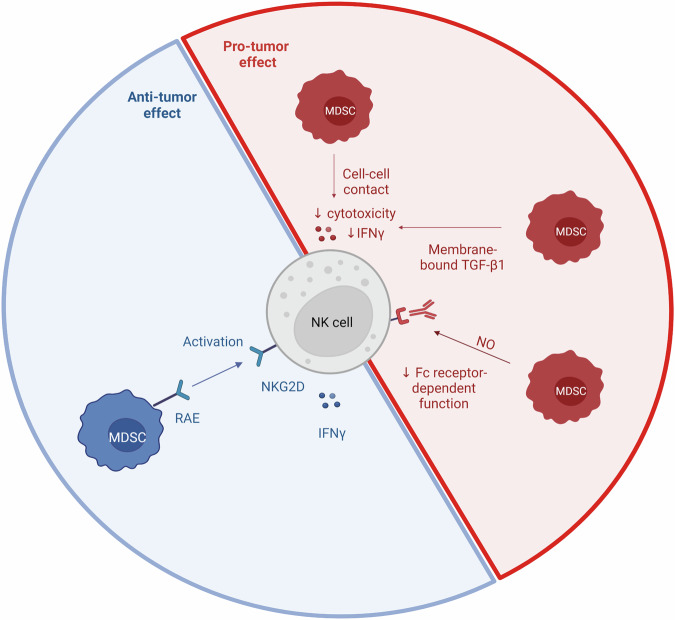
Fig. 3. NK cells and MDSC interaction.
MDSC are innate immune cells divided into PMN-MDSC and M-MDSC. There are different interactions between MDSC and NK. MDSCs reduce the cytotoxicity, the IFNγ production of NK and their Fc-receptor dependent function. MDSCs also have an anti-tumor effect by expressing Rae, which binds to NKG2D and induces the production of IFNγ by NK cells. Created with BioRender.com.
Fig. 4
Fig. 4. NK cells and DC interaction.
DCs are able to increase antibody-mediated NK cell activation but in some other conditions to decrease NK cytokines production and cytotoxicity. In the other part, NK recruits DC and increases their maturation. However, the expression of some immune checkpoints on NK cells is able to decrease DC maturation. Created with BioRender.com.
Fig. 5
Fig. 5. NK cells and neutrophils interaction.
Neutrophils are able to increase NK cell IFNγ production directly or indirectly through slanDCs IL-12p70 production. On the other hand, neutrophils can decrease NK cells cytotoxicity and recruitment in tumor. Created with BioRender.com.
Fig. 6
Fig. 6. NK cells and T cells interaction.
NK are able to suppress DCs-induced CD4+ T cells response, to block Treg differentiation, to promote CD8+ T cells recruitment directly or indirectly via iDC interaction and to restrict TEM CD8+ T cells generation. On their side, adaptive immune cells are able to maintain NK viability, to drive NK maturation, and improve NK cells ADCC. Created with BioRender.com.

References

    1. Kiessling R, Klein E, Wigzell H. ‘’Natural’’ killer cells in the mouse. I. Cytotoxic cells with specificity for mouse Moloney leukemia cells. Specificity and distribution according to genotype. Eur J Immunol. 1975;5:112–7. 10.1002/eji.1830050208 - DOI - PubMed
    1. Kiessling R, Petranyi G, Klein G, Wigzel H. Genetic variation of in vitro cytolytic activity and in vivo rejection potential of non-immunized semi-syngeneic mice against a mouse lymphoma line. Int J Cancer. 1975;15:933–40. 10.1002/ijc.2910150608 - DOI - PubMed
    1. Savoy SKA, Boudreau JE. The evolutionary arms race between virus and NK cells: diversity enables population-level virus control. Viruses. 2019;11:959. 10.3390/v11100959 - DOI - PMC - PubMed
    1. Wu SY, Fu T, Jiang YZ, Shao ZM. Natural killer cells in cancer biology and therapy. Mol Cancer. 2020;19:120. 10.1186/s12943-020-01238-x - DOI - PMC - PubMed
    1. Liu M, Liang S, Zhang C. NK cells in autoimmune diseases: protective or pathogenic? Front Immunol. 2021;12:624687. 10.3389/fimmu.2021.624687 - DOI - PMC - PubMed

LinkOut - more resources