


Acute effects of R-MDMA, S-MDMA, and racemic MDMA in a randomized double-blind cross-over trial in healthy participants
- PMID: 39179638
- PMCID: PMC11631982
- DOI: 10.1038/s41386-024-01972-6
Acute effects of R-MDMA, S-MDMA, and racemic MDMA in a randomized double-blind cross-over trial in healthy participants
Abstract
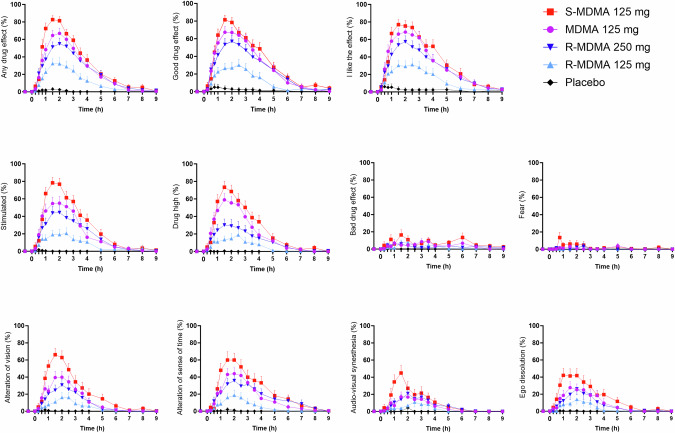
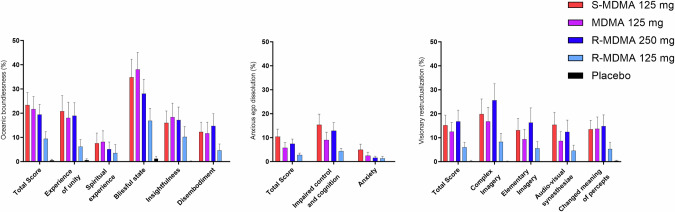
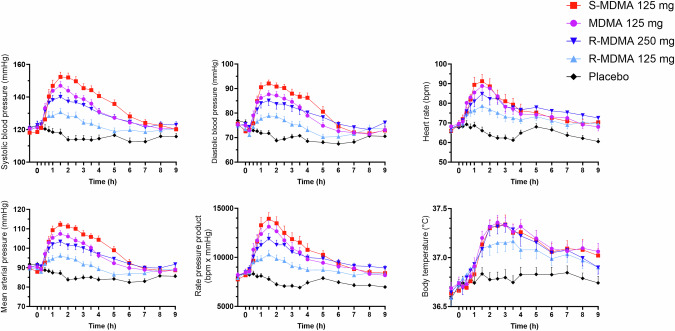
Racemic 3,4-methylenedioxymethamphetamine (MDMA) acutely increases mood, feelings of empathy, trust, and closeness to others and is investigated to assist psychotherapy. Preclinical research indicates that S-MDMA releases monoamines and oxytocin more potently than R-MDMA, whereas R-MDMA more potently stimulates serotonin 5-hydroxytryptamine-2A receptors. S-MDMA may have more stimulant properties, and R-MDMA may be more psychedelic-like. However, acute effects of S- and R-MDMA have not been examined in a controlled human study. We used a double-blind, randomized, placebo-controlled, crossover design to compare acute effects of MDMA (125 mg), S-MDMA (125 mg), R-MDMA (125 mg and 250 mg), and placebo in 24 healthy participants. Outcome measures included subjective, autonomic, and adverse effects, pharmacokinetics, and plasma oxytocin, prolactin, and cortisol concentrations. S-MDMA (125 mg) induced greater subjective effects ("stimulation," "drug high," "happy," "open") and higher increases in blood pressure than R-MDMA (both 125 and 250 mg) and MDMA (125 mg). Unexpectedly, R-MDMA did not produce more psychedelic-like effects than S-MDMA. S-MDMA increased plasma prolactin more than MDMA, and S-MDMA increased plasma cortisol and oxytocin more than MDMA and R-MDMA. The plasma elimination half-life of S-MDMA was 4.1 h after administration. The half-life of R-MDMA was 12 and 14 h after the administration of 125 and 250 mg, respectively. Half-lives for S-MDMA and R-MDMA were 5.1 h and 11 h, respectively, after racemic MDMA administration. Concentrations of the CYP2D6-formed MDMA-metabolite 4-hydroxy-3-methoxymethamphetamine were lower after R-MDMA administration compared with S-MDMA administration. The pharmacokinetic findings are consistent with the R-MDMA-mediated inhibition of CYP2D6. Stronger stimulant-like effects of S-MDMA in the present study may reflect the higher potency of S-MDMA rather than qualitative differences between S-MDMA and R-MDMA. Equivalent acute effects of S-MDMA, MDMA, and R-MDMA can be expected at doses of 100, 125, and 300 mg, respectively, and need to be investigated.Trial registration: ClinicalTrials.gov identifier: NCT05277636.
© 2024. The Author(s).
Conflict of interest statement
Competing interests: MEL is a consultant for Mind Medicine, Inc. The other authors declare no conflicts of interest. Knowhow and data associated with this work are owned by the University Hospital Basel and were licensed by Mind Medicine, Inc. Mind Medicine, Inc., had no role in planning or conducting the present study or writing the publication.
Figures
References
-
- Atila C, Holze F, Murugesu R, Rommers N, Hutter N, Varghese N, et al. Oxytocin in response to MDMA provocation test in patients with arginine vasopressin deficiency (central diabetes insipidus): a single-centre, case-control study with nested, randomised, double-blind, placebo-controlled crossover trial. Lancet Diabetes Endocrinol. 2023;11:454–64. - PubMed
-
- Verrico CD, Miller GM, Madras BK. MDMA (ecstasy) and human dopamine, norepinephrine, and serotonin transporters: implications for MDMA-induced neurotoxicity and treatment. Psychopharmacology. 2007;189:489–503. - PubMed
-
- Hiramatsu M, Cho AK. Enantiomeric differences in the effects of 3,4-methylenedioxymethamphetamine on extracellular monoamines and metabolites in the striatum of freely-moving rats: an in vivo microdialysis study. Neuropharmacology. 1990;29:269–75. - PubMed
Publication types
MeSH terms
Substances
Associated data
Grants and funding
LinkOut - more resources
Full Text Sources
Other Literature Sources
Medical
