


Rising incidence of obesity-related cancers among younger adults in China: A population-based analysis (2007-2021)
- PMID: 39181132
- PMCID: PMC11560649
- DOI: 10.1016/j.medj.2024.07.012
Rising incidence of obesity-related cancers among younger adults in China: A population-based analysis (2007-2021)
Abstract
Background: Developing countries face an "obesity epidemic," particularly affecting children and younger adults. While obesity is a known risk factor for 12 types of cancer, primarily affecting older populations, its impact on younger generations is understudied.
Methods: This study analyzed data from a population-based cancer registry covering 14.14 million individuals in China (2007-2021). We compared the incidence of obesity- and non-obesity-related cancers and applied an age-period-cohort model to estimate their impacts.
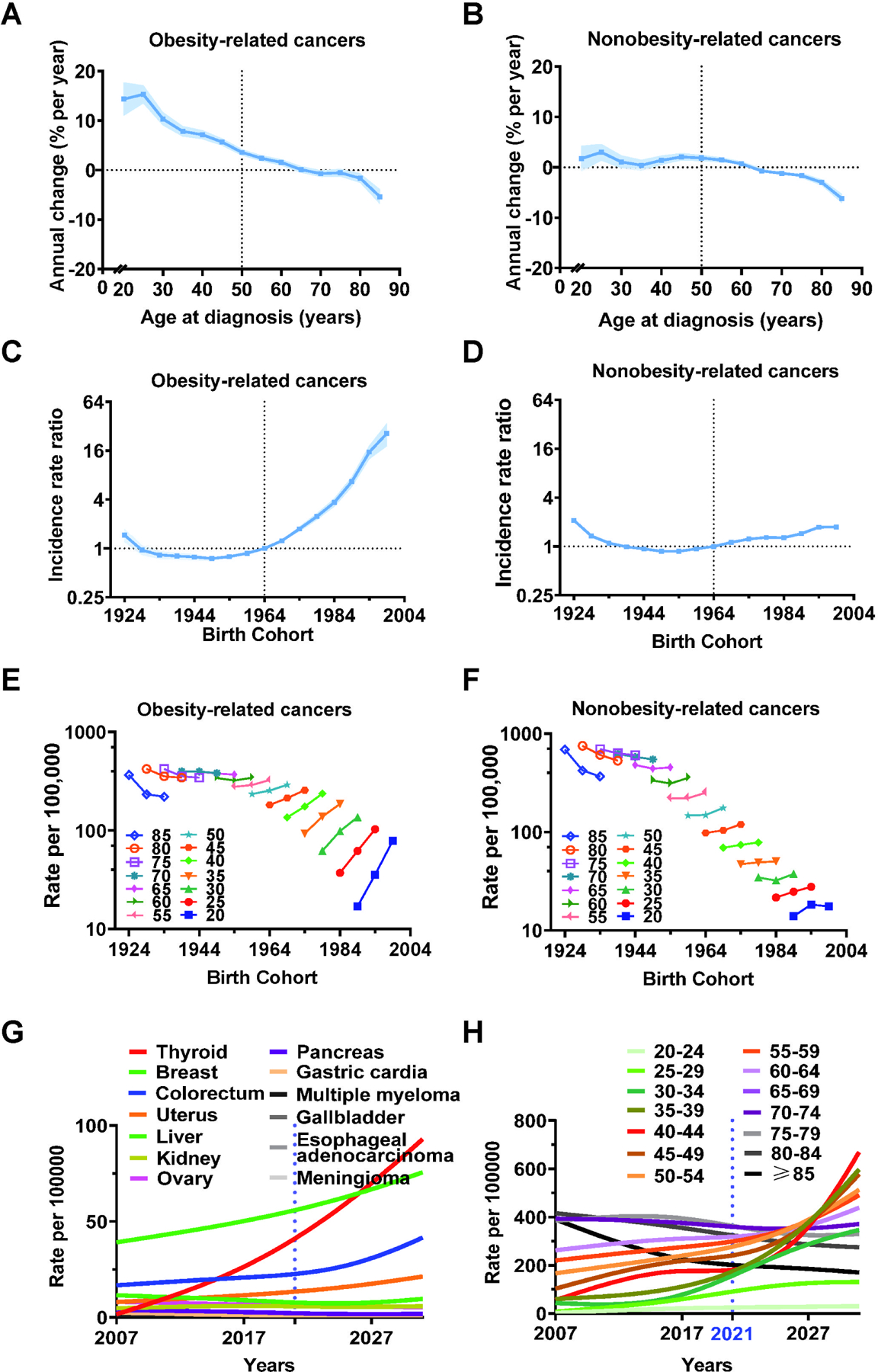
Findings: Among 651,342 cancer cases, 48.47% were obesity related. The age-standardized incidence rates (ASRs) of the 12 obesity-related cancers increased annually by 3.6% (p < 0.001), while ASRs for non-obesity-related cancers remained stable. Obesity-related cancers surged among younger adults, with rates rising across successive generations. The annual percentage of change decreased with age, from 15.28% for ages 25-29 years to 1.55% for ages 60-64 years. The incidence rate ratio for obesity-related cancer was higher in younger generations compared to those born in 1962-1966. We predict that the ASR for obesity-related cancers will nearly double in the next decade.
Conclusions: The rising incidence of obesity-related cancers among young adults poses a significant public health concern. The increasing cancer burden underscores the need for targeted interventions to address the obesity epidemic.
Funding: This work was supported by the National Natural Science Foundation of China (81930019, 82341076) to J.-K.Y.
Keywords: Translation to population health.
Copyright © 2024 Elsevier Inc. All rights reserved.
Conflict of interest statement
Declaration of interests The authors declare no competing interests.
Figures
References
-
- Furer A, Afek A, Sommer A, Keinan-Boker L, Derazne E, Levi Z, Tzur D, Tiosano S, Shina A, Glick Y, et al. (2020). Adolescent obesity and midlife cancer risk: a population-based cohort study of 2·3 million adolescents in Israel. The Lancet Diabetes & Endocrinology 8, 216–225. 10.1016/s2213-8587(20)30019-x. - DOI - PubMed
MeSH terms
Grants and funding
LinkOut - more resources
Full Text Sources
Medical
