


International treatment outcomes of neonates on extracorporeal membrane oxygenation (ECMO) with persistent pulmonary hypertension of the newborn (PPHN): a systematic review
- PMID: 39182148
- PMCID: PMC11344431
- DOI: 10.1186/s13019-024-03011-3
International treatment outcomes of neonates on extracorporeal membrane oxygenation (ECMO) with persistent pulmonary hypertension of the newborn (PPHN): a systematic review
Abstract
Background: PPHN is a common cause of neonatal respiratory failure and is still a serious condition and associated with high mortality.
Objectives: To compare the demographic variables, clinical characteristics, and treatment outcomes in neonates with PHHN who underwent ECMO and survived compared to neonates with PHHN who underwent ECMO and died.
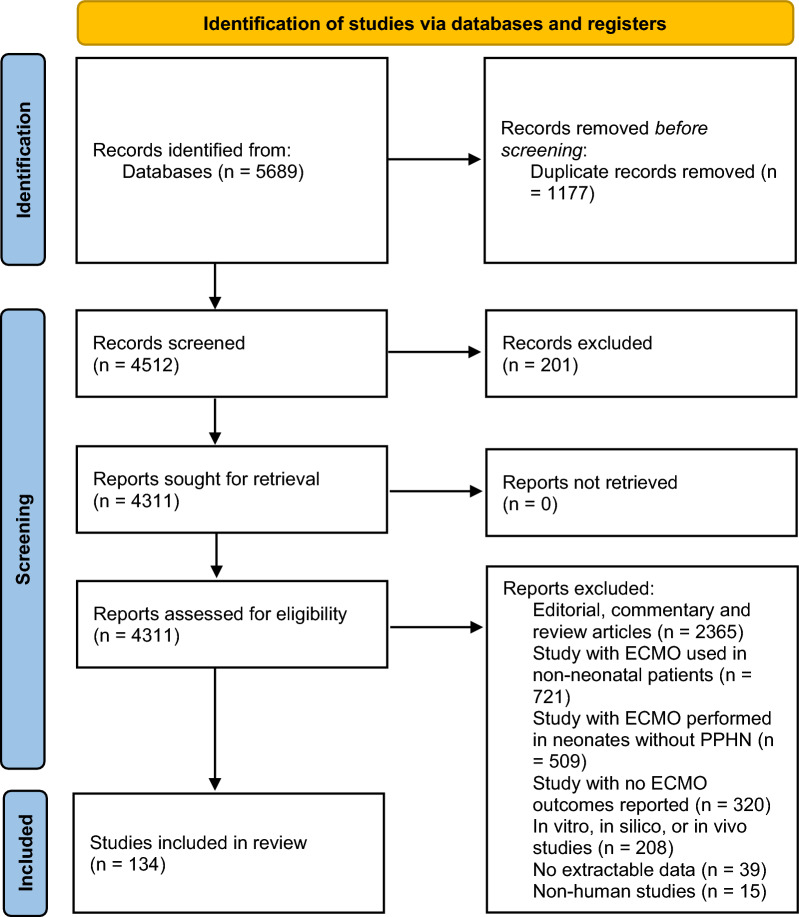
Methods: We adhered to the Preferred Reporting Items for Systematic Reviews and Meta-Analyses (PRISMA) guideline and searched ProQuest, Medline, Embase, PubMed, CINAHL, Wiley online library, Scopus and Nature for studies on the development of PPHN in neonates who underwent ECMO, published from January 1, 2010 to May 31, 2023, with English language restriction.
Results: Of the 5689 papers that were identified, 134 articles were included in the systematic review. Studies involving 1814 neonates with PPHN who were placed on ECMO were analyzed (1218 survived and 594 died). Neonates in the PPHN group who died had lower proportion of normal spontaneous vaginal delivery (6.4% vs 1.8%; p value > 0.05) and lower Apgar scores at 1 min and 5 min [i.e., low Apgar score: 1.5% vs 0.5%, moderately abnormal Apgar score: 10.3% vs 1.2% and reassuring Apgar score: 4% vs 2.3%; p value = 0.039] compared to those who survived. Neonates who had PPHN and died had higher proportion of medical comorbidities such as omphalocele (0.7% vs 4.7%), systemic hypotension (1% vs 2.5%), infection with Herpes simplex virus (0.4% vs 2.2%) or Bordetella pertussis (0.7% vs 2%); p = 0.042. Neonates with PPHN in the death group were more likely to present due to congenital diaphragmatic hernia (25.5% vs 47.3%), neonatal respiratory distress syndrome (4.2% vs 13.5%), meconium aspiration syndrome (8% vs 12.1%), pneumonia (1.6% vs 8.4%), sepsis (1.5% vs 8.2%) and alveolar capillary dysplasia with misalignment of pulmonary veins (0.1% vs 4.4%); p = 0.019. Neonates with PPHN who died needed a longer median time of mechanical ventilation (15 days, IQR 10 to 27 vs. 10 days, IQR 7 to 28; p = 0.024) and ECMO use (9.2 days, IQR 3.9 to 13.5 vs. 6 days, IQR 3 to 12.5; p = 0.033), and a shorter median duration of hospital stay (23 days, IQR 12.5 to 46 vs. 58.5 days, IQR 28.2 to 60.7; p = 0.000) compared to the neonates with PPHN who survived. ECMO-related complications such as chylothorax (1% vs 2.7%), intracranial bleeding (1.2% vs 1.7%) and catheter-related infections (0% vs 0.3%) were more frequent in the group of neonates with PPHN who died (p = 0.031).
Conclusion: ECMO in the neonates with PPHN who failed supportive cardiorespiratory care and conventional therapies has been successfully utilized with a neonatal survival rate of 67.1%. Mortality in neonates with PPHN who underwent ECMO was highest in cases born via the caesarean delivery mode or neonates who had lower Apgar scores at birth. Fatality rate in neonates with PPHN who underwent ECMO was the highest in patients with higher rate of specific medical comorbidities (omphalocele, systemic hypotension and infection with Herpes simplex virus or Bordetella pertussis) or cases who had PPHN due to higher rate of specific etiologies (congenital diaphragmatic hernia, neonatal respiratory distress syndrome and meconium aspiration syndrome). Neonates with PPHN who died may need a longer time of mechanical ventilation and ECMO use and a shorter duration of hospital stay; and may experience higher frequency of ECMO-related complications (chylothorax, intracranial bleeding and catheter-related infections) in comparison with the neonates with PPHN who survived.
Keywords: ECLS; ECMO; Extracorporeal life support; Extracorporeal membrane oxygenation; Neonates; Newborn; Patent ductus arteriosus; Persistent fetal circulation; Pulmonary hypertension; Systematic review.
© 2024. The Author(s).
Conflict of interest statement
The authors declare that they have no competing interests.
Figures
References
-
- Nakwan N, Jain S, Kumar K, Hosono S, Hammoud M, Elsayed YY, Ariff S, Hasan B, Khowaja W, Poon WB. An Asian multicenter retrospective study on persistent pulmonary hypertension of the newborn: incidence, etiology, diagnosis, treatment and outcome. J Matern Fetal Neonatal Med. 2020;33(12):2032–7. 10.1080/14767058.2018.1536740 - DOI - PubMed
Publication types
MeSH terms
LinkOut - more resources
Full Text Sources
