Comparing single-shot damage thresholds of boron carbide and silicon at the European XFEL
- PMID: 39182203
- PMCID: PMC11371029
- DOI: 10.1107/S1600577524007318
Comparing single-shot damage thresholds of boron carbide and silicon at the European XFEL
Abstract
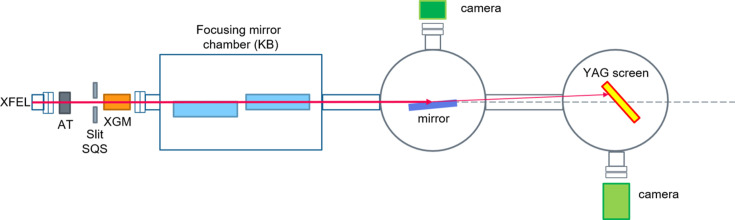
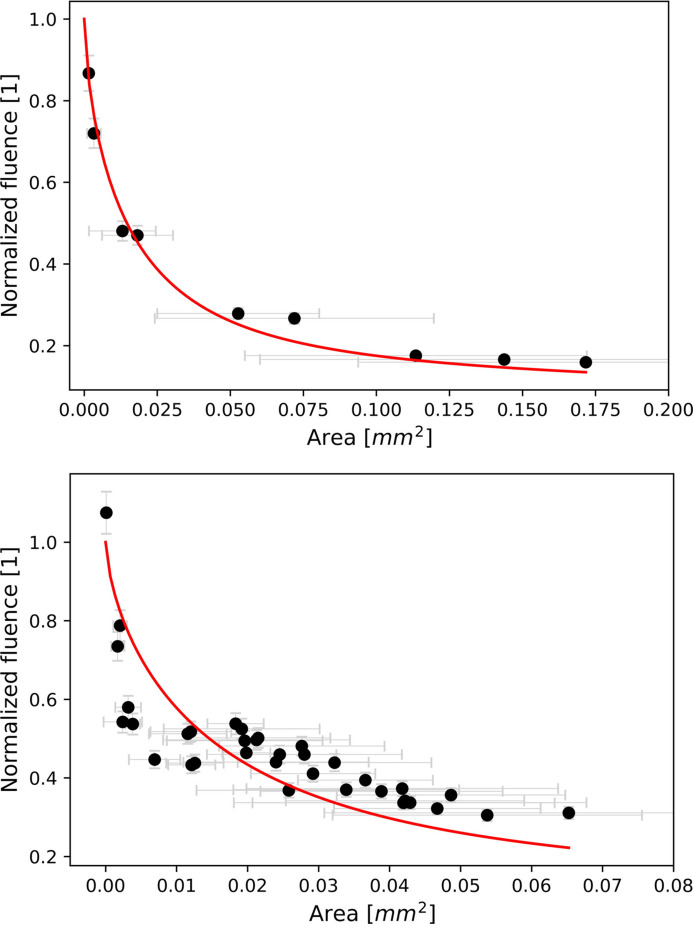
Xray free-electron lasers (XFELs) enable experiments that would have been impractical or impossible at conventional X-ray laser facilities. Indeed, more XFEL facilities are being built and planned, with their aim to deliver larger pulse energies and higher peak brilliance. While seeking to increase the pulse power, it is quintessential to consider the maximum pulse fluence that a grazing-incidence FEL mirror can withstand. To address this issue, several studies were conducted on grazing-incidence damage by soft X-ray FEL pulses at the European XFEL facility. Boron carbide (B4C) coatings on polished silicon substrate were investigated using 1 keV photon energy, similar to the X-ray mirrors currently installed at the soft X-ray beamlines (SASE3). The purpose of this study is to compare the damage threshold of B4C and Si to determine the advantages, tolerance and limits of using B4C coatings.
Keywords: B4C coating; X-ray mirrors; XFEL; damage threshold; single-shot damage threshold.
open access.
Conflict of interest statement
The authors declare no competing interests.
Figures

References
-
- Aquila, A., Ozkan, C., Sobierajski, R., Hájková, V., Burian, T., Chalupsky, J., Juha, L., Störmer, M., Ohashi, H., Koyama, T., Tono, K., Inubushi, Y., Yabashi, M., Sinn, H., Tschentscher, T., Mancuso, A. P. & Gaudin, J. (2013). Proc. SPIE, 8777, 87770H.
-
- Aquila, A., Sobierajski, R., Ozkan, C., Hájková, V., Burian, T., Chalupský, J., Juha, L., Störmer, M., Bajt, S., Klepka, M. T., Dłużewski, P., Morawiec, K., Ohashi, H., Koyama, T., Tono, K., Inubushi, Y., Yabashi, M., Sinn, H., Tschentscher, T., Mancuso, A. P. & Gaudin, J. (2015). Appl. Phys. Lett.106, 241905.
-
- Chalupský, J., Hájková, V., Altapova, V., Burian, T., Gleeson, A. J., Juha, L., Jurek, M., Sinn, H., Störmer, M., Sobierajski, R., Tiedtke, K., Toleikis, S., Tschentscher, Th., Vyšín, L., Wabnitz, H. & Gaudin, J. (2009). Appl. Phys. Lett.95, 031111.
-
- Chalupský, J., Krzywinski, J., Juha, L., Hájková, V., Cihelka, J., Burian, T., Vyšín, L., Gaudin, J., Gleeson, A., Jurek, M., Khorsand, A. R., Klinger, D., Wabnitz, H., Sobierajski, R., Störmer, M., Tiedtke, K. & Toleikis, S. (2010). Opt. Express, 18, 27836. - PubMed
-
- Dastjani Farahani, S., Chalupsky, J., Burian, T., Chapman, H., Gleeson, A. J., Hajkoya, V., Juha, L., Jurek, M., Klinger, D., Sinn, H., Sobierajski, R., Störmer, M., Tiedtke, K., Toleikis, S., Tschentscher, T., Wabnitz, H. & Gaudin, J. (2011). Nucl. Instrum. Methods Phys. Res. A, 635, S39–S42.
Grants and funding
LinkOut - more resources
Full Text Sources