


Impact of the Great East Japan Earthquake followed by the nuclear power plant accident on the nursing students' academic progress in Soma, Fukushima, Japan: a retrospective cohort study with questionnaire survey
- PMID: 39183265
- PMCID: PMC11346269
- DOI: 10.1186/s12912-024-02225-z
Impact of the Great East Japan Earthquake followed by the nuclear power plant accident on the nursing students' academic progress in Soma, Fukushima, Japan: a retrospective cohort study with questionnaire survey
Abstract
Background: The Great East Japan Earthquake and the subsequent Fukushima nuclear power plant accident in 2011 posed significant challenges to the educational sector, particularly affecting nursing students in the disaster area. However, to the best of our knowledge, there are no reports on the effects of the natural disaster coupled with the nuclear accident on the nursing students. Therefore, this study aimed to determine the impact of the Fukushima disasters on rate of academic failure events in nursing education.
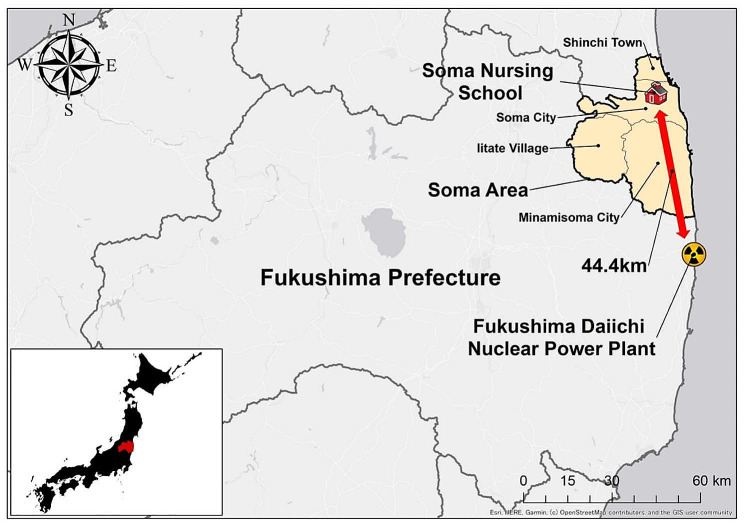
Methods: A retrospective cohort approach was conducted, focusing on 677 students from Soma Nursing School admitted between 2001 and 2017. Four failure events-failure to pass the national examination, student retention, suspension, and withdrawal from school-were compared between three time periods: pre-disaster, early peri-disaster, and later peri-disaster. This analysis was followed by a questionnaire survey among the students and an interview with faculty members to gain further insights.
Results: Of the student cohort, 17% had at least one failure event. Students in the later peri-disaster phase faced an elevated failure rate at 29%. Variables such as being male, admission during later peri-disaster period, and local pre-admission residence played a significant role in these failure events in multivariate logistic regression analysis (adjusted odds ratio [95% confidence interval, p value]; 2.63 [1.49-4.64, < 0.001], 3.207 [2.00-5.15, < 0.001], and 1.84 [1.12-3.02, 0.02], respectively).
Conclusions: This study highlights the impact of the Great East Japan Earthquake and the following nuclear accident on nursing education. The elevated failure rates in the later peri-disaster period emphasize the challenges posed by continuing disaster phases. Thus, there is a need for intensified and tailored strategies in nursing education in disaster-affected regions.
Keywords: Fukushima nuclear accident; Natural disaster; Nursing education research.
© 2024. The Author(s).
Conflict of interest statement
The authors declare no competing interests.
Figures
References
-
- Learning in Crisis. Prioritizing education and effective policies to recover lost learning [https://www.worldbank.org/en/news/immersive-story/2022/09/16/learning-in...]
-
- Sapkota JBK, Neupane P. Progress after the 2015 Nepal earthquake: evidence from two household surveys in one of the hardest-hit mountain villages. Sustainability. 2021;13(21):11677.10.3390/su132111677 - DOI
-
- Trip H, Tabakakis K, Maskill V, Richardson S, Dolan B, Josland H, McKay L, Richardson A, Cowan L, Hickmott B, Houston G. Psychological health and resilience: the impact of significant earthquake events on tertiary level professional students. A cross-sectional study. Contemp Nurse. 2018;54(3):319–32. 10.1080/10376178.2018.1503549 - DOI - PubMed
Grants and funding
LinkOut - more resources
Full Text Sources
