. 2024 Nov;31(11-12):553-559.
doi: 10.1038/s41434-024-00480-y. Epub 2024 Aug 25.

Lentiviral vector gene therapy and CFTR modulators show comparable effectiveness in cystic fibrosis rat airway models

Affiliations

Lentiviral vector gene therapy and CFTR modulators show comparable effectiveness in cystic fibrosis rat airway models

Alexandra McCarron et al. Gene Ther. 2024 Nov.

Abstract

Mutation-agnostic treatments such as airway gene therapy have the potential to treat any individual with cystic fibrosis (CF), irrespective of their CF transmembrane conductance regulator (CFTR) gene variants. The aim of this study was to employ two CF rat models, Phe508del and CFTR knockout (KO), to assess the comparative effectiveness of CFTR modulators and lentiviral (LV) vector-mediated gene therapy. Cells were isolated from the tracheas of rats and used to establish air-liquid interface (ALI) cultures. Phe508del rat ALIs were treated with the modulator combination, elexacaftor-tezacaftor-ivacaftor (ETI), and separate groups of Phe508del and KO tracheal epithelial cells were treated with LV-CFTR followed by differentiation at ALI. Ussing chamber measurements were performed to assess CFTR function. ETI-treated Phe508del ALI cultures demonstrated CFTR function that was 59% of wild-type level, while gene-addition therapy restored Phe508del to 68% and KO to 47% of wild-type level, respectively. Our findings show that rat Phe508del-CFTR protein can be successfully rescued with ETI treatment, and that CFTR gene-addition therapy provides significant CFTR correction in Phe508del and KO ALI cultures to levels that were comparable to ETI. These findings highlight the potential of an LV vector-based gene therapy for the treatment of CF lung disease.


Conflict of interest statement

Competing interests The authors declare no competing interests.

Figures

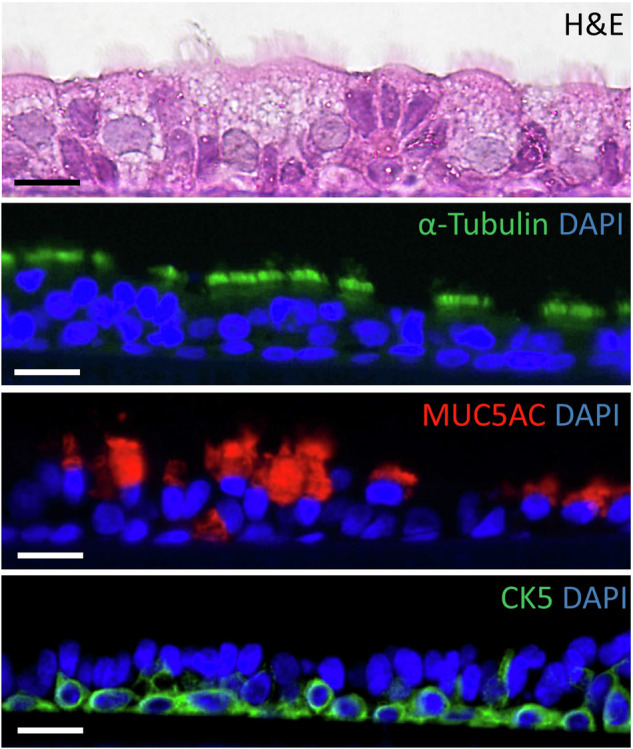
Fig. 1
Fig. 1. Rat ALI cultures demonstrate mucociliary differentiation.
Cellular markers of differentiated cell types identified via immunohistochemistry, including α-tubulin for ciliated cells, MUC5AC for goblet cells, and CK5 for basal cells. Representative images are from a wild-type rat ALI culture at 15-days post air-lift. Scale bar = 10 µM.
Fig. 2
Fig. 2. Rat tracheal epithelial cells can be successfully transduced with VSV-G pseudotyped LV vector.
A Wild-type rat airway cells transduced with LV-GFP at MOIs of 1, 10 and 100 show dose-related increases in the proportion of cells with green fluorescence. B Corresponding flow cytometry quantification of the percentage of GFP-positive cells. C Graph showing the average percentage of GFP-positive cells at the respective MOIs. D Immunostaining with cytokeratin 5 confirmed the identity of the rat airway epithelial cells as predominantly basal. Data are represented as mean ± SEM, one-way ANOVA, Tukey’s multiple comparison test, ****p < 0.0001, n = 6 technical replicates per group (performed over two independent experiments).
Fig. 3
Fig. 3. ETI and LV-CFTR treatment show comparable efficacy in restoring CFTR function.
Representative Isc traces from A ALIs derived from wild-type, Phe508del and KO airway epithelial cells, B untreated Phe508del and ETI-treated rat ALI cultures, C Phe508del LV-CFTR treated ALI culture compared to untreated Phe508del and D KO LV-CFTR treated ALI culture compared to untreated KO. E ΔIsc forskolin response in wild-type, Phe508del, KO, Phe508del treated with ETI, and Phe508del and KO treated with LV-CFTR. Data are represented as mean ± SEM, one-way ANOVA, Tukey’s multiple comparison test, ns: not significant, **p < 0.01, ***p < 0.001, ****p < 0.0001, n = 5-14 per group. Each data point represents an individual animal. F508; Phe508del.
Fig. 4
Fig. 4. Human CFTR mRNA is detected in LV-CFTR treated ALI cultures.
Absolute quantification of A human and B rat CFTR mRNA in untreated and LV-CFTR treated rat ALIs. Total copy number is expressed relative to the total copy number of the housekeeping gene CycA. Data are represented as mean ± SEM, one-way ANOVA, Tukey’s multiple comparison test, ns: not significant, ***p < 0.001, ****p < 0.0001, n = 2–5 per group. F508; Phe508del.

References

    1. Turcios NL. Cystic fibrosis lung disease: an overview. Respir Care. 2020;65:233–51. - PubMed
    1. Guilbault C, Saeed Z, Downey GP, Radzioch D. Cystic fibrosis mouse models. Am J Respir Cell Mol Biol. 2007;36:1–7. - PubMed
    1. Tuggle KL, Birket SE, Cui X, Hong J, Warren J, Reid L, et al. Characterization of defects in ion transport and tissue development in cystic fibrosis transmembrane conductance regulator (CFTR)-knockout rats. PLoS One. 2014;9:e91253. - PMC - PubMed
    1. Dreano E, Bacchetta M, Simonin J, Galmiche L, Usal C, Slimani L, et al. Characterization of two rat models of cystic fibrosis-KO and F508del CFTR-Generated by Crispr-Cas9. Anim Model Exp Med. 2019;2:297–311. - PMC - PubMed
    1. McCarron A, Cmielewski P, Reyne N, McIntyre C, Finnie J, Craig F, et al. Phenotypic characterization and comparison of cystic fibrosis rat models generated using CRISPR/Cas9 gene editing. Am J Pathol. 2020;190:977–93. - PubMed

MeSH terms