


Health Equity Considerations in Cost-Effectiveness Analysis: Insights from an Umbrella Review
- PMID: 39184340
- PMCID: PMC11344546
- DOI: 10.2147/CEOR.S471827
Health Equity Considerations in Cost-Effectiveness Analysis: Insights from an Umbrella Review
Abstract
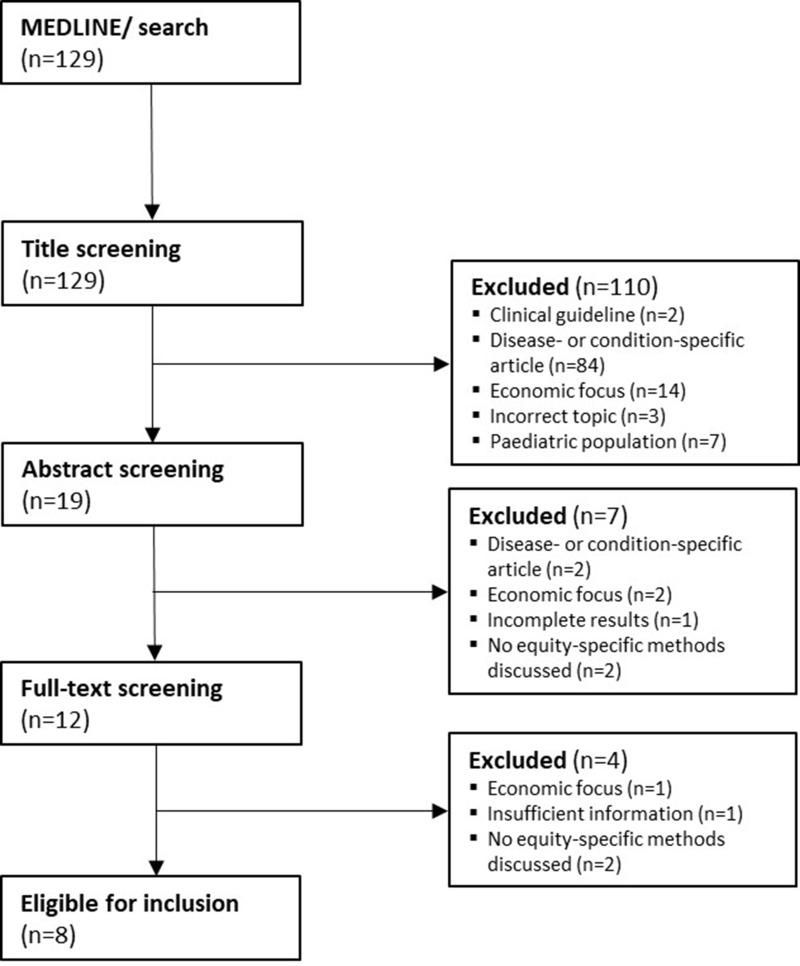
Cost-effectiveness analyses (CEA) are important in healthcare decision-making and resource allocation; however, expanding the scope of CEAs beyond the traditional clinicoeconomic concepts to also include value elements such as health equity has attracted much interest in recent years. This umbrella review aimed to synthesize evidence on how equity concepts have been considered in modified types of CEAs. Publicly available articles in MEDLINE were searched on January 25, 2024, to identify systematic reviews (SLRs) published in English since 2013 that incorporate health equity considerations in CEAs. Title/abstract, full-text article screening and data extraction were conducted by a single reviewer and validated by a second reviewer. Results were qualitatively synthesized to identify common themes. Eight SLRs were included. Distributional CEAs (DCEA), equity-based weighting, extended CEA (ECEA), mathematical programming and multi-criteria decision analysis (MCDA) were the most discussed approaches. A lack of consensus on the best approach for incorporating health equity into CEAs was highlighted, as these approaches are not currently consistently used in decision-making. Important limitations included scarcity of robust data to inform health equity indices, bias associated with commonly used health outcome metrics and the challenge of accounting for additional contextual factors such as fairness and opportunity costs. Proposals to expand CEAs to address equity issues come with challenges due to data unavailability, methods complexity, and decision-makers unfamiliarity with these approaches. Our review indicates that extended and distributional CEAs can support decision-making by capturing the impact of inequity on the clinical and cost-effectiveness assessment of treatments, although future modeling should account for additional contextual factors such as fairness and opportunity costs. Recommendations for actions moving forward include standardization of data collection for outcomes related to equity and familiarity with methodologies to account for the complexities of integrating health equity considerations in CEAs.
Keywords: cost-effectiveness analysis; health equity; health technology assessment; umbrella review; value elements.
© 2024 Muir et al.
Conflict of interest statement
JMM, AR and GS are employees of Cytel, Inc. IOS is an employee of Takeda Pharmaceuticals, Inc. The authors declare no other competing interests in this work.
Figures

References
-
- Muir JM, Radhakrishnan A, Freitag A, Ozer Stillman I, Sarri G. Reconstructing the value puzzle in health technology assessment: a pragmatic review to determine which modelling methods can account for additional value elements. Front Pharmacol. 2023;14:1197259. doi:10.3389/fphar.2023.1197259 - DOI - PMC - PubMed
Publication types
LinkOut - more resources
Full Text Sources
