Case Reports
. 2024 Aug 22:12:2050313X241271883.
doi: 10.1177/2050313X241271883. eCollection 2024.

Surgical treatment of a Salmonella-related infective native aortic aneurysm: A case report

Affiliations
Case Reports

Surgical treatment of a Salmonella-related infective native aortic aneurysm: A case report

Tran Thanh Vy et al. SAGE Open Med Case Rep. .

Abstract

Infective native abdominal aortic aneurysms are a life-threatening condition with a high mortality rate. We report the case of a 53-year-old male patient who presented with abdominal pain and fever. Laboratory results showed an elevated white blood cell count and C-reactive protein levels. Blood cultures detected Salmonella species, and computed tomography revealed a saccular abdominal aortic aneurysm. After 14 days of preoperative antibiotic therapy, the patient underwent a successful surgical bypass from the descending thoracic aorta, through the diaphragm and muscle layers of the anterior abdominal wall, to the bilateral common femoral arteries. The patient was discharged after 30 days of hospitalization and continued antibiotic treatment for another 30 days. Follow-up clinical evaluations and imaging studies showed good recovery and no signs of infection. This case highlights the importance of combining appropriate antibiotic therapy with surgical intervention in managing infective native aortic aneurysms. In particular, an extra-anatomical approach from the descending aorta can be a viable option in selected cases of infected aortic aneurysms, providing an effective means to achieve thorough debridement and prevent future graft infections.

Keywords: Infective native aortic aneurysms; Salmonella; antibiotic therapy.


Conflict of interest statement

The author(s) declared no potential conflicts of interest with respect to the research, authorship, and/or publication of this article.

Figures
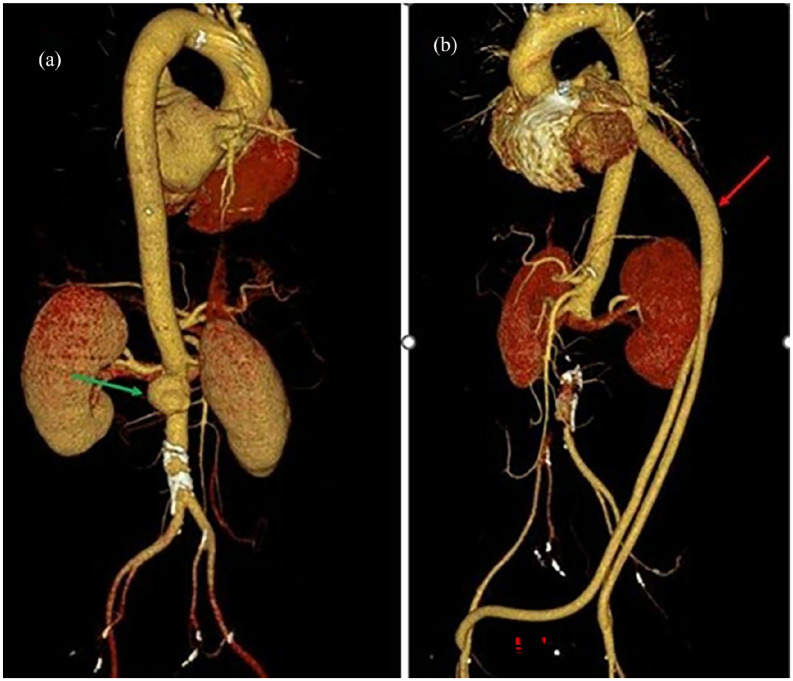
Figure 1.
Figure 1.
(a) The reconstructed angiography image demonstrates a saccular juxtarenal abdominal aortic aneurysm with dimensions of 30 × 20 × 25 mm (width × anterior-posterior diameter × height)—green arrow. (b) The postoperative reconstructed angiography image shows that the aorta-femoral bypass and visceral blood vessels had good circulation—red arrow.
Figure 2.
Figure 2.
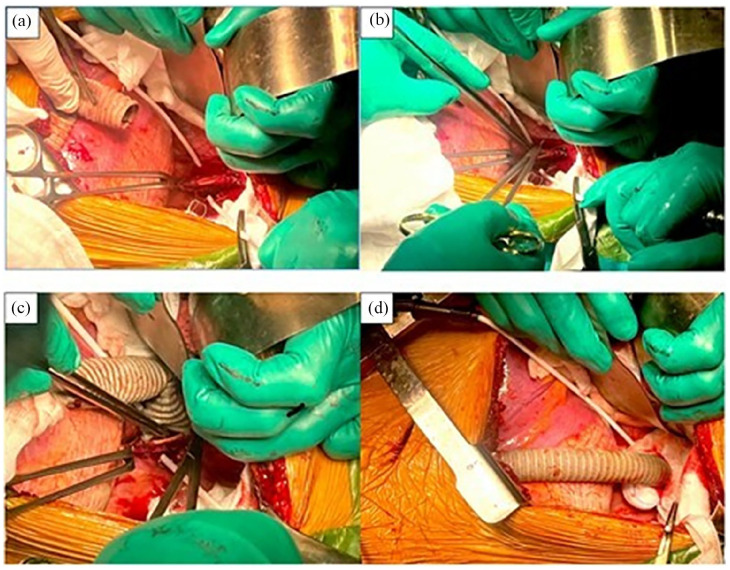
Proximal end-to-side anastomosis is observed via lateral thoracotomy between the thoracic aorta and prosthetic graft with Prolene 4-0 sutures. (a) The thoracic aorta was incised longitudinally about 2 cm. (b, c) End-to-side anastomosis between the thoracic aorta and prosthetic graft with Prolene 4-0 sutures. (d) We inserted the graft through the diaphragm, clamped the distal end of the graft, and unclamped the proximal end of the graft.
Figure 3.
Figure 3.
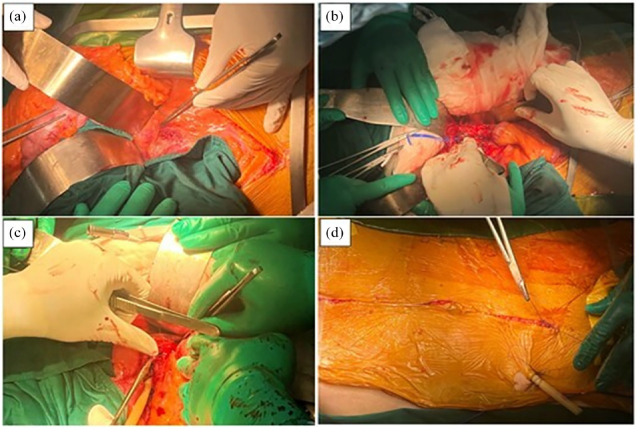
Resection of the aneurysm and extensive local debridement surgery via the midline abdominal incision. (a) Exposure and control of the abdominal aorta. (b) Clamping the suprarenal abdominal aorta for 10 min, removal of the aneurysm and necrotic tissue, and suturing the end of the infrarenal abdominal aorta. (c) The drainage of the retroperitoneal cavity. (d) The closure of the midline abdominal incision.
Figure 4.
Figure 4.
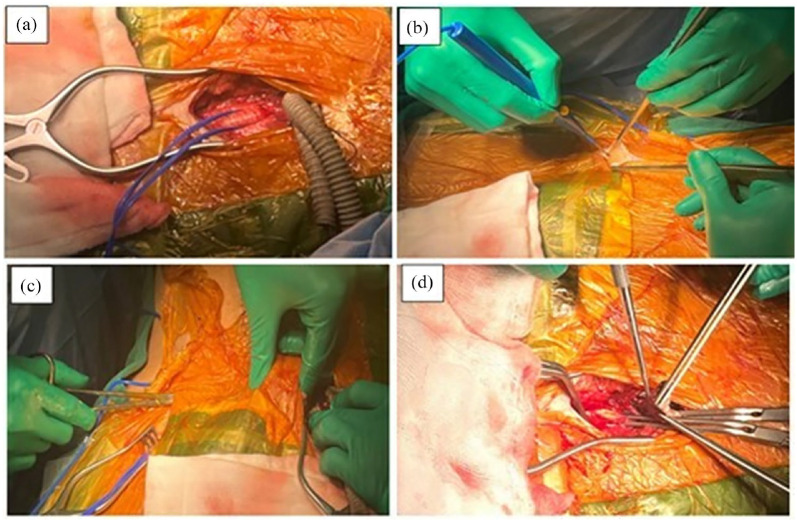
(a) The left common femoral artery was exposed, and the two ends of the Y-shaped graft were carried down to the left inguinal position. (b) Exposing the right common femoral artery. (c) The graft was routed in the subcutaneous tunnel from left to right. (d) End-to-side anastomosis between the two ends of the Y-shaped graft and common femoral arteries with Prolene 5-0 sutures.

References

    1. Sekar N. Primary aortic infections and infected aneurysms. Ann Vasc Dis 2010; 3: 24–27. - PMC - PubMed
    1. Sörelius K, Budtz-Lilly J, Mani K, et al. Systematic review of the management of mycotic aortic aneurysms. Eur J Vasc Endovasc Surg 2019; 58: 426–435. - PubMed
    1. Cury MVM, de Campos MH, dos Santos DP. Salmonella-related mycotic pseudoaneurysm of the superficial femoral artery. Int J Surg Case Rep 2012; 3: 27–29. - PMC - PubMed
    1. Ahmad M, Poh YW, Imray CHE. A staged, endovascular approach to treat a ruptured external iliac artery mycotic pseudoaneurysm in an intravenous drug user: a case report. Int J Surg Case Rep 2017; 39: 115–118. - PMC - PubMed
    1. Molina G, Mesías C, Calispa J, et al. Mycotic pseudoaneurysm of the extracranial carotid artery, a severe and rare disease, a case report. Int J Surg Case Rep 2020; 71: 382–385. - PMC - PubMed

Publication types

LinkOut - more resources