


A 27-country test of communicating the scientific consensus on climate change
- PMID: 39187712
- PMCID: PMC11493676
- DOI: 10.1038/s41562-024-01928-2
A 27-country test of communicating the scientific consensus on climate change
Abstract
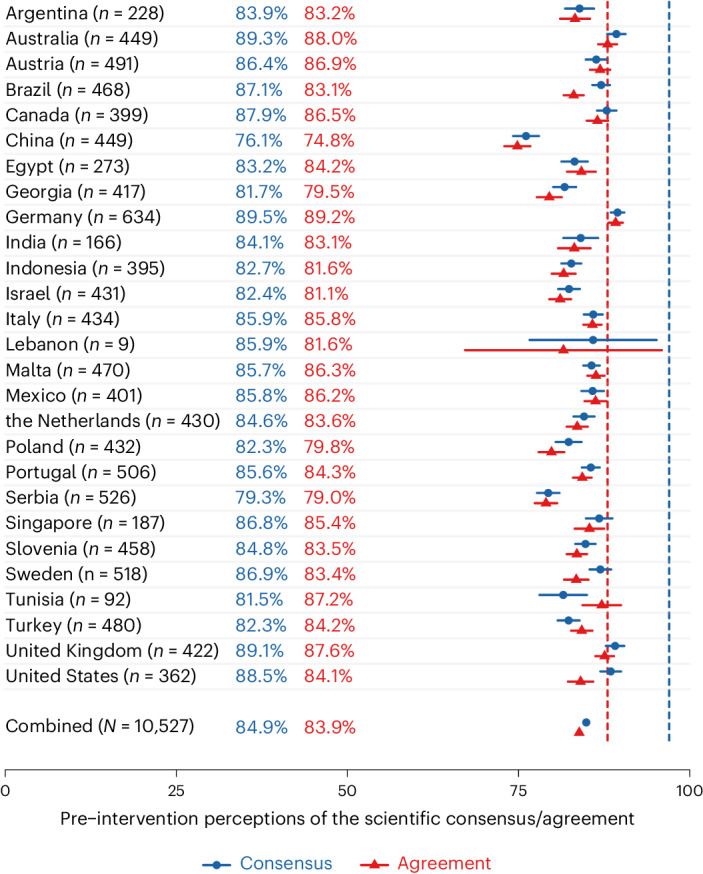
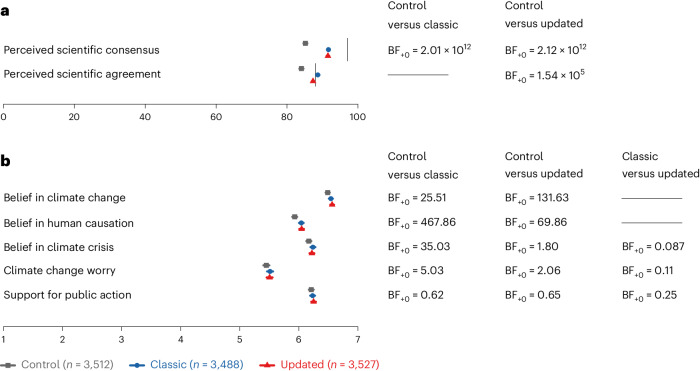
Communicating the scientific consensus that human-caused climate change is real increases climate change beliefs, worry and support for public action in the United States. In this preregistered experiment, we tested two scientific consensus messages, a classic message on the reality of human-caused climate change and an updated message additionally emphasizing scientific agreement that climate change is a crisis. Across online convenience samples from 27 countries (n = 10,527), the classic message substantially reduces misperceptions (d = 0.47, 95% CI (0.41, 0.52)) and slightly increases climate change beliefs (from d = 0.06, 95% CI (0.01, 0.11) to d = 0.10, 95% CI (0.04, 0.15)) and worry (d = 0.05, 95% CI (-0.01, 0.10)) but not support for public action directly. The updated message is equally effective but provides no added value. Both messages are more effective for audiences with lower message familiarity and higher misperceptions, including those with lower trust in climate scientists and right-leaning ideologies. Overall, scientific consensus messaging is an effective, non-polarizing tool for changing misperceptions, beliefs and worry across different audiences.
© 2024. The Author(s).
Conflict of interest statement
The authors declare no competing interests.
Figures
References
-
- Lynas, M., Houlton, B. Z. & Perry, S. Greater than 99% consensus on human caused climate change in the peer-reviewed scientific literature. Environ. Res. Lett.16, 114005 (2021).
-
- Cook, J. et al. Quantifying the consensus on anthropogenic global warming in the scientific literature. Environ. Res. Lett.8, 024024 (2013).
-
- Powell, J. L. Climate scientists virtually unanimous: anthropogenic global warming is true. Bull. Sci. Technol. Soc.35, 121–124 (2015).
-
- Egan, P. J. & Mullin, M. Climate change: US public opinion. Annu. Rev. Polit. Sci.20, 209–227 (2017).
-
- Duffy, B., Malcolm, F., May, G., Hewlett, K. & Haggar, T. Public Perceptions of Climate Change (Policy Institute, 2022); https://www.kcl.ac.uk/policy-institute/assets/peritia-climate-change%E2%...
MeSH terms
Grants and funding
LinkOut - more resources
Full Text Sources
Medical
