Review
. 2024 Aug 26;23(1):175.
doi: 10.1186/s12943-024-02079-8.

Reshaping the tumor immune microenvironment to improve CAR-T cell-based cancer immunotherapy

Affiliations
Review

Reshaping the tumor immune microenvironment to improve CAR-T cell-based cancer immunotherapy

Xueting Xia et al. Mol Cancer. .

Abstract

In many hematologic malignancies, the adoptive transfer of chimeric antigen receptor (CAR) T cells has demonstrated notable success; nevertheless, further improvements are necessary to optimize treatment efficacy. Current CAR-T therapies are particularly discouraging for solid tumor treatment. The immunosuppressive microenvironment of tumors affects CAR-T cells, limiting the treatment's effectiveness and safety. Therefore, enhancing CAR-T cell infiltration capacity and resolving the immunosuppressive responses within the tumor microenvironment could boost the anti-tumor effect. Specific strategies include structurally altering CAR-T cells combined with targeted therapy, radiotherapy, or chemotherapy. Overall, monitoring the tumor microenvironment and the status of CAR-T cells is beneficial in further investigating the viability of such strategies and advancing CAR-T cell therapy.

Keywords: CAR-T; Solid tumor; Tumor immunotherapy; Tumor microenvironment.


Conflict of interest statement

The authors declare no competing interests.

Figures
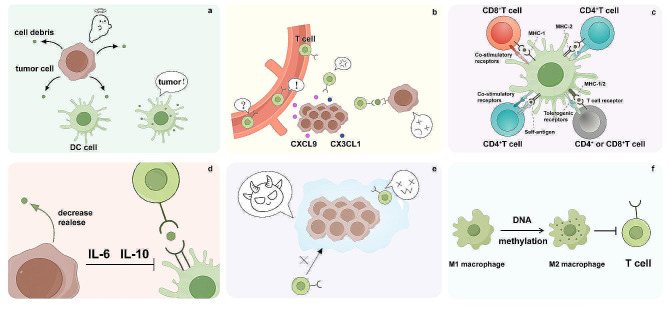
Fig. 1
Fig. 1
The tumor microenvironment (TME) resembles a battleground for promoting and suppressing tumor immunity. The process of tumor immunity includes: (1) tumor cell death and release of cell-associated antigens; (2) dendritic cells capturing and presenting antigens via the major histocompatibility complex (MHC) complex after processing; (3) activation of T cells by various cytokines; (4) recruitment of T cells to the tumor site via chemokines such as CX3CL1 (C-X-C motif chemokine), CXCL9, etc.; (5) infiltration of activated T cells into the tumor location; (6) recognition of corresponding tumor cells by activated T cells; (7) killing of tumor cells by T cells through secretion of granular enzymes, perforins, etc. Throughout this process, tumor cells develop various mechanisms to counteract immunity, such as a) reducing expression of highly immunogenic antigens; b) inducing dysfunction of dendritic cells and inhibiting their antigen-presenting ability through secretion of immunosuppressive factors (e.g., (IL)-6, IL-10); c) inhibiting T cell infiltration into the tumor; d) regulating the function of immunosuppressive cells like M2 macrophages and myeloid-derived suppressor cells (MDSCs); e) activating immunosuppressive signaling pathways and enhancing immunosuppressive metabolism, e.g., creating an acidic environment induced by anaerobic glycolysis
Fig. 2
Fig. 2
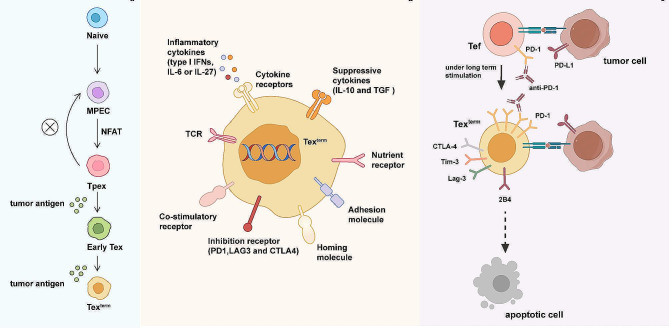
T cell exhaustion pathway (a) Steps by which T cell exhaustion occurs. (b) Specific receptors expressed by terminally exhausted T cells. (c) Differences and transformation conditions between terminally exhausted T cells and normal T cells in the tumor microenvironment
Fig. 3
Fig. 3
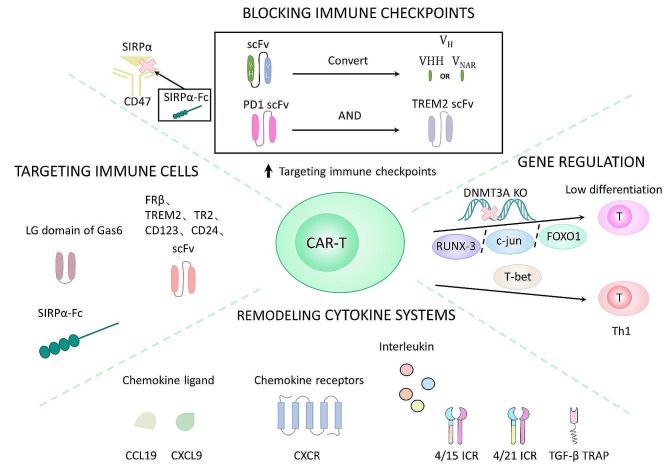
Enhancement strategy for the CAR-T framework. The structure of CAR-T cells is modified by blocking immune checkpoints, targeting immunosuppressive TAMs, reshaping the cytokine system, and regulating gene expression. Blocking the immune checkpoints primarily involves the CD47 and PD1 systems. Expressing scFv (single-chain variable fragments) of PD-1-TREM2 (triggering receptors expressed by myeloid cells) or converting scFv into the VH single domain (heavy chain only) can enhance the ability to block the PD1 immune checkpoint. The CD47 system blocks the CD47-SIRPα (signal regulatory protein α) pathway primarily through SIRPα-Fc expression. Remodeling cytokine systems include the expression of chemokine ligands, receptors, and pro-inflammatory factors producing 4/15ICR (IL-4 and IL-15 inverted cytokine receptor), 4/21ICR (IL-4 and IL-21 inverted cytokine receptor), and TGF-β (transforming growth factor-β) traps to alter the immunosuppressive factors IL-4 and TGF-β. Targeting immune cells is achieved by expressing the scFv of FRβ, TREM2, TR2 (tumor necrosis factor-related apoptosis-induced ligand-receptor 2), CD123, CD24, the Lg (laminin G-like) domain of GAS6 (growth arrest-specific protein 6), and SIRPα-Fc. Gene regulation includes the knockout of DNMT3A (DNA methyltransferase 3α) and overexpression of RUNX-3 (RUNX family transcription factor 3), FOXO1 (forkhead box protein O1), and c-JUN to promote the production of poorly differentiated T cells; overexpression of T-bet (T-box transcription factor) promotes the production of Th1 (T helper) pro-inflammatory cells
Fig. 4
Fig. 4
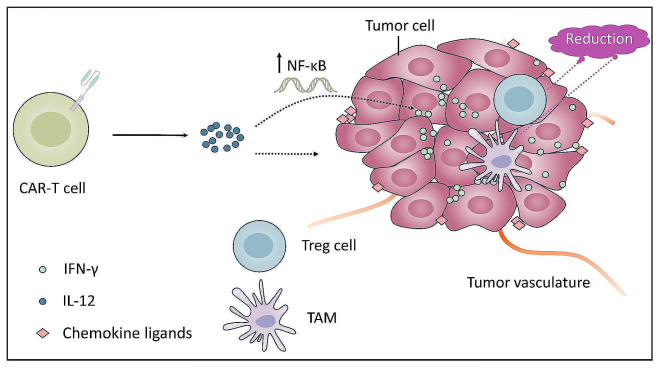
Effect of IL-12 on the TME. IL-12 reduces the number of Tregs and TAMs in the TME, while the increase of chemokine ligands can resist the inhibition of tumor blood vessels and promote T-cell infiltration. Simultaneously, the heightened release of IFN-γ, facilitated by IL-12 through the stimulation of NF-κB, is vital in eliminating cancerous cells
Fig. 5
Fig. 5
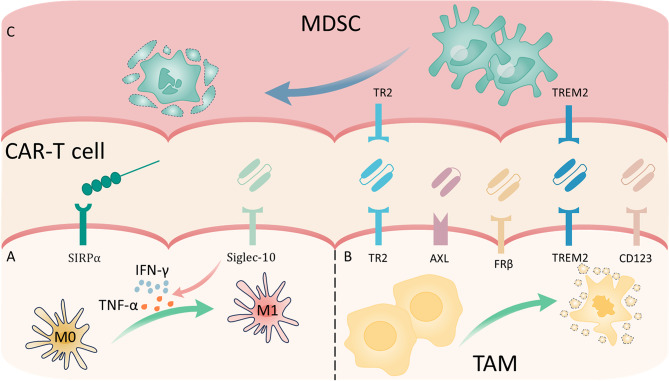
Measures to reshape the immunosuppressive cell composition in the tumor microenvironment (TME). (A) The CD47–SIRPα and CD24–SIGLEC pathways can be blocked by CAR-T cells, polarizing macrophages toward the M1 phenotype. TNF-α and IFN-γ secretion can be stimulated by blocking the CD24– SIGLEC-10 pathway, facilitating the differentiation of M1-like cells. (B) Binding targets on tumor-associated macrophages (TAMs) to single-chain Fv fragments (scFv) expressing agonistic TR2 (tumor necrosis factor-related apoptosis-induced ligand-receptor 2) antibody, FRβ, TREM2, CD123, or the Lg (laminin G-like) domain of GAS-6 can facilitate TAM elimination. (C) MDSCs can be depleted by scFv-expressing TREM2 and TR2 antibodies
Fig. 6
Fig. 6
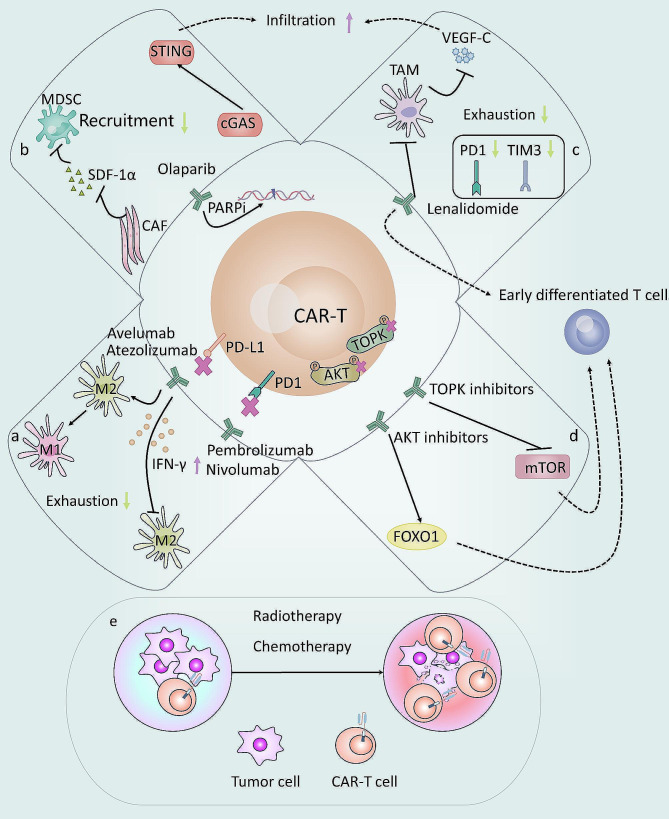
Impact of CAR-T combination treatment on the tumor microenvironment (TME) and CAR-T cells. (ad) Effects of the combined treatment of targeted drugs and CAR-T on the TME and CAR-T cells. (e) Chemotherapy or radiotherapy coupled with CAR-T enhances CAR-T cell penetration into tumors and reshapes the ITME into an immune-activated TME.

References

    1. Batlevi CL, Matsuki E, Brentjens RJ, Younes A. Novel immunotherapies in lymphoid malignancies. Nature reviews. Clin Oncol. 2016;13(1):25–40. - PMC - PubMed
    1. Montironi C, Muñoz-Pinedo C, Eldering E. Hematopoietic versus solid cancers and T cell dysfunction: looking for similarities and distinctions. Cancers (Basel). 2021;13(2):284. 10.3390/cancers13020284 - DOI - PMC - PubMed
    1. Frey NV, Porter DL. CAR T-cells merge into the fast lane of cancer care. Am J Hematol. 2016;91(1):146–50. 10.1002/ajh.24238 - DOI - PubMed
    1. Jena B, Moyes JS, Huls H, Cooper LJN. Driving CAR-Based T-Cell therapy to Success. Curr Hematol Malig Rep. 2014;9(1):50–6. 10.1007/s11899-013-0197-7 - DOI - PMC - PubMed
    1. Zhang Z, Wang T, Wang X, Zhang Y, Song S, Ma C. Improving the ability of CAR-T cells to hit solid tumors: challenges and strategies. Pharmacol Res. 2022;175:106036. 10.1016/j.phrs.2021.106036 - DOI - PubMed

MeSH terms

Substances

LinkOut - more resources