


Arsenical keratosis in China: A case report and review of the literature
- PMID: 39189802
- PMCID: PMC11348506
- DOI: 10.1111/srt.13903
Arsenical keratosis in China: A case report and review of the literature
Erratum in
-
Correction to "Arsenical Keratosis in China: A Case Report and Review of the Literature".Skin Res Technol. 2025 Oct;31(10):e70275. doi: 10.1111/srt.70275. Skin Res Technol. 2025. PMID: 41065313 Free PMC article. No abstract available.
Abstract
Background: Arsenical keratosis is a precancerous dermatosis which could be induced by long-term exposure to arsenic poisoning. Arsenic is often added to traditional Chinese medicine in a non-compliant manner to increase the effectiveness of psoriasis treatment, which is often the main cause of arsenic poisoning in Chinese patients with psoriasis.
Objectives: We performed a systemic review of arsenic keratosis during the past 32 years to better understand the sources, treatment, and prognosis of arsenic keratosis in China.
Methods: We searched Medline/PubMed, Embase, CNKI, and Wanfang databases for research studies published between 1992 and 2024. A total of 64 papers with 78 individual Chinese of arsenical keratosis were included in this analysis.
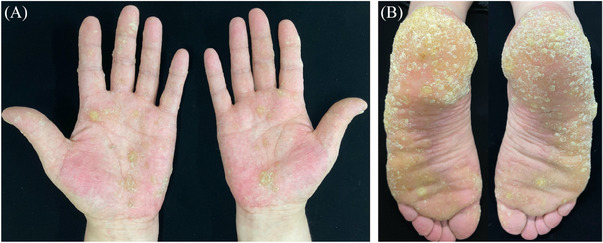
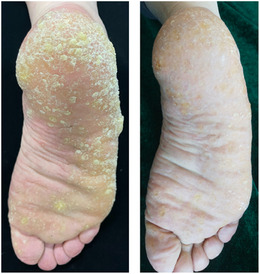
Results: Of the patients included in the analysis, 92.21% of arsenic poisoning was due to iatrogenic factors: Chinese traditional medicine. Seventy-six patients (98.70%) had skin manifestation of hyperkeratotic papules and plaques, 68 patients (88.31%) had hyperpigmentation, 43 cases (55.84%) had hypopigmentation, and only 4 had a clear indication of Mees' lines in nails. A total of 52.63% of patients presented with tumors, including squamous cell carcinoma, Bowen's disease, and basal cell carcinoma. For patients with tumors, 20 opted for surgery, 6 for radiotherapy, and 3 for PDT. All patients with only cutaneous tumors are currently well-controlled. Death occurred in one patient with metastatic squamous cell carcinoma. Keratinizing papules improved significantly in 70.59% of patients treated with Acitretin Capsules.
Conclusions: In this study, arsenic sources in Chinese patients were mainly from traditional Chinese medicine, and there were no reports of exposure to water sources or occupational sources in the past 32 years. Most of the patients showed keratinizing papules and pigmentation, and more than 1/2 of the patients showed skin tumors, mainly squamous cell carcinoma. The treatments of tumors are mainly surgical treatment, PDT and radiotherapy can also be selected. The improvement in keratinizing rash was greater than 70% with acitretin capsules. Patients with this disease should be regularly followed up for early detection and timely treatment of potential malignant tumors.
Keywords: arsenic poisoning; arsenical keratosis; traditional Chinese medicine.
© 2024 The Author(s). Skin Research and Technology published by John Wiley & Sons Ltd.
Conflict of interest statement
The authors declare no conflicts of interest.
Figures
References
-
- Shajil C, Chen P, Mahabal GD. Arsenical Keratosis. StatPearls Publishing; Accessed online August 11, 2022.
-
- Hanjani NM, Fender AB, Mercurio MG. Chronic arsenicism from Chinese herbal medicine. Cutis. 2007; 80:305‐308. - PubMed
Publication types
MeSH terms
Substances
LinkOut - more resources
Full Text Sources
Medical
Miscellaneous
