


Ketone monoester attenuates oxygen desaturation during weighted ruck exercise under acute hypoxic exposure but does not impact cognitive performance
- PMID: 39190570
- PMCID: PMC11442785
- DOI: 10.1113/EP091789
Ketone monoester attenuates oxygen desaturation during weighted ruck exercise under acute hypoxic exposure but does not impact cognitive performance
Abstract
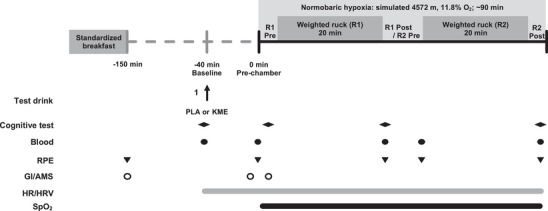
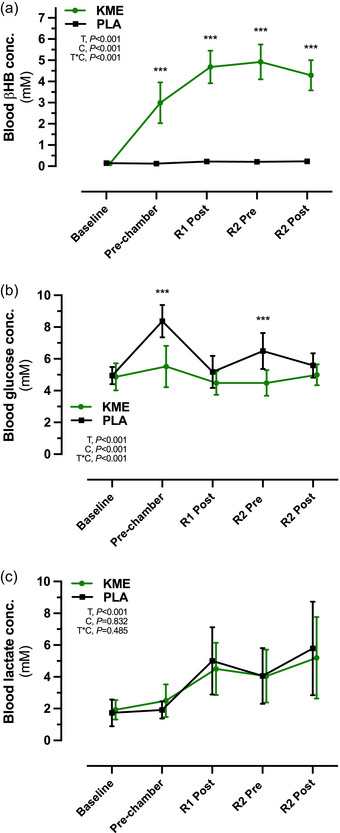
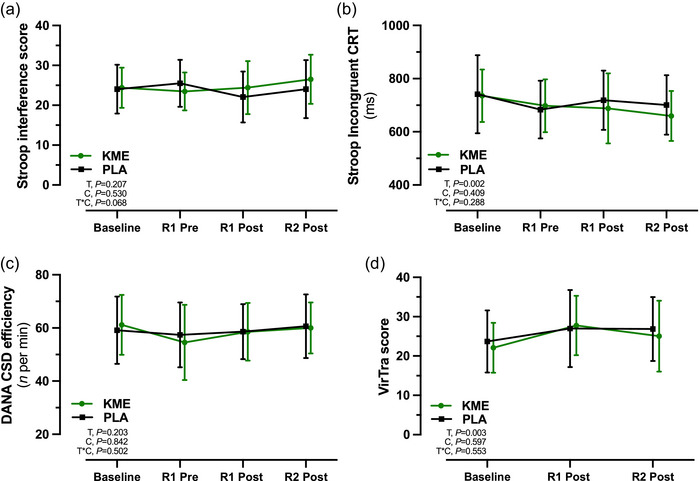
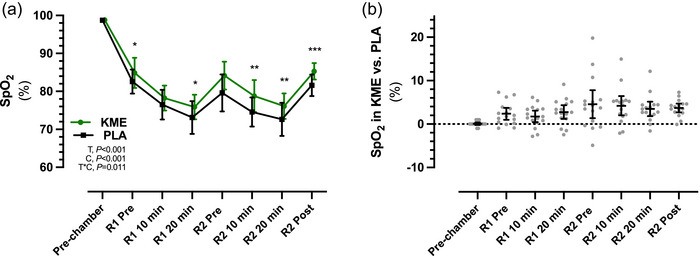
Acute ingestion of exogenous ketone supplements in the form of a (R)-3-hydroxybutyl (R)-3-hydroxybutyrate (R-BD R-βHB) ketone monoester (KME) can attenuate declines in oxygen availability during hypoxic exposure and might impact cognitive performance at rest and in response to moderate-intensity exercise. In a single-blind randomized crossover design, 16 males performed assessments of cognitive performance before and during hypoxic exposure with moderate exercise [2 × 20 min weighted ruck (∼22 kg) at 3.2 km/h at 10% incline] in a normobaric altitude chamber (4572 m, 11.8% O2). The R-BD R-βHB KME (573 mg/kg) or a calorie- and taste-matched placebo (∼50 g maltodextrin) were co-ingested with 40 g of dextrose before exposure to hypoxia. The R-βHB concentrations were rapidly elevated and sustained (>3 mM; P < 0.001) by KME. The decline in oxygen saturation during hypoxic exposure was attenuated in KME conditions by 2.4%-4.2% (P < 0.05) compared with placebo. Outcomes of cognitive performance tasks, in the form of the Defense Automated Neurobehavioral Assessment (DANA) code substitution task, the Stroop color and word task, and a shooting simulation, did not differ between trials before and during hypoxic exposure. These data suggest that the acute exogenous ketosis induced by KME ingestion can attenuate declining blood oxygen saturation during acute hypoxic exposure both at rest and during moderate-intensity exercise, but this did not translate into differences in cognitive performance before or after exercise in the conditions investigated.
Keywords: cognitive performance; exogenous ketones; heart rate variability; oxygen saturation; β‐hydroxybutyrate.
© 2024 The Author(s). Experimental Physiology published by John Wiley & Sons Ltd on behalf of The Physiological Society.
Conflict of interest statement
HVMN Inc. had no involvement in data collection, analysis, or data interpretation. T.S.M., J.P., K.C., E.C., D.K., B.E. and M.M.B. declare no conflicts of interest and do not have any financial disclosures. B.J.S. has stock and stock options in companies that produce ketone products (HVMN Inc., Juvenescence Ltd, BHB Therapeutics Ltd and Selah Ltd) and is an inventor on patents that relate to ketone bodies. B.J.S. was an employee of HVMN Inc. at the time this study was conceived. G.R.C. participates on Data and Safety Monitoring Boards for Applied Therapeutics, AI therapeutics, AMO Pharma, Astra‐Zeneca, Avexis Pharmaceuticals, Bristol Meyers Squibb/Celgene, CSL Behring, Horizon Pharmaceuticals, Immunic, Karuna Therapeutics, Kezar Life Sciences, Mapi Pharmaceuticals Ltd, Merck, Mitsubishi Tanabe Pharma Holdings, Opko Biologics, Prothena Biosciences, Novartis, Regeneron, Sanofi‐Aventis, Reata Pharmaceuticals, Teva Pharmaceuticals, NHLBI (Protocol Review Committee), University of Texas Southwestern, University of Pennsylvania and Visioneering Technologies, Inc. G.R.C. participates as a consultant or Advisory Board member for Alexion, Antisense Therapeutics, Avotres, Biogen, Clene Nanomedicine, Clinical Trial Solutions LLC, Entelexo Biotherapeutics, Inc., Genzyme, Genentech, GW Pharmaceuticals, Hoya Corporation, Immunic, Immunosis Pty Ltd, Klein‐Buendel Inc., Linical, Merck/Serono, Novartis, Perception Neurosciences, Protalix Biotherapeutics, Regeneron, Roche and SAB Biotherapeutics. G.R.C. is President of Pythagoras Inc., a private consulting company located in Birmingham, AL, USA. A.P.K. is a patent inventor (US11452704B2 and US11596616B2) and is on the Scientific Advisory Board for Simply Good Foods and Nutrishus. Any opinions, findings and conclusions or recommendations expressed in this material are those of the authors and do not necessarily reflect the views of the United States Special Operations Command or the United States Department of Defense.
Figures
References
-
- Ando, S. , Komiyama, T. , Sudo, M. , Higaki, Y. , Ishida, K. , Costello, J. T. , & Katayama, K. (2020). The interactive effects of acute exercise and hypoxia on cognitive performance: A narrative review. Scandinavian Journal of Medicine & Science in Sports, 30(3), 384–398. - PubMed
-
- Asmaro, D. , Mayall, J. , & Ferguson, S. (2013). Cognition at altitude: Impairment in executive and memory processes under hypoxic conditions. Aviation, Space, and Environmental Medicine, 84(11), 1159–1165. - PubMed
-
- Beer, J. M. A. , Shender, B. S. , Chauvin, D. , Dart, T. S. , & Fischer, J. (2017). Cognitive deterioration in moderate and severe hypobaric hypoxia conditions. Aerospace Medicine and Human Performance, 88(7), 617–626. - PubMed
-
- Bradwell, A. R. , Ashdown, K. , Rue, C. , Delamere, J. , Thomas, O. D. , Lucas, S. J. E. , Wright, A. D. , Harris, S. J. , & Myers, S. D. (2018). Acetazolamide reduces exercise capacity following a 5‐day ascent to 4559 m in a randomised study. British Medical Journal Open Sport — Exercise Medicine, 4(1), e000302. - PMC - PubMed
-
- Brady, A. J. , & Egan, B. (2024). Acute ingestion of a ketone monoester without co‐ingestion of carbohydrate improves running economy in male endurance runners. Medicine & Science in Sports & Exercise, 56(1), 134–142. - PubMed
Publication types
MeSH terms
Substances
Grants and funding
LinkOut - more resources
Full Text Sources
Medical
Miscellaneous
