


Clinical and cognitive outcomes in first-episode psychosis: focus on the interplay between cannabis use and genetic variability in endocannabinoid receptors
- PMID: 39193030
- PMCID: PMC11348434
- DOI: 10.3389/fpsyg.2024.1414098
Clinical and cognitive outcomes in first-episode psychosis: focus on the interplay between cannabis use and genetic variability in endocannabinoid receptors
Abstract
Introduction: Research data show the impact of the endocannabinoid system on psychosis through its neurotransmission homeostatic functions. However, the effect of the endocannabinoid system genetic variability on the relationship between cannabis use and psychosis has been unexplored, even less in first-episode patients. Here, through a case-only design, we investigated the effect of cannabis use and the genetic variability of endocannabinoid receptors on clinical and cognitive outcomes in first-episode psychosis (FEP) patients.
Methods: The sample comprised 50 FEP patients of European ancestry (mean age (sd) = 26.14 (6.55) years, 76% males), classified as cannabis users (58%) or cannabis non-users. Two Single Nucleotide Polymorphisms (SNP) were genotyped at the cannabinoid receptor type 1 gene (CNR1 rs1049353) and cannabinoid receptor type 2 gene (CNR2 rs2501431). Clinical (PANSS, GAF) and neuropsychological (WAIS, WMS, BADS) assessments were conducted. By means of linear regression models, we tested the main effect of cannabis use and its interaction with the polymorphic variants on the clinical and cognitive outcomes.
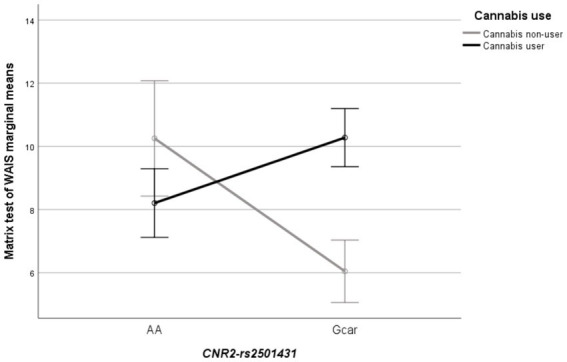
Results: First, as regards cannabis effects, our data showed a trend towards more severe positive symptoms (PANSS, p = 0.05) and better performance in manipulative abilities (matrix test-WAIS, p = 0.041) among cannabis users compared to non-users. Second, concerning the genotypic effects, the T allele carriers of the CNR1 rs1049353 presented higher PANSS disorganization scores than CC homozygotes (p = 0.014). Third, we detected that the observed association between cannabis and manipulative abilities is modified by the CNR2 polymorphism (p = 0.022): cannabis users carrying the G allele displayed better manipulative abilities than AA genotype carriers, while the cannabis non-users presented the opposite genotype-performance pattern. Such gene-environment interaction significantly improved the overall fit of the cannabis-only model (Δ-R2 = 8.4%, p = 0.019).
Discussion: Despite the preliminary nature of the sample, our findings point towards the role of genetic variants at CNR1 and CNR2 genes in the severity of the disorganized symptoms of first-episode psychosis and modulating cognitive performance conditional to cannabis use. This highlights the need for further characterization of the combined role of endocannabinoid system genetic variability and cannabis use in the understanding of the pathophysiology of psychosis.
Keywords: cannabinoid receptors genes (CNR1 and CNR2); cannabis; cognition; first episode psychosis; symptoms.
Copyright © 2024 Oscoz-Irurozqui, Guardiola-Ripoll, Almodóvar-Payá, Guerrero-Pedraza, Hostalet, Carrion, Sarró, Gomar, Pomarol-Clotet and Fatjó-Vilas.
Conflict of interest statement
The authors declare that the research was conducted in the absence of any commercial or financial relationships that could be construed as a potential conflict of interest.
Figures
References
-
- Baeza I., Graell M., Moreno D., Castro-Fornieles J., Parellada M., González-Pinto A., et al. (2009). Cannabis use in children and adolescents with first episode psychosis: influence on psychopathology and short-term outcome (CAFEPS study). Schizophr. Res. 113, 129–137. doi: 10.1016/j.schres.2009.04.005, PMID: - DOI - PubMed
-
- Bioque M., Mas S., Costanzo M. C., Cabrera B., Lobo A., González-Pinto A., et al. (2019). Gene-environment interaction between an endocannabinoid system genetic polymorphism and cannabis use in first episode of psychosis. Eur. Neuropsychopharmacol. 29, 786–794. doi: 10.1016/j.euroneuro.2019.04.005, PMID: - DOI - PubMed
LinkOut - more resources
Full Text Sources
