Review
. 2024 Jul 24;5(1):iqae008.
doi: 10.1093/oxfimm/iqae008. eCollection 2024.

The gut-lung axis: the impact of the gut mycobiome on pulmonary diseases and infections

Affiliations
Review

The gut-lung axis: the impact of the gut mycobiome on pulmonary diseases and infections

Emily A Sey et al. Oxf Open Immunol. .

Abstract

The gastrointestinal tract contains a diverse microbiome consisting of bacteria, fungi, viruses and archaea. Although these microbes usually reside as commensal organisms, it is now well established that higher abundance of specific bacterial or fungal species, or loss of diversity in the microbiome can significantly affect development, progression and outcomes in disease. Studies have mainly focused on the effects of bacteria, however, the impact of other microbes, such as fungi, has received increased attention in the last few years. Fungi only represent around 0.1% of the total gut microbial population. However, key fungal taxa such as Candida, Aspergillus and Wallemia have been shown to significantly impact health and disease. The composition of the gut mycobiome has been shown to affect immunity at distal sites, such as the heart, lung, brain, pancreas, and liver. In the case of the lung this phenomenon is referred to as the 'gut-lung axis'. Recent studies have begun to explore and unveil the relationship between gut fungi and lung immunity in diseases such as asthma and lung cancer, and lung infections caused by viruses, bacteria and fungi. In this review we will summarize the current, rapidly growing, literature describing the impact of the gut mycobiome on respiratory disease and infection.

Keywords: Mycobiome; gut-lung axis; lung infections.


Figures

Graphical Abstract
Graphical Abstract
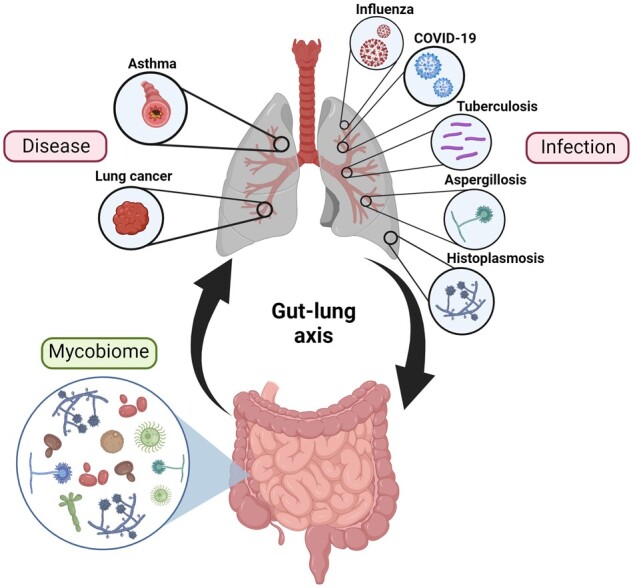
The gut-lung axis: the impact of the gut mycobiome on pulmonary diseases and infections. Fungal constituents of the gut microbiome, known as the mycobiome, can influence disease in the lung. Additionally, patients with lung disease have altered mycobiome compared to healthy individuals. This bidirectional communication is known as the gut-lung axis. Gut fungi have been shown to impact development, progression and outcome of diseases including asthma and lung cancer, viral infections including influenza and COVID-19, bacterial infections such as tuberculosis, and fungal infections including aspergillosis and histoplasmosis
Figure 1.
Figure 1.
Gut mycobiome effects on allergic airway disease. Relative abundance of various fungal taxa can occur in the gut through various factors including oral antibiotics and antifungals. The relative abundance of specific fungi in the gut is linked to severity and susceptibility to allergic airway disease. Overgrowth of Candida species increases susceptibility to allergic airway disease induced by A. fumigatus and house dust mite (HDM) sensitization. In response to A. fumigatus sensitization, mice with overgrowth of Candida in the gut show increased eosinophils (E), mast cells (MC), and Th2 cells in the lung. Furthermore, in humans, Th17 cells have been isolated from asthma patients that show cross-reactivity against C. albicans and A. fumigatus. Sensitization with HDM in mice promotes influx of innate lymphoid cells 2 (ILC2s) which influence Th2 cells in the lung. Oral antifungals such as fluconazole increase abundance of Aspergillus amstelodami, Epicoccum nigrum, and Wallemia sebi which increase allergic airway disease susceptibility following HDM sensitization. The cells involved in this response are unknown. However, high abundance of W. mellicola in the gut induces Th2, Th17 and IgE responses in the lung following HDM induced sensitization in mice. In humans, infants with high abundance of Candida and Rhodotorula in the gut have increased risk of asthma in childhood. Created with BioRender.com

References

    1. Qin J, Li R, Raes J. et al. A human gut microbial gene catalogue established by metagenomic sequencing. Nature 2010;464:59–65. - PMC - PubMed
    1. Jangi S, Hsia K, Zhao N. et al. Dynamics of the gut mycobiome in patients with ulcerative colitis. Clin Gastroenterol Hepatol 2023;22:821–30.e7. - PMC - PubMed
    1. Yu S, Ge X, Xu H. et al. Gut microbiome and mycobiome in inflammatory bowel disease patients with Clostridioides difficile infection. Front Cell Infect Microbiol 2023;13:1129043. - PMC - PubMed
    1. Krawczyk A, Salamon D, Kowalska-Duplaga K. et al. Changes in the gut mycobiome in pediatric patients in relation to the clinical activity of Crohn's disease. World J Gastroenterol 2023;29:2172–87. - PMC - PubMed
    1. Coker OO, Nakatsu G, Dai RZ. et al. Enteric fungal microbiota dysbiosis and ecological alterations in colorectal cancer. Gut 2019;68:654–62. - PMC - PubMed

LinkOut - more resources