. 2024 Jul 24;15(8):204.
doi: 10.3390/jfb15080204.

Physico-Mechanical Properties and Bonding Performance of Graphene-Added Orthodontic Adhesives

Affiliations

Physico-Mechanical Properties and Bonding Performance of Graphene-Added Orthodontic Adhesives

Shiyao Liu et al. J Funct Biomater. .

Abstract

This study aimed to assess the key physico-mechanical properties and bonding performance of orthodontic adhesives with graphene addition for bonding a fixed retainer. Transbond LR (3M) and Transbond LV (3M) with no graphene were set as the control groups. Graphene was added into LR and LV at concentrations of 0.01 wt%, 0.05 wt% and 0.1 wt%. The stickiness of the uncured samples (n = 5) and real-time degree of conversion (DC) of the samples (n = 3) were measured over a 24-h period using Fourier-transform infrared spectroscopy. The hardness and other mechanical parameters, including the Martens hardness (HM), indentation modulus (EIT), elastic index (ηIT) and creep (CIT), were measured (n = 5). To measure the shear bond strength (SBS), adhesive composites were applied using a mold to bond the retainer wire to the lingual surfaces of bovine incisors (n = 10). Fracture modes subsequent to the SBS test were examined under light microscopy. Statistical analysis was conducted using ANOVA and Tukey tests (α = 0.05). In the LR groups, the LR + 0.01 showed the highest SBS (12.6 ± 2.0 MPa) and HM (539.4 ± 17.9 N/mm2), while the LV + 0.05 (7.7 ± 1.1 MPa) had the highest SBS and the LV + 0.1 had the highest HM (312.4 ± 17.8 N/mm2) among the LV groups. The most frequent failure mode observed was adhesive fracture followed by mixed fracture. No statistical difference was found between the graphene-added groups and the control groups in terms of the EIT, ηIT and CIT, except that the CIT was significantly lower in the LR + 0.01 than in the control group. Graphene addition had no significant adverse effect on the stickiness and DC of both LR and LV.

Keywords: bonding strength; degree of conversion; graphene; orthodontic adhesives; retainer; stickiness.


Conflict of interest statement

The authors declare no conflicts of interest.

Figures

Figure 1
Figure 1
Schematic diagram of the texture analyzer used to measure the stickiness.
Figure 2
Figure 2
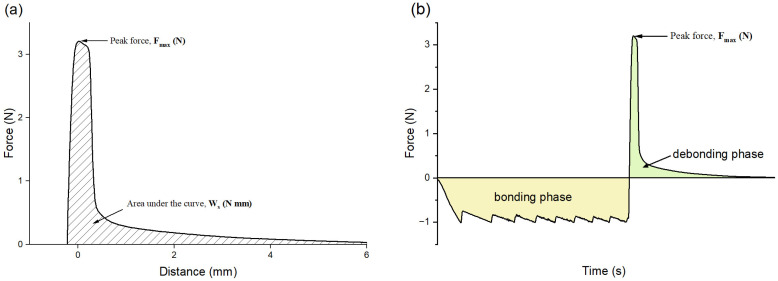
Representative diagrams showing the measurement of stickiness. (a) Force–distance curve, (b) force–time curve.
Figure 3
Figure 3
Differences in (a). Fmax and (b). Ws. Within each material, significant differences between graphene concentrations are indicated by different lower-case letters. Within each graphene concentration, significant differences between materials are indicated by different upper-case letters.
Figure 4
Figure 4
DC (%) as a function of log-time up to 24 h for (a) LR, (b) LV.
Figure 5
Figure 5
Mean and standard deviation values of (a). Martens hardness (HM), (b). indentation modulus (EIT), (c). elastic index (ηIT), (d). creep (CIT). Within each material, significant differences between graphene concentrations are indicated by different lower-case letters. Within each graphene concentration, significant differences between materials are indicated by different upper-case letters.
Figure 6
Figure 6
Mean and standard deviation values of shear bond strength (SBS). Within each material, significant differences between graphene concentrations are indicated by different lower-case letters. Within each graphene concentration, significant differences between materials are indicated by different upper-case letters.
Figure 7
Figure 7
Representative SEM images after SBS test. (a). Fractured orthodontic adhesive after cohesive resin failure, (b) mixed failure, blue arrow showing the enamel surface and the red arrow showing the remained orthodontic adhesive, (c) surface of retainer, retainer, red arrow showing the remained orthodontic adhesive.

References

    1. Zachrisson B.U. Long-term experience with direct-bonded retainers: Update and clinical advice. J. Clin. Orthod. 2007;41:728–737. - PubMed
    1. Kartal Y., Kaya B. Fixed Orthodontic Retainers: A Review. Turk. J. Orthod. 2019;32:110–114. doi: 10.5152/TurkJOrthod.2019.18080. - DOI - PMC - PubMed
    1. Kucera J., Littlewood S.J., Marek I. Fixed retention: Pitfalls and complications. Br. Dent. J. 2021;230:703–708. doi: 10.1038/s41415-021-2892-4. - DOI - PubMed
    1. Dietrich P., Patcas R., Pandis N., Eliades T. Long-term follow-up of maxillary fixed retention: Survival rate and periodontal health. Eur. J. Orthod. 2015;37:37–42. doi: 10.1093/ejo/cju001. - DOI - PubMed
    1. Jedliński M., Grocholewicz K., Mazur M., Janiszewska-Olszowska J. What causes failure of fixed orthodontic retention?—Systematic review and meta-analysis of clinical studies. Head Face Med. 2021;17:32. doi: 10.1186/s13005-021-00281-3. - DOI - PMC - PubMed

LinkOut - more resources