


Psychometric Reliability to Assess the Perception of Women's Fulfillment of Maternity Rights
- PMID: 39194944
- PMCID: PMC11353840
- DOI: 10.3390/ejihpe14080150
Psychometric Reliability to Assess the Perception of Women's Fulfillment of Maternity Rights
Abstract
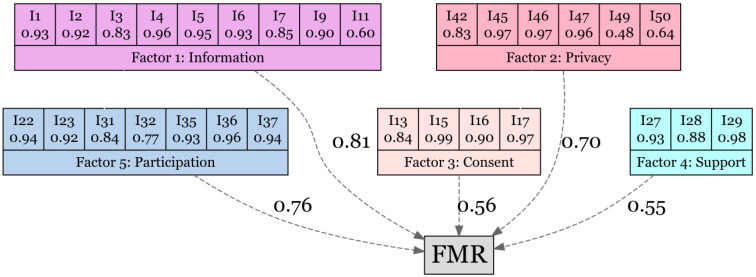
The fulfillment of rights to maternal healthcare is a key factor for the wellbeing of women. However, there is a lack of an instrument to ascertain the experience of women during maternity to enable adequate monitoring. The aim of this study was to validate a new instrument to measure women's perception of the fulfillment of rights during healthcare in pregnancy and childbirth and immediately postpartum. The initial version of the instrument consists of 50 items and was validated using exploratory factor analysis. Additionally, the final version of the instrument consists of 29 items and was validated by confirmatory factor analysis and known-group validity. The instrument was applied to 185 Spanish women. The global Aiken's V of the initial instrument proposal was 0.89. The process resulted in an instrument with five factors (information, privacy, consent, support, and participation) that explained the 60% of the total variance. The score of the instrument was correlated with resilience, maternity beliefs, and positive and negative affect. External validation showed relations with age, gravida, and the number of times a woman has been in labor. Additionally, the Cronbach's α reliability was 0.93 [0.91; 0.94]. In conclusion, the instrument developed is consistent and has appropriate psychometric properties for assessing the fulfillment rights of maternity healthcare.
Keywords: healthcare during pregnancy; maternity rights; perception of fulfillment; vulnerability.
Conflict of interest statement
The authors declare no conflicts of interest.
Figures
References
-
- Bohren M.A., Vogel J.P., Hunter E.C., Lutsiv O., Makh S.K., Souza J.P., Aguiar C., Saraiva Coneglian F., Diniz A.L.A., Tunçalp Ö., et al. The Mistreatment of Women during Childbirth in Health Facilities Globally: A Mixed-Methods Systematic Review. PLoS Med. 2015;12:e1001847. doi: 10.1371/journal.pmed.1001847. - DOI - PMC - PubMed
-
- Silva-Fernandez C.S., de la Calle M., Arribas S.M., Garrosa E., Ramiro-Cortijo D. Factors Associated with Obstetric Violence Implicated in the Development of Postpartum Depression and Post-Traumatic Stress Disorder: A Systematic Review. Nurs. Rep. 2023;13:1553–1576. doi: 10.3390/nursrep13040130. - DOI - PMC - PubMed
-
- Lukasse M., Schroll A., Karro H., Schei B., Steingrimsdottir T., Van Parys A., Ryding E.L., Tabor A. Prevalence of Experienced Abuse in Healthcare and Associated Obstetric Characteristics in Six European Countries. Acta Obstet. Gynecol. Scand. 2015;94:508–517. doi: 10.1111/aogs.12593. - DOI - PubMed
LinkOut - more resources
Full Text Sources
