Differential increase of hippocampal subfield volume after socio-affective mental training relates to reductions in diurnal cortisol
- PMID: 39196261
- PMCID: PMC11357357
- DOI: 10.7554/eLife.87634
Differential increase of hippocampal subfield volume after socio-affective mental training relates to reductions in diurnal cortisol
Abstract
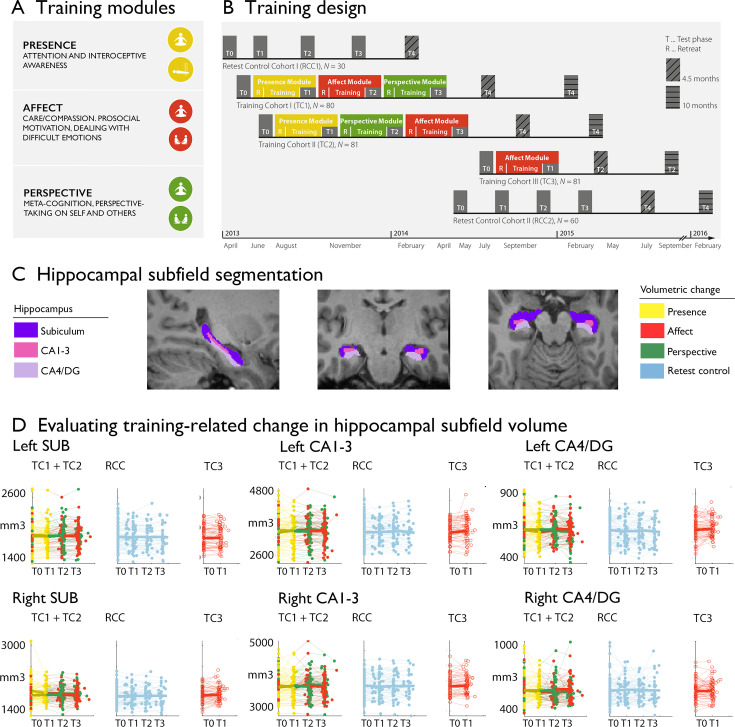
The hippocampus is a central modulator of the HPA-axis, impacting the regulation of stress on brain structure, function, and behavior. The current study assessed whether three different types of 3 months mental Training Modules geared towards nurturing (a) attention-based mindfulness, (b) socio-affective, or (c) socio-cognitive skills may impact hippocampal organization by reducing stress. We evaluated mental training-induced changes in hippocampal subfield volume and intrinsic functional connectivity, by combining longitudinal structural and resting-state fMRI connectivity analysis in 332 healthy adults. We related these changes to changes in diurnal and chronic cortisol levels. We observed increases in bilateral cornu ammonis volume (CA1-3) following the 3 months compassion-based module targeting socio-affective skills (Affect module), as compared to socio-cognitive skills (Perspective module) or a waitlist cohort with no training intervention. Structural changes were paralleled by relative increases in functional connectivity of CA1-3 when fostering socio-affective as compared to socio-cognitive skills. Furthermore, training-induced changes in CA1-3 structure and function consistently correlated with reductions in cortisol output. Notably, using a multivariate approach, we found that other subfields that did not show group-level changes also contributed to changes in cortisol levels. Overall, we provide a link between a socio-emotional behavioural intervention, changes in hippocampal subfield structure and function, and reductions in cortisol in healthy adults.
Keywords: cortisol; hippocampus; human; mental training; neuroscience; structure-function.
Plain language summary
Too much stress is harmful to the brain and overall health, as it can lead to chronically high levels of the stress hormone cortisol. The part of the brain that regulates memory and emotions, called the hippocampus, is especially sensitive to stress because it has a high number of receptors that bind to cortisol. This connection may explain why stress can lead to memory lapses or strong emotions. Studies have shown that mental training exercises, such as mindfulness and meditation, may change the structure of the brain and reduce stress. However, the results from these experiments have been mixed due to the variation in mental practices used by different programs. Here, Valk, Engert et al. set out to find how distinct types of mental training affect the brain, focusing on the hippocampus and cortisol levels. The team used various magnetic resonance imaging techniques to study the hippocampus of 322 healthy adult volunteers who had undergone three months of mental training. The relationship between mental training, hippocampus size, and stress levels was complex when studying the results of each individual. However, when the results were grouped together, it revealed that volunteers who underwent training to increase empathy and compassion experienced expansion in parts of their hippocampus. As these areas of the brain increased in size, these individuals experienced corresponding reductions in cortisol levels. But volunteers who underwent mental training focused on attention or developing perspective did not experience such increases. These findings suggest that mental training to increase empathy and compassion alters brain structure and lowers cortisol levels. Future studies may explain how this happens, which could lead to improved mental training programs for mitigating stress.
© 2023, Valk, Engert et al.
Conflict of interest statement
SV, VE, LP, RL, BC, AB, NB, BB, TS No competing interests declared
Figures


Update of
- doi: 10.1101/2023.03.03.531039
- doi: 10.7554/eLife.87634.1
- doi: 10.7554/eLife.87634.2
- doi: 10.7554/eLife.87634.3
References
-
- Almeida DM. Resilience and vulnerability to daily stressors assessed via diary methods. Current Directions in Psychological Science. 2005;14:64–68. doi: 10.1111/j.0963-7214.2005.00336.x. - DOI
MeSH terms
Substances
Grants and funding
LinkOut - more resources
Full Text Sources
Medical
Research Materials
Miscellaneous