


Does repetitive transcranial magnetic stimulation have a beneficial effect on improving unilateral spatial neglect caused by stroke? A meta-analysis
- PMID: 39196395
- PMCID: PMC11446973
- DOI: 10.1007/s00415-024-12612-w
Does repetitive transcranial magnetic stimulation have a beneficial effect on improving unilateral spatial neglect caused by stroke? A meta-analysis
Abstract
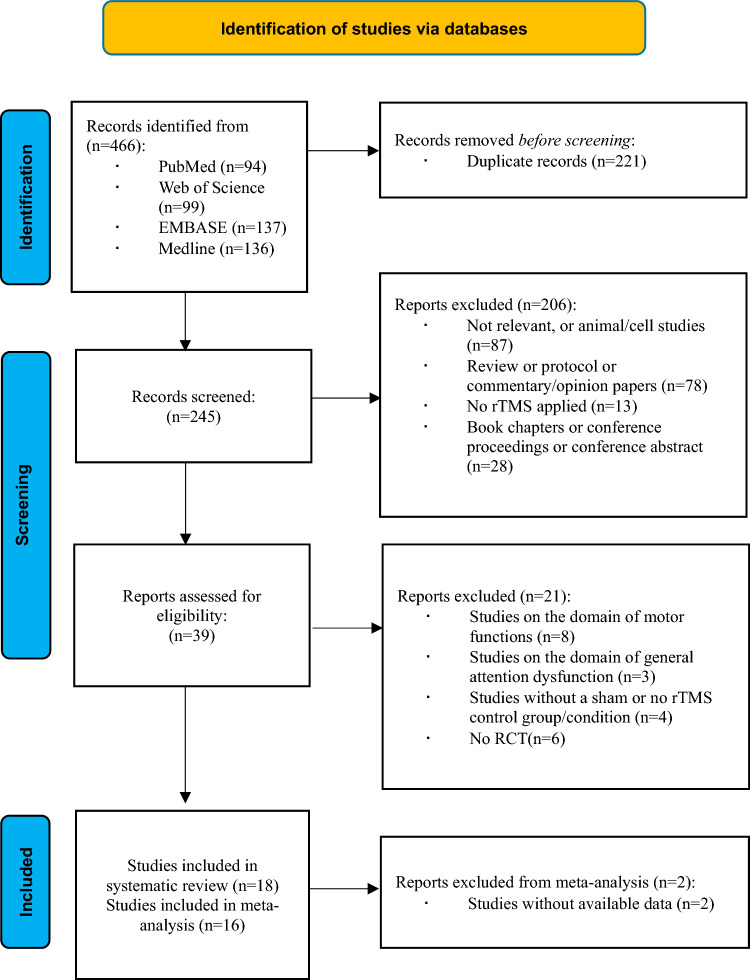
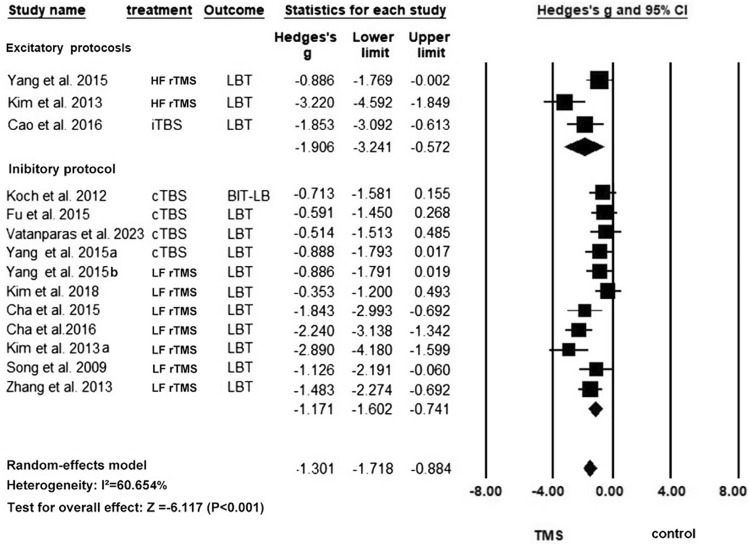
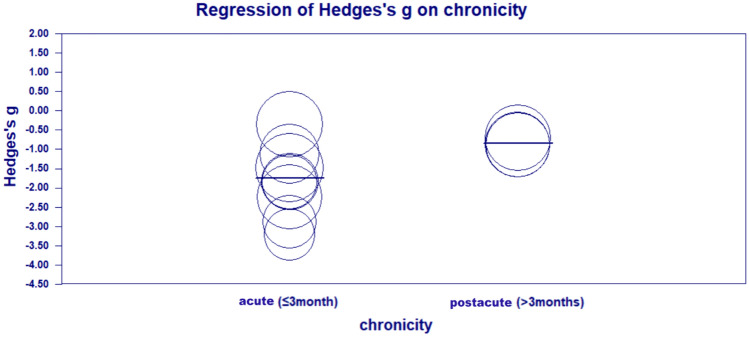
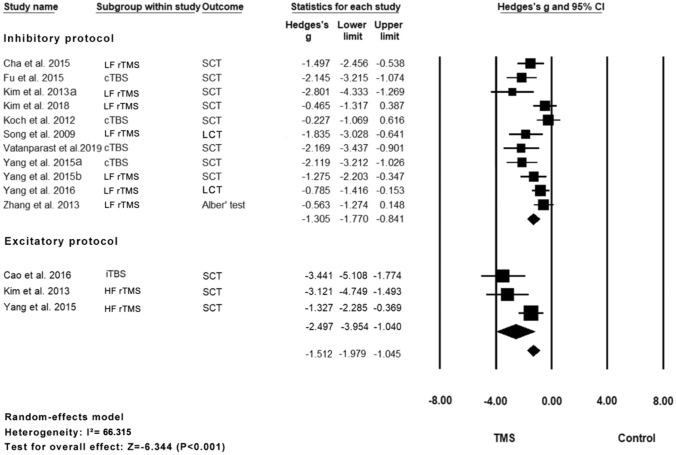
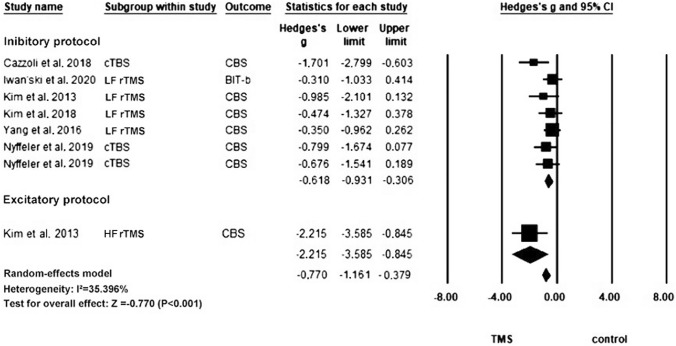
This review aimed to assess the effect of repetitive transcranial magnetic stimulation (rTMS) in improving post-stroke unilateral spatial neglect (USN) using a meta-analysis. Further, we aimed to identify any association between rTMS parameters, patient demographics, and treatment effect sizes using subgroup analyses and meta-regression. A literature search was conducted through four databases from inception to March 6, 2024, to retrieve all relevant controlled trials investigating the effects of rTMS on symptoms of USN in post-stroke patients. Overall, rTMS significantly improved post-stroke USN, as measured by the line bisection test (Hedges' g = - 1.301, p < 0.0001), the cancelation test (Hedge's g = - 1.512, p < 0.0001), and the Catherine Bergego Scale (Hedges'g = - 0.770, p < 0.0001), compared to sham stimulation. Subgroup analysis found that generally larger effect sizes following excitatory rTMS across several outcome measures, indicating that excitatory rTMS on the ipsilesional hemisphere may be more effective than inhibitory rTMS on the contralesional hemisphere in ameliorating neglect symptoms. Meta-regression analysis of the line bisection test showed a significant difference in the chronicity of stroke patients, suggesting that rTMS may be more effective for USN in patients at the acute stage (within 3 months since stroke) than in those at the post-acute stage (p = 0.035). In conclusion, rTMS appears to be effective in promoting recovery from post-stroke USN. Excitatory protocols and early intervention may enhance recovery outcomes for neglect behaviors in post-stroke survivors.
Keywords: Meta-analysis; Rehabilitation; Repetitive transcranial magnetic stimulation; Stroke; Unilateral spatial neglect.
© 2024. The Author(s).
Conflict of interest statement
None.
Figures
References
-
- Bisiach E (1993) Mental representation in unilateral neglect and related disorders: the twentieth Bartlett memorial lecture. Q J Exp Psychol A Human Exp Psychol 46:435–461 - PubMed
-
- Borenstein M, Hedges LV, Higgins JP, Rothstein HR (2010) A basic introduction to fixed-effect and random-effects models for meta-analysis. Res Synth Methods 1:97–111 - PubMed
-
- Cao L, Fu W, Zhang Y, Huo S, Du J, Zhu L, Song W (2016) Intermittent θ burst stimulation modulates resting-state functional connectivity in the attention network and promotes behavioral recovery in patients with visual spatial neglect. NeuroReport 27:1261–1265 - PubMed
-
- Carson RG (2020) Inter-hemispheric inhibition sculpts the output of neural circuits by co-opting the two cerebral hemispheres. J Physiol 598:4781–4802 - PubMed
Publication types
MeSH terms
Grants and funding
LinkOut - more resources
Full Text Sources
Medical
