. 2024 Aug 28;15(1):7431.
doi: 10.1038/s41467-024-51751-6.

Genome-wide DNA methylation profiling in blood reveals epigenetic signature of incident acute coronary syndrome

Affiliations

Genome-wide DNA methylation profiling in blood reveals epigenetic signature of incident acute coronary syndrome

Pinpin Long et al. Nat Commun. .

Abstract

DNA methylation (DNAm) has been implicated in acute coronary syndrome (ACS), but the causality remains unclear in cross-sectional studies. Here, we conduct a prospective epigenome-wide association study of incident ACS in two Chinese cohorts (discovery: 751 nested case-control pairs; replication: 476 nested case-control pairs). We identified and validated 26 differentially methylated positions (DMPs, false discovery rate [FDR] <0.05), including three mapped to known cardiovascular disease genes (PRKCZ, PRDM16, EHBP1L1) and four with causal evidence from Mendelian randomization (PRKCZ, TRIM27, EMC2, EHBP1L1). Two hypomethylated DMPs were negatively correlated with the expression in blood of their mapped genes (PIGG and EHBP1L1), which were further found to overexpress in leukocytes and/or atheroma plaques. Finally, our DMPs could substantially improve the prediction of ACS over traditional risk factors and polygenic scores. These findings demonstrate the importance of DNAm in the pathogenesis of ACS and highlight DNAm as potential predictive biomarkers and treatment targets.


Conflict of interest statement

The authors declare no competing interests.

Figures
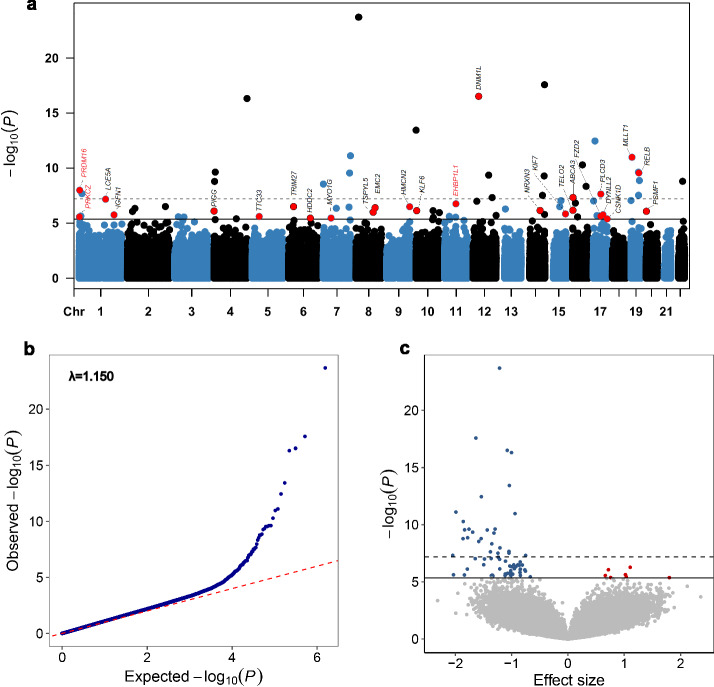
Fig. 1
Fig. 1. Epigenome-wide association study of incident ACS in the Dongfeng–Tongji cohort.
a Manhattan plot. The 26 validated CpGs associated with incident ACS are shown in red dots. We labelled genes mapped to the 26 validated CpGs, with 3 mapped to known cardiovascular disease genes labelled in red text. b QQ plot. The QQ plot illustrates the distribution of observed P values compared to expected values under the null hypothesis of no association. λ is the genomic inflation factor. c Volcano plot. The x-axis shows the effect size of each CpG (raw M value) associated with incident ACS, whereas the y-axis indicates –log10 (P) of the associations. The 7 hypermethylated CpGs with FDR < 0.05 are shown in red dots, and the 65 hypomethylated CpGs with FDR < 0.05 are shown in blue dots. For Manhattan plot and volcano plot, the horizontal solid line corresponds to the genome-wide significance threshold after multiple testing correction (FDR < 0.05), and the horizontal dashed line corresponds to the significance threshold of Bonferroni-corrected P < 0.05. The P value and FDR are calculated using two-sided tests. ACS acute coronary syndrome, CpG cytosine-phosphate-guanine, FDR false discovery rate.
Fig. 2
Fig. 2. Three-way association among cg03609847, PIGG gene expression, and ACS risk.
a The schematic diagram depicting association directions between DNAm, mRNA expression, and ACS risk. b The correlation between DNAm of cg03609847 and PIGG gene expression levels in leukocytes of 156 healthy participants was examined by Pearson correlation test. c The comparison of PIGG gene expression levels in leukocytes between 12 pairs of ACS cases and matched controls was analyzed using the “limma” package. d The comparison of PIGG gene expression levels in 32 pairs of normal carotid tissue and carotid atheroma plaques was performed by GEO2R online tool. e The comparison of PIGG gene expression in 13 early atherosclerotic carotid artery segments and 16 advanced atherosclerotic carotid artery segments was performed by GEO2R online tool. All P values were two-sided. All box plots show median value, IQR, up to 1.5 IQR (whiskers). RNA expression was quantified by TPM across all genes, followed by log2(TPM + 1) transformation for subsequent analysis. ACS acute coronary syndrome, DNAm DNA methylation, IQR interquartile range, TPM transcripts per million.
Fig. 3
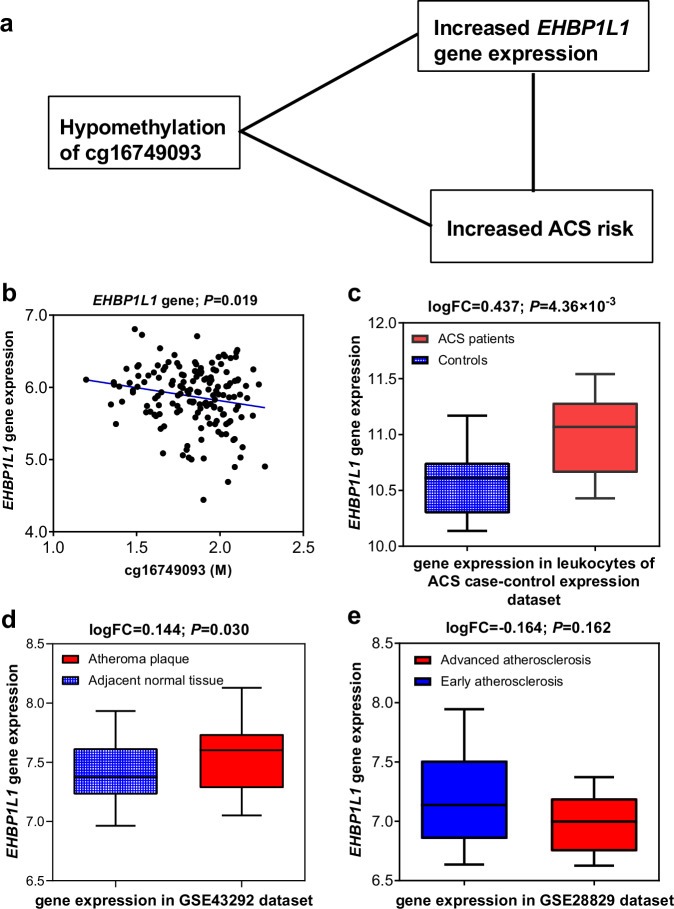
Fig. 3. Three-way association among cg16749093, EHBP1L1 gene expression, and ACS risk.
a The schematic diagram depicting association directions between DNAm, mRNA expression and ACS risk. b The correlation between DNAm of cg16749093 and EHBP1L1 gene expression levels in leukocytes of 156 healthy participants was examined by Pearson correlation test. c The comparison of EHBP1L1 gene expression levels in leukocytes between 12 pairs of ACS cases and matched controls was analyzed using the “limma” package. d The comparison of EHBP1L1 gene expression levels in 32 pairs of normal carotid tissue and carotid atheroma plaques was performed by GEO2R online tool. e The comparison of EHBP1L1 gene expression in 13 early atherosclerotic carotid artery segments and 16 advanced atherosclerotic carotid artery segments was performed by GEO2R online tool. All P values were two-sided. All box plots show median value, IQR, up to 1.5 IQR (whiskers). RNA expression was quantified by TPM across all genes, followed by log2(TPM + 1) transformation for subsequent analysis. ACS acute coronary syndrome, DNAm DNA methylation, IQR interquartile range, TPM transcripts per million.
Fig. 4
Fig. 4. Evaluation of MRS, PRS, and traditional risk factors in the prediction of incident ACS.
a Evaluation in the DFTJ cohort. b Evaluation in the CKB cohort. Traditional risk factors include age, sex, BMI, smoking status, drinking status, hypertension, dyslipidemia, and diabetes. The MRS was calculated by adding the M-values of 67 DMPs identified in the discovery cohort, weighted by their β coefficients from the discovery cohort. ACS acute coronary syndrome, AUC area under ROC curve, DMP differentially methylated position, MRS methylation risk score, PRS polygenic risk score, PRSBBJ published PRS based on the BioBank Japan cohort, PRSCHN published PRS based on Chinese populations, ROC receiver operating characteristic curve.

References

    1. Bhatt, D. L., Lopes, R. D. & Harrington, R. A. Diagnosis and treatment of acute coronary syndrome: a review. JAMA327, 662–675 (2022). 10.1001/jama.2022.0358 - DOI - PubMed
    1. Bergmark, B. A., Mathenge, N., Merlini, P. A., Lawrence-Wright, M. B. & Giugliano, R. P. Acute coronary syndromes. Lancet399, 1347–1358 (2022). 10.1016/S0140-6736(21)02391-6 - DOI - PMC - PubMed
    1. Erdmann, J., Kessler, T., Munoz Venegas, L. & Schunkert, H. A decade of genome-wide association studies for coronary artery disease: the challenges ahead. Cardiovasc. Res.114, 1241–1257 (2018). - PubMed
    1. Bjorkegren, J. L. M., Kovacic, J. C., Dudley, J. T. & Schadt, E. E. Genome-wide significant loci: how important are they? Systems genetics to understand heritability of coronary artery disease and other common complex disorders. J. Am. Coll. Cardiol.65, 830–845 (2015). - PMC - PubMed
    1. Rakyan, V. K., Down, T. A., Balding, D. J. & Beck, S. Epigenome-wide association studies for common human diseases. Nat. Rev. Genet.12, 529–541 (2011). 10.1038/nrg3000 - DOI - PMC - PubMed

LinkOut - more resources