


Investigating the impact of dietary guidelines transition on cardiometabolic risk profile: a forensic analysis using diet quality metrics
- PMID: 39198625
- PMCID: PMC11358446
- DOI: 10.1038/s41598-024-70699-7
Investigating the impact of dietary guidelines transition on cardiometabolic risk profile: a forensic analysis using diet quality metrics
Abstract
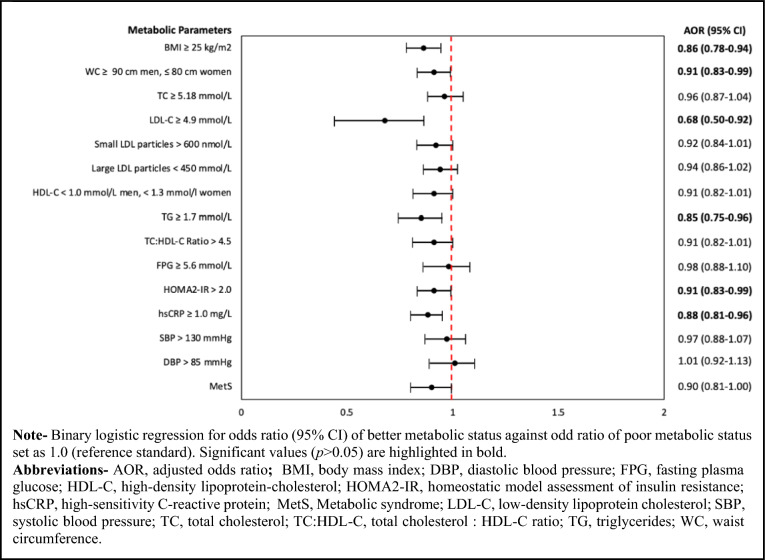
Evaluating dietary guidelines using diet quality (DQ) offers valuable insights into the healthfulness of a population's diet. We conducted a forensic analysis using DQ metrics to compare the Malaysian Dietary Guidelines (MDG-2020) with its former version (MDG-2010) in relation to cardiometabolic risk (CMR) for an adult Malaysian population. A DQ analysis of cross-sectional data from the Malaysia Lipid Study (MLS) cohort (n = 577, age: 20-65yrs) was performed using the healthy eating index-2015 (HEI-2015) framework in conformation with MDG-2020 (MHEI2020) and MDG-2010 (MHEI2010). Of 13 dietary components, recommended servings for whole grain, refined grain, beans and legumes, total protein, and dairy differed between MDGs. DQ score associations with CMR, dietary patterns and sociodemographic factors were examined. Out of 100, total DQ scores of MLS participants were 'poor' for both MHEI2020 (37.1 ± 10.3) and MHEI2010 (39.1 ± 10.4), especially among young adults, males, Malays, and those frequently 'eating out' as well as those with greatest adherence to Sugar-Sweetened Beverages pattern and lowest adherence to Food Plant pattern. Both metrics shared similar correlations with CMR markers, with MHEI2020 exhibiting stronger correlations with WC, BF%, TG, insulin, HOMA2-IR, and smallLDL than MHEI2010, primarily attributed to reduced refined grain serving. Notably, participants with the highest adherence to MHEI2020 scores exhibited significantly reduced odds for elevated TG (AOR 0.44, 95% CI 0.21-0.93, p = 0.030), HOMA2-IR (AOR 0.44, 95% CI 0.21-0.88, p = 0.022), and hsCRP (AOR 0.54, 95% CI 0.31-0.96, p = 0.040, compared to those with the lowest adherence. Each 5-unit increase in MHEI2020 scores reduced odds for elevated BMI (- 14%), WC (- 9%), LDL-C (- 32%), TG (- 15%), HOMA2-IR (- 9%) and hsCRP (- 12%). While MHEI2020 scores demonstrated better calibration with CMR indicators, the overall sub-optimally 'poor' DQ scores of this population call for health promotion activities to target the public to achieve adequate intake of healthful fruits, non-starchy vegetables and whole grain, and moderate intake of refined grain, added sugar and saturated fat.
© 2024. The Author(s).
Conflict of interest statement
T.K. was partially fund from Malaysian Palm Oil Council (MPOC) for this project. K.S. was employed by MPOC at the time of this research. All other authors declare no competing interests.
Figures

References
MeSH terms
Grants and funding
- DLP-2014-017/Universiti Kebangsaan Malaysia (National University of Malaysia)
- GUP-2014-057/Universiti Kebangsaan Malaysia (National University of Malaysia)
- GSP-2013-020/Universiti Kebangsaan Malaysia (National University of Malaysia)
- Grant Reference Number = NN-047-2012/Funder = Malaysian Palm Oil Council (MPOC)
LinkOut - more resources
Full Text Sources
Miscellaneous
