


Variant Impact Predictor database (VIPdb), version 2: trends from three decades of genetic variant impact predictors
- PMID: 39198917
- PMCID: PMC11360829
- DOI: 10.1186/s40246-024-00663-z
Variant Impact Predictor database (VIPdb), version 2: trends from three decades of genetic variant impact predictors
Abstract
Background: Variant interpretation is essential for identifying patients' disease-causing genetic variants amongst the millions detected in their genomes. Hundreds of Variant Impact Predictors (VIPs), also known as Variant Effect Predictors (VEPs), have been developed for this purpose, with a variety of methodologies and goals. To facilitate the exploration of available VIP options, we have created the Variant Impact Predictor database (VIPdb).
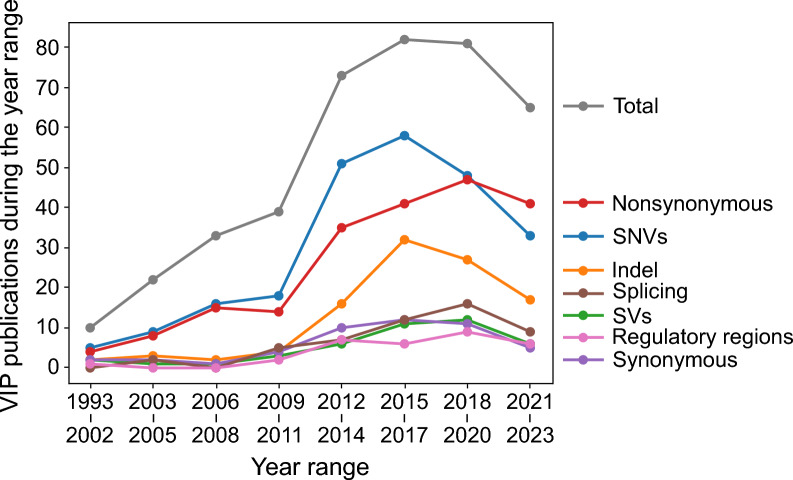
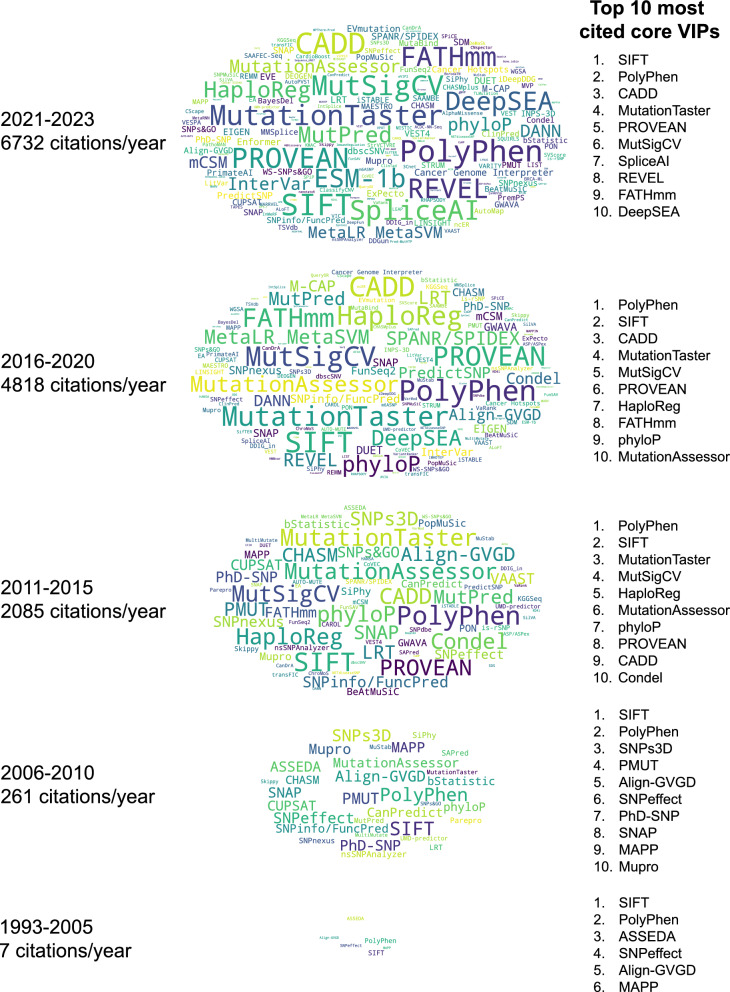
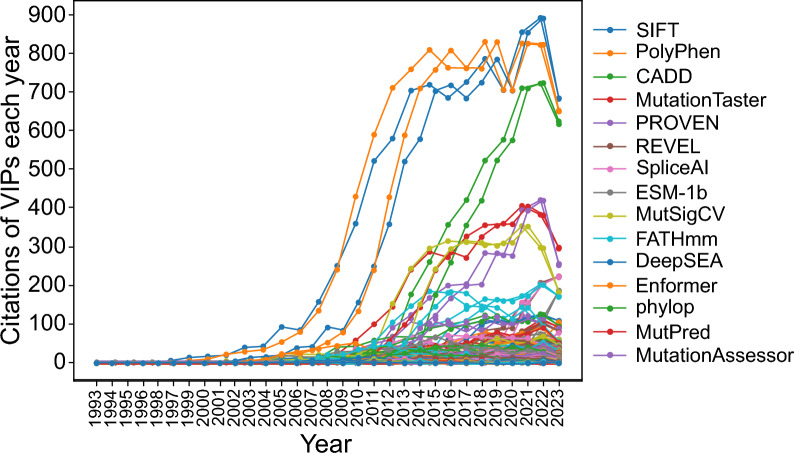
Results: The Variant Impact Predictor database (VIPdb) version 2 presents a collection of VIPs developed over the past three decades, summarizing their characteristics, ClinGen calibrated scores, CAGI assessment results, publication details, access information, and citation patterns. We previously summarized 217 VIPs and their features in VIPdb in 2019. Building upon this foundation, we identified and categorized an additional 190 VIPs, resulting in a total of 407 VIPs in VIPdb version 2. The majority of the VIPs have the capacity to predict the impacts of single nucleotide variants and nonsynonymous variants. More VIPs tailored to predict the impacts of insertions and deletions have been developed since the 2010s. In contrast, relatively few VIPs are dedicated to the prediction of splicing, structural, synonymous, and regulatory variants. The increasing rate of citations to VIPs reflects the ongoing growth in their use, and the evolving trends in citations reveal development in the field and individual methods.
Conclusions: VIPdb version 2 summarizes 407 VIPs and their features, potentially facilitating VIP exploration for various variant interpretation applications. VIPdb is available at https://genomeinterpretation.org/vipdb.
Keywords: Genomic variant; Genotype–phenotype relationship; Indel; SNV; SV; VIPdb; Variant Effect Predictor (VEP); Variant Impact Predictor (VIP); Variant interpretation.
© 2024. The Author(s).
Conflict of interest statement
Zhiqiang Hu is employed at Illumina and has a financial interest in Illumina.
Figures

Update of
-
Variant Impact Predictor database (VIPdb), version 2: Trends from 25 years of genetic variant impact predictors.bioRxiv [Preprint]. 2024 Jun 28:2024.06.25.600283. doi: 10.1101/2024.06.25.600283. bioRxiv. 2024. Update in: Hum Genomics. 2024 Aug 28;18(1):90. doi: 10.1186/s40246-024-00663-z. PMID: 38979289 Free PMC article. Updated. Preprint.
References
Publication types
MeSH terms
Grants and funding
LinkOut - more resources
Full Text Sources
Miscellaneous
