. 2024 Aug 21;16(16):2903.
doi: 10.3390/cancers16162903.

Neutrophil-to-Lymphocyte and Platelet-to-Lymphocyte Ratio: Side by Side with Molecular Mutations in Patients with Non-Small Cell Lung Cancer-The INOLUNG Study

Affiliations

Neutrophil-to-Lymphocyte and Platelet-to-Lymphocyte Ratio: Side by Side with Molecular Mutations in Patients with Non-Small Cell Lung Cancer-The INOLUNG Study

Corina Eugenia Budin et al. Cancers (Basel). .

Abstract

Background and objective: Analysis of inflammatory biomarkers, along with the neutrophil/lymphocyte ratio (NLR) or platelet/lymphocyte ratio (PLR), supports the connection between inflammation and carcinogenesis. Methods: We conducted a retrospective observational study at the Clinical County Hospital Mureș involving patients with lung cancer. The parameters analyzed included histopathological type (NSCLC: squamous cell carcinoma or adenocarcinoma; SCLC), molecular mutations (EGFR, ALK, PD-L1), parameters from the complete blood count, inflammatory parameters, and associated comorbidities. Results: A total of 380 patients were included: 115 patients in the cancer group and 265 patients in the control group. Among patients in the lung cancer group, 88 were diagnosed with NSCLC (44 adenocarcinomas, 44 squamous cell carcinomas) and 27 with SCLC. Both NLR and PLR were significantly higher in cancer patients than in the control group (5.30 versus 2.60, p < 0.001; 217 versus 136, p < 0.001, respectively). NLR and PLR differ between men and women (p = 0.005 and p = 0.056, respectively). C-reactive protein was not correlated with either NLR (p-value: 0.0669) or PLR (p-value: 0.6733) in lung cancer patients. Conclusions: The NLR and PLR values may serve as new predictive biomarkers for the diagnosis of disease in patients with lung cancer, especially those with NSCLC.

Keywords: EGFR; molecular mutations; neutrophil-to-lymphocyte ratio (NLR); non-small cell lung cancer (NSCLC); platelet-to-lymphocyte ratio (PLR).


Conflict of interest statement

The authors declare no conflicts of interest.

Figures
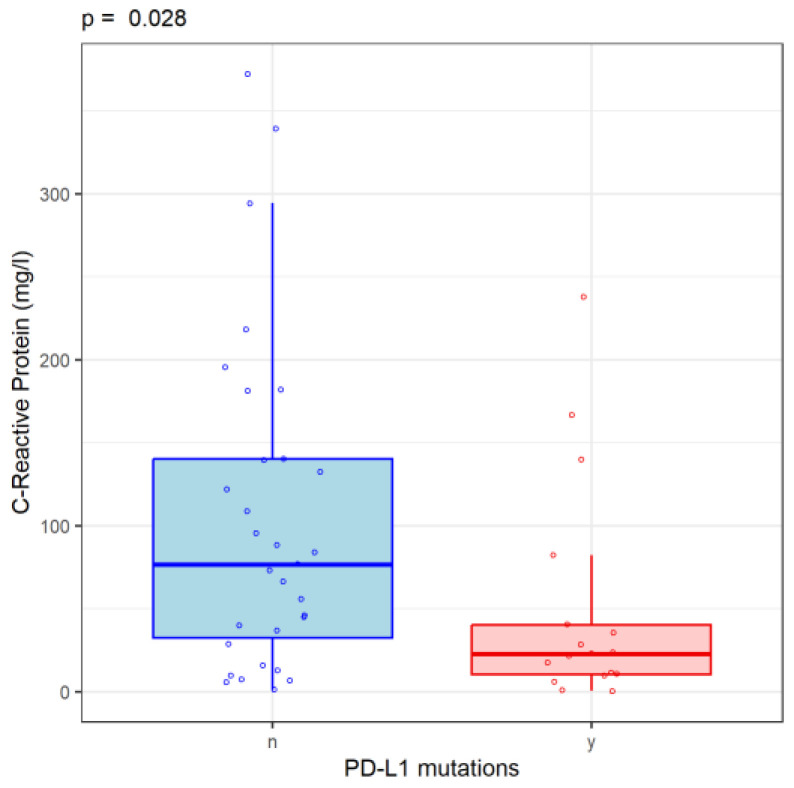
Figure 1
Figure 1
CRP value in PD-L1 mutation patients. y = presence of PD-L1 mutation; n = no PD-L1 mutation.
Figure 2
Figure 2
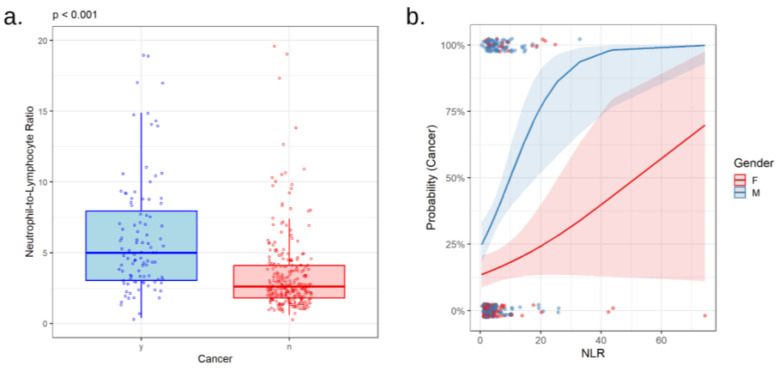
Neutrophil-to-lymphocyte ratio (NLR) in relation to lung cancer (a). Comparison of NLR values in patients with (y) or without (n) lung cancer (b). Correlation between NLR values with the probability of lung cancer in males (M) and females (F).
Figure 3
Figure 3
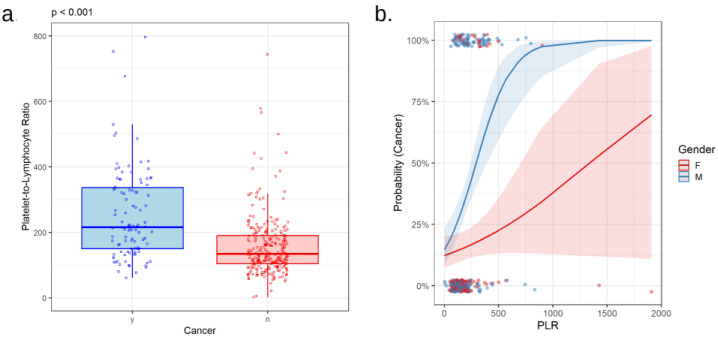
Platelet-to-lymphocyte ratio (PLR) in relation to lung cancer (a). Comparison of PLR values in patients with (y) or without (n) lung cancer (b). Correlation between PLR values with the probability of lung cancer in males (M) and females (F).
Figure 4
Figure 4
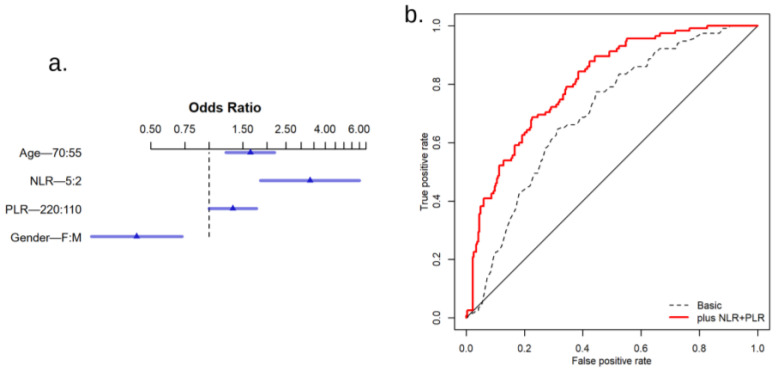
Predictive model for the presence of lung cancer in patients with pulmonary disease (a). Odds ratios (triangles) and their 95% confidence intervals (horizontal bars) for the components of the predictive model: Age, Gender, NLR, and PLR (b). Receiver operating characteristic (ROC) curves for a basic model (based on Age and Gender only) and the complete model (based on Age, Gender, NLR, and PLR) based on multiple logistic regression for the prediction of the presence of lung cancer. The closer the curve to the top-left corner of the chart, the more accurate the distinction between a patient with and a patient without cancer.

References

    1. Michaels E., Bestvina C.M. Meeting an un-MET need: Targeting MET in non-small cell lung cancer. Front. Oncol. 2022;12:1004198. doi: 10.3389/fonc.2022.1004198. - DOI - PMC - PubMed
    1. Mosca M., Nigro M.C., Pagani R., De Giglio A., Di Federico A. Neutrophil-to-Lymphocyte Ratio (NLR) in NSCLC, Gastrointestinal, and Other Solid Tumors: Immunotherapy and Beyond. Biomolecules. 2023;13:1803. doi: 10.3390/biom13121803. - DOI - PMC - PubMed
    1. Guo R., Berry L.D., Aisner D.L. MET IHC is a Poor Screen for MET Amplification or MET exon 14 mutations in Lung Adenocarcinomas: Data from a Tri-Institutional Cohort of the Lung Cancer Mutation Consortium. J. Thorac. Oncol. 2019;14:1666–1671. doi: 10.1016/j.jtho.2019.06.009. - DOI - PMC - PubMed
    1. Guthrie G.J.K., Charles K.A., Roxburgh C.S.D., Horgan P.G., McMillan D.C., Clarke S.J. The systemic inflammation-based neutrophil-lymphocyte ratio: Experience in patients with cancer. Crit. Rev. Oncol. Hematol. 2013;88:218–230. doi: 10.1016/j.critrevonc.2013.03.010. - DOI - PubMed
    1. Køstner A.H., Fuglestad A.J., Georgsen J.B. Fueling the flames of colon cancer–does CRP play a direct pro-inflammatory role? Front. Immunol. 2023;14:1170443. doi: 10.3389/fimmu.2023.1170443. - DOI - PMC - PubMed

LinkOut - more resources