


Exploring the Antimicrobial Resistance Profile of Salmonella typhi and Its Clinical Burden
- PMID: 39200066
- PMCID: PMC11350866
- DOI: 10.3390/antibiotics13080765
Exploring the Antimicrobial Resistance Profile of Salmonella typhi and Its Clinical Burden
Abstract
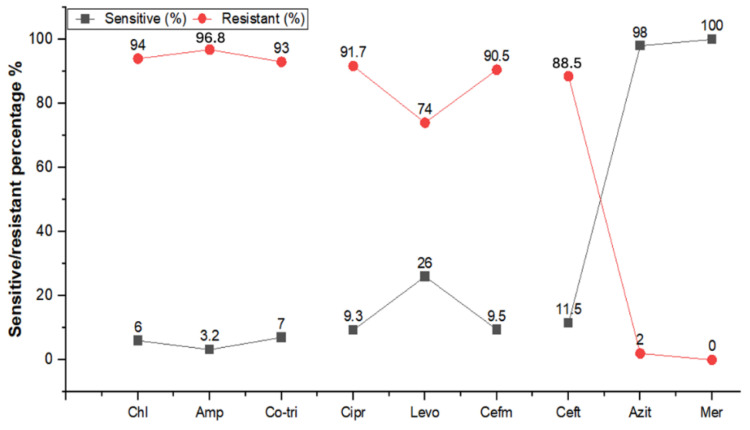
Background: Typhoid fever caused by Salmonella enterica serovar Typhi (S. typhi) continues to pose a significant risk to public health in developing countries, including Pakistan. This study investigated the epidemiological factors linked to suspected and confirmed S. typhi infections in Peshawar's hospital population. Methodology: A total of 5735 blood samples of patients with suspected enteric fever were collected from September 2022 to November 2023. S. typhi infection was confirmed using microbiological culture of blood samples, biochemical-based tests, and DNA-sequencing methods. Drug sensitivity testing on cultures was conducted as per the CLSI guidelines. Chi-square tests were used to analyze the clinical and epidemiologic characteristics of 5735 samples stratified by S. typhi infection status, and risk factors were assessed by applying logistic regression models to estimate odds ratios (ORs). Results: The number of confirmed typhoid fever cases in this hospital-based study population was 691 (/5735, 12.0%), more prevalent in males (447/3235 13.8%) and children (0-11 years) (429/2747, 15.6%). Compared to children, the risk of S. typhi infection was lower in adolescence (adjusted OR = 0.52; 95% CI: 0.42-0.66), adulthood (19-59 years; aOR = 0.30; 95% CI: 0.25-0.38), and older adulthood (aOR = 0.08; 95% CI: 0.04-0.18) (p < 0.001). Compared to males, the risk of S. typhi infection was lower in females (aOR = 0.67; 95% CI = 0.56-0.80; p = 0.002). Living in a rural residence (compared to urban) was associated with a higher risk of infection (aOR = 1.38; 95% CI: 1.16-1.63; p = 0.001), while access to a groundwater source (compared to municipal water supply) led to a lower risk (aOR = 0.56; 95% CI: 0.43-0.73; p = 0.002). Vaccination demonstrated a robust protective effect (aOR = 0.069; 95% CI = 0.04-0.11, p = 0.002). For those with typhoid infections, clinical biomarker analysis revealed the presence of leucopenia (65/691, 9.4%), thrombocytopenia (130/691, 18.8%), and elevated alanine aminotransferase (ALT) (402/691, 58.2%) and C-reactive protein (CRP) (690/691, 99.9%) levels. Worryingly, among the positive S. typhi isolates, there was a high prevalence of drug resistance (653/691), including multidrug-resistant (MDR 82/691, 11.9%) and extensively drug-resistant types (XDR, 571/691, 82.6%). Conclusions: This study highlights the importance of age, sex, locality, water source, and vaccination status in shaping the epidemiological landscape of S. typhi in the Peshawar district. It implies that expanding vaccination coverage to the broader population of Khyber Pakhtunkhwa province, particularly in the district of Peshawar, would be beneficial.
Keywords: Salmonella typhi; antibiogram; clinical paradigm; drug resistance; typhoid fever.
Conflict of interest statement
The authors declare that they have no known competing financial interests or personal relationships that could have appeared to influence the work reported in this paper.
Figures
References
-
- Saeed M., Rasool M.H., Rasheed F., Saqalein M., Nisar M.A., Imran A.A., Tariq S., Amir A., Ikram A., Khurshid M. Extended-spectrum beta-lactamases producing extensively drug-resistant Salmonella typhi in Punjab, Pakistan. J. Infect. Dev. Ctries. 2020;14:169–176. doi: 10.3855/jidc.12049. - DOI - PubMed
-
- Carey M.E., MacWright W.R., Im J., Meiring J.E., Gibani M.M., Park S.E., Longley A., Jeon H.J., Hemlock C., Yu A.T., et al. The Surveillance for Enteric Fever in Asia Project (SEAP), Severe Typhoid Fever Surveillance in Africa (SETA), Surveillance of Enteric Fever in India (SEFI), and Strategic Typhoid Alliance Across Africa and Asia (STRATAA) Population-based Enteric Fever Studies: A Review of Methodological Similarities and Differences. Clin. Infect. Dis. 2020;71((Suppl. S2)):S102–S110. - PMC - PubMed
-
- Meiring J.E., Shakya M., Khanam F., Voysey M., Phillips M.T., Tonks S., Thindwa D., Darton T.C., Dongol S., Karkey A., et al. Burden of enteric fever at three urban sites in Africa and Asia: A multicentre population-based study. Lancet Glob. Health. 2021;9:e1688–e1696. doi: 10.1016/S2214-109X(21)00370-3. - DOI - PMC - PubMed
-
- Informatics, G.; Berger, S.; G.S. Team. Infectious Diseases of China. GIDEON Informatics Inc.; Los Angeles, CA, USA: 2023.
Grants and funding
LinkOut - more resources
Full Text Sources
Molecular Biology Databases
Research Materials
Miscellaneous
