


Challenges Facing Two Outbreaks of Carbapenem-Resistant Acinetobacter baumannii: From Cefiderocol Susceptibility Testing to the Emergence of Cefiderocol-Resistant Mutants
- PMID: 39200084
- PMCID: PMC11350900
- DOI: 10.3390/antibiotics13080784
Challenges Facing Two Outbreaks of Carbapenem-Resistant Acinetobacter baumannii: From Cefiderocol Susceptibility Testing to the Emergence of Cefiderocol-Resistant Mutants
Abstract
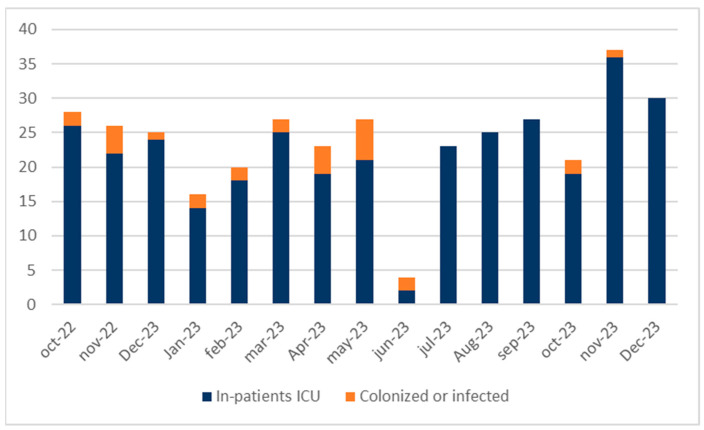
Carbapenem-resistant Acinetobacter baumannii (CRAB) infections are associated with poor outcomes depending on patient's conditions, clinical severity and type of infection, and treatment is challenging given the limited therapeutic options available. The aim of this study was to describe the clinical and microbiological characteristics of two outbreaks caused by CRAB in an intensive care unit (ICU). In addition, the mechanisms of resistance detected in these strains and the treatment chosen according to the available therapeutic options were analyzed. Overall, 28 patients were included. Ten patients (35.71%) had ventilator-associated pneumonia (VAP), ten (35.71%) had a bloodstream infection (BSI), and eight (28.57%) were only colonized. Recurrent infection occurred in 25% (5/20) of infected patients. Two different strains of A. baumannii were isolated from the index patient of the first outbreak. The first strain belonged to the ST85 and carried the blaNDM-1 carbapenemase gene, while the second belonged to the ST2 and carried blaOXA-23, and blaOXA-66 carbapenemase genes. The phylogenetic analysis revealed that the ST2 strain was the cause of the major outbreak, and mutations in the AmpC gene were related to progressive increasing minimum inhibitory concentration (MIC) and finally, cefiderocol-resistance in one strain. The CRAB isolates from the second outbreak were also identified as ST2. Cefiderocol-resistant strains tests identified by the disc diffusion method were involved in 24% (6/25) of nosocomial infections. Using broth microdilution (BMD) ComASP® only, 33.3% (2/6) of these strains were cefiderocol-resistant. All-cause ICU mortality was 21.4%. Conclusions: Cefiderocol is the first approved siderophore cephalosporin for the treatment of CRAB infections. Cefiderocol-resistant strains were related with blaNDM-1 carbapenemase and mutations in the AmpC gene. Cefiderocol-resistant strains or that cannot be properly interpreted by disk diffusion, should be retested using BMD for definitive categorization.
Keywords: Acinetobacter baumannii; carbapenem-resistant; cefiderocol; outbreak.
Conflict of interest statement
M.R.-A. has conducted consulting work for Viatris and Shionogi. M.R.-A. has served as a speaker for Pfizer, Gilead Sciences, and Shionogi. Mª.J.A.-M. has served as a speaker for Pfizer, MSD, and Shionogi. J.C.R.-R has served as a speaker for Shionogi. The remaining authors declare no conflict of interest.
Figures
References
-
- Kollef M., Dupont H., Greenberg D.E., Viale P., Echols R., Yamano Y., Nicolau D.P. Prospective role of cefiderocol in the management of carbapenem-resistant Acinetobacter baumannii infections: Review of the evidence. Int. J. Antimicrob. Agents. 2023;62:106882. doi: 10.1016/j.ijantimicag.2023.106882. - DOI - PubMed
LinkOut - more resources
Full Text Sources
