


Parents in the Driver's Seat-Experiences of Parent-Delivered Baby-mCIMT Coached Remotely
- PMID: 39201006
- PMCID: PMC11355282
- DOI: 10.3390/jcm13164864
Parents in the Driver's Seat-Experiences of Parent-Delivered Baby-mCIMT Coached Remotely
Abstract
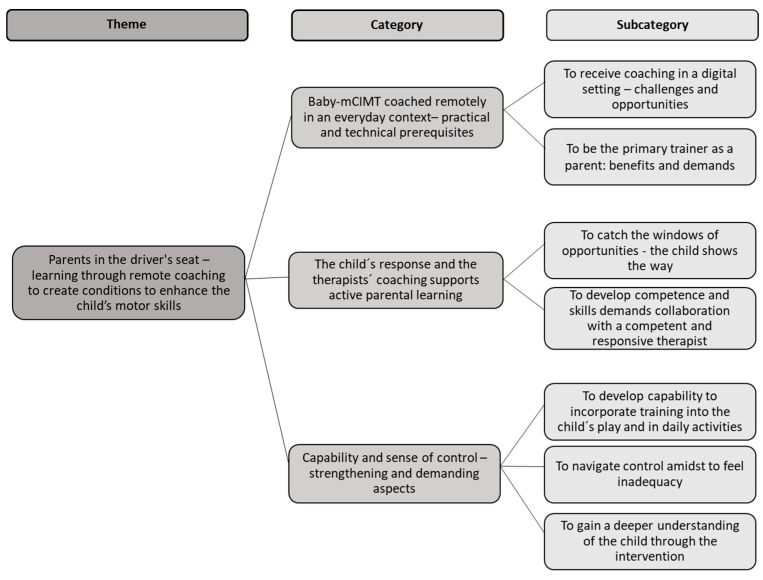
Background/Objectives: Recent guidelines on early intervention in children at high risk of cerebral palsy (CP) recommend parental involvement and family-centered home-based interventions with parents as primary trainers. Therapist coaching by home visitation is resource demanding, and telerehabilitation is a viable option for remote intervention and coaching. This study aims to describe parents' experiences of engaging in Baby-mCIMT coached remotely. Their infants are at high risk of unilateral cerebral palsy and the parents have been the primary trainers in regard to home-based intervention, optimizing the use of the affected hand. Methods: A qualitative approach involving semi-structured interviews with eight parents was employed. Data were analyzed using qualitative content analysis. Results: The overarching theme "Parents in the driver's seat-learning through remote coaching to create conditions to enhance the child's motor skills" describes parents' experiences as primary training providers. The following three underlying categories with subcategories were identified: (1) Baby-mCIMT coached remotely in an everyday context-practical and technical prerequisites; (2) the child's response and the therapists' coaching supports active parental learning; (3) capability and sense of control-strengthening and demanding aspects. Conclusions: Our findings revealed that Baby-mCIMT coached remotely empowered the parents as primary trainers, which provided them with opportunities for understanding and learning about their child and their development. The findings underscore the importance of responsive professional guidance and a strong therapist-parent relationship to succeed with the Baby-mCIMT program coached remotely and to manage the digital coaching format.
Keywords: early intervention; home-training; parent experience; remote Baby-mCIMT; telerehabilitation; unilateral cerebral palsy.
Conflict of interest statement
The authors declare no conflicts of interest. The funders had no role in the design of the study; in the collection, analyses, or interpretation of the data; in the writing of the manuscript; or in the decision to publish the results.
Figures
References
-
- Morgan C., Fetters L., Adde L., Badawi N., Bancale A., Boyd R.N., Chorna O., Cioni G., Damiano D.L., Darrah J., et al. Early Intervention for Children Aged 0 to 2 Years With or at High Risk of Cerebral Palsy: International Clinical Practice Guideline Based on Systematic Reviews. JAMA Pediatr. 2021;175:846. doi: 10.1001/jamapediatrics.2021.0878. - DOI - PMC - PubMed
-
- Tanner K., Bican R., Boster J., Christensen C., Coffman C., Fallieras K., Long R., Mansfield C., O’Rourke S., Pauline L., et al. Feasibility and Acceptability of Clinical Pediatric Telerehabilitation Services. Int. J. Telerehabilitation. 2020;12:43–52. doi: 10.5195/ijt.2020.6336. - DOI - PMC - PubMed
Grants and funding
LinkOut - more resources
Full Text Sources
Miscellaneous
