. 2024 Aug 14;25(16):8834.
doi: 10.3390/ijms25168834.

Function Analysis of a Maize Endo-1,4-β-xylanase Gene ZmHSL in Response to High-Temperature Stress

Affiliations

Function Analysis of a Maize Endo-1,4-β-xylanase Gene ZmHSL in Response to High-Temperature Stress

Shengyan Pang et al. Int J Mol Sci. .

Abstract

Rising temperature is a major threat to the normal growth and development of maize, resulting in low yield production and quality. The mechanism of maize in response to heat stress remains uncertain. In this study, a maize mutant Zmhsl-1 (heat sensitive leaves) with wilting and curling leaves under high temperatures was identified from maize Zheng 58 (Z58) mutant lines generated by ethyl methanesulfonate (EMS) mutagenesis. The Zmhsl-1 plants were more sensitive to increased temperature than Z58 in the field during growth season. The Zmhsl-1 plants had lower plant height, lower yield, and lower content of photosynthetic pigments. A bulked segregant analysis coupled with whole-genome sequencing (BSA-seq) enabled the identification of the corresponding gene, named ZmHSL, which encodes an endo-β-1,4-xylanase from the GH10 family. The loss-of-function of ZmHSL resulted in reduced lignin content in Zmhsl-1 plants, leading to defects in water transport and more severe leaf wilting with the increase in temperature. RNA-seq analysis revealed that the differentially expressed genes identified between Z58 and Zmhsl-1 plants are mainly related to heat stress-responsive genes and unfolded protein response genes. All these data indicated that ZmHSL plays a key role in lignin synthesis, and its defective mutation causes changes in the cell wall structure and gene expression patterns, which impedes water transport and confers higher sensitivity to high-temperature stress.

Keywords: BSA-seq; RNA-seq; cell wall; endo-β-1,4-xylanase; heat stress; maize; water transport.


Conflict of interest statement

The authors declare no conflicts of interest.

Figures
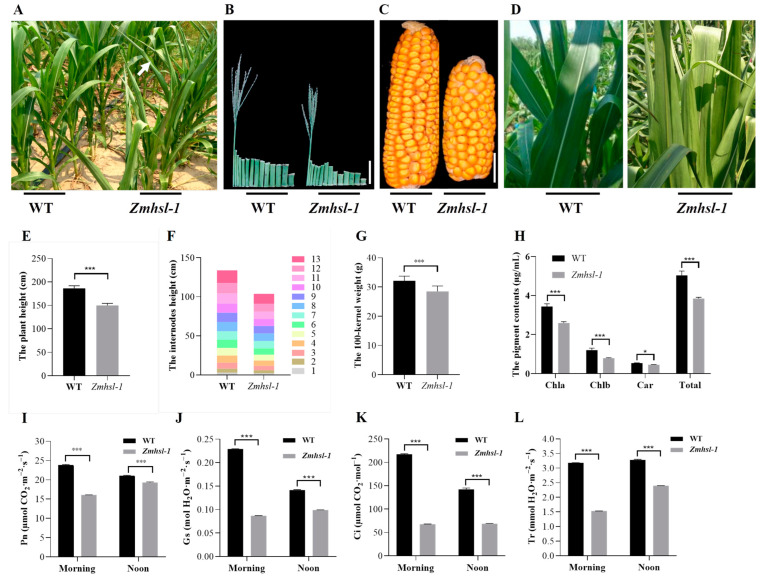
Figure 1
Figure 1
Phenotypic comparison between wild-type and Zmhsl-1 plants. (A) Phenotypes of wild-type (WT) and Zmhsl-1 plants at late whorl stage. The arrow indicates the curling leaf. (B) Internodes and tassel of wild-type and Zmhsl-1 plants at tasselling stage, Bar = 10 cm. (C) Ears of wild-type and Zmhsl-1 plants at the mature stage, bar = 3 cm. (D) Comparison of leaf colour between wild-type and Zmhsl-1 plants. (E) Comparison of plant height between wild-type and Zmhsl-1 plants, n = 18. (F) Comparison of internode length between wild-type and Zmhsl-1 plants, n = 10. (G) Comparison of 100-grain weight between wild-type and Zmhsl-1, n = 10. (H) Determination of pigment content of wild-type and Zmhsl-1 leaves. (I) Determination of net photosynthetic rate (Pn) between wild-type and Zmhsl-1 plants. (J) Determination of stomatal conductance (Gs) between wild-type and Zmhsl-1 plants. (K) Determination of intercellular carbon dioxide concentration (Ci) between wild-type and Zmhsl-1 plants. (L) Measurement of respiration rate (Tr) between wild-type and Zmhsl-1 plants. n represents the number of samples; t-test (* p < 0.05, *** p < 0.001).
Figure 2
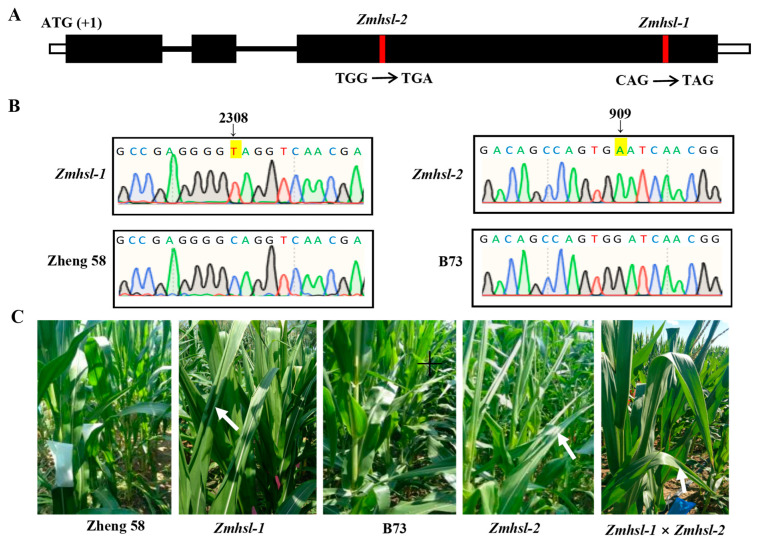
Figure 2
ZmHSL mutation site and allele test. (A) Schematic diagram of ZmHSL mutation site. (B) Zmhsl-1 and Zmhsl-2 sequencing peak map. (C) The phenotype of F1 plants derived from the cross of Zmhsl-1 with Zmhsl-2 at noon in the field with a temperature higher than 30 °C. The arrows indicate curling leaves.
Figure 3
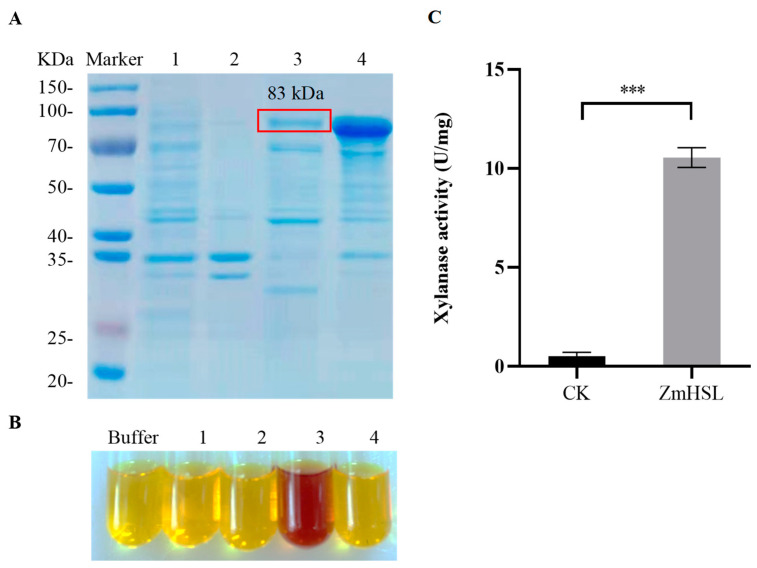
Figure 3
Determination of ZmHSL xylanase activity. (A) SDS-PAGE electrophoresis picture of ZmHSL expressed protein. (B) Xylanase activity of ZmHSL protein was determined by 3,5-dinitrosalicylic acid. (C) Xylanase activity of ZmHSL and control; the error bars represent ± SE (n = 3), t-test (***, p < 0.001). The numbers “1, 2, 3, and 4” in (A,B) represent pET-28a(+) unloaded supernatant, pET-28a(+) unloaded precipitate, pET-28a(+)-ZmHSL supernatant, and pET-28a(+)-ZmHSL precipitate.
Figure 4
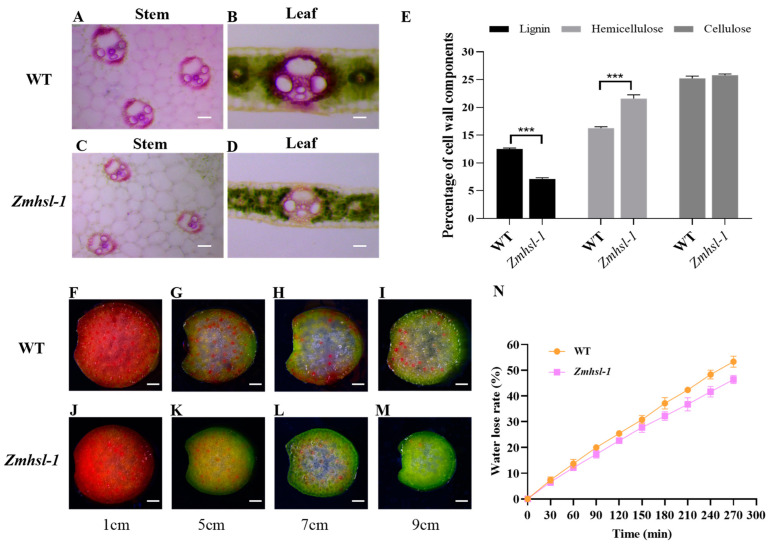
Figure 4
Comparison of cell wall components and water transport between wild-type and Zmhsl-1 plants. (AD) Lignin staining of cross-sections of stems and leaves from wild-type and Zmhsl-1 plants. (A,C) Bar = 0.1 mm, (B,D) Bar = 0.2 mm. (E) Determination of cell wall components in wild-type and Zmhsl-1 plants. (FM) Cross-section staining observations at 1 cm, 5 cm, 7 cm, and 9 cm above the stained end of a stem in wild-type and Zmhsl-1 plants. (N) The detached leaf water loss rates of wild-type and Zmhsl-1 plants at indicated time. t-test (*** p < 0.001).
Figure 5
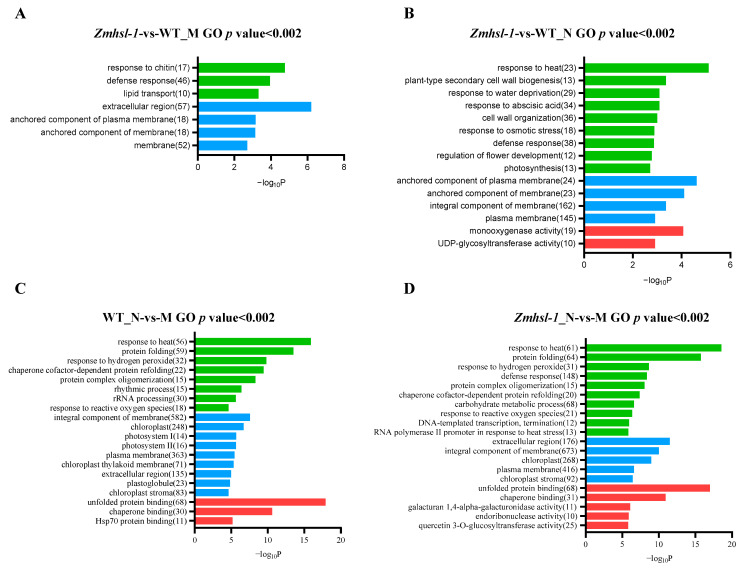
Figure 5
GO enrichment analysis of wild-type and Zmhsl-1 plants. (A) GO enrichment analysis of DEGs between wild type and Zmhsl-1 at 24 °C (in the morning). (B) GO enrichment analysis of DEGs between wild type and Zmhsl-1 at 34 °C (at noon). (C) GO enrichment analysis of DEGs in wild-type plants between morning and noon. (D) GO enrichment analysis of DEGs in Zmhsl-1 between morning and noon. The M in the picture refers to “morning” with an ambient temperature of about 24 °C, and N refers to “noon” with an ambient temperature of about 34 °C.
Figure 6
Figure 6
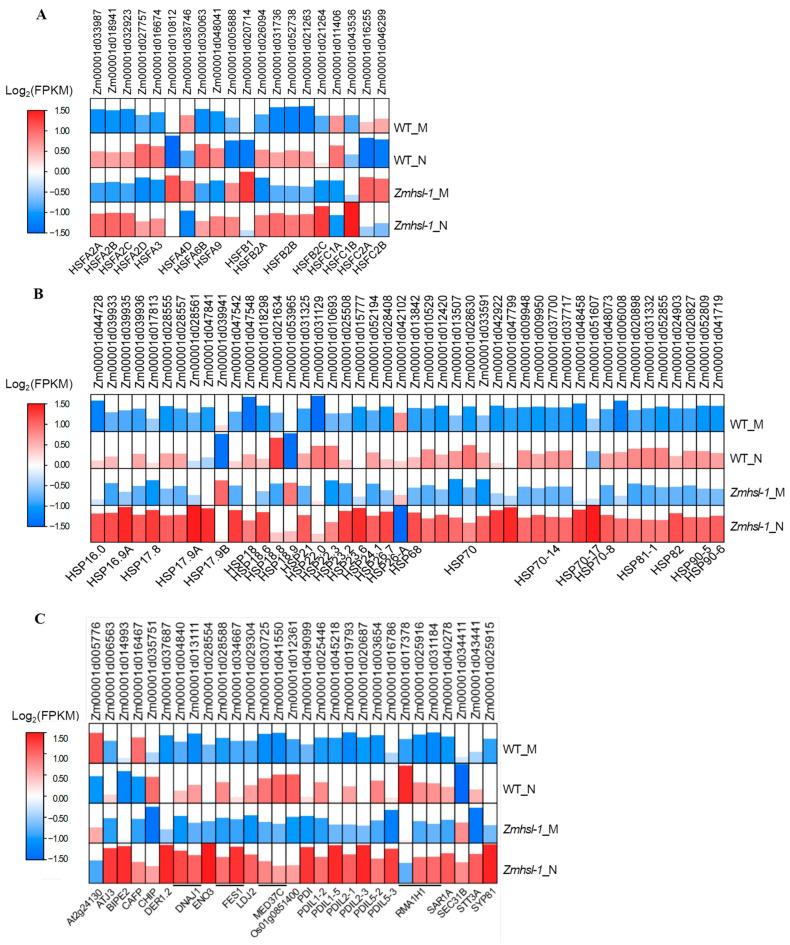
Expression patterns of HSR- and UPR-related genes in different maize genotypes. (A) Expression pattern of DEGs associated with the heat shock transcription factors (HSFs). (B) Expression pattern of DEGs associated with the heat shock proteins (HSPs). (C) Expression pattern of DEGs associated with unfolded protein response (UPR).

Similar articles

Cited by

References

    1. El-Sappah A.H., Rather S.A., Wani S.H., Elrys A.S., Bilal M., Huang Q., Dar Z.A., Elashtokhy M.M.A., Soaud N., Koul M., et al. Heat stress-mediated constraints in maize (Zea mays) production: Challenges and solutions. Front. Plant Sci. 2022;13:879366. doi: 10.3389/fpls.2022.879366. - DOI - PMC - PubMed
    1. Xie C., Yang L., Jia G., Yan K., Zhang S., Yang G., Wu C., Gai Y., Zheng C., Huang J. Maize HEAT UP-REGULATED GENE 1 plays vital roles in heat stress tolerance. J. Exp. Bot. 2022;73:6417–6433. doi: 10.1093/jxb/erac262. - DOI - PubMed
    1. Li B., Gao K., Ren H., Tang W. Molecular mechanisms governing plant responses to high temperatures. J. Integr. Plant Biol. 2018;60:757–779. doi: 10.1111/jipb.12701. - DOI - PubMed
    1. Li Z., Howell S.H. Heat stress responses and thermotolerance in maize. Int. J. Mol. Sci. 2021;22:948. doi: 10.3390/ijms22020948. - DOI - PMC - PubMed
    1. Gu L., Jiang T., Zhang C., Li X., Wang C., Zhang Y., Li T., Dirk L.M.A., Downie A.B., Zhao T. Maize HSFA2 and HSBP2 antagonistically modulate raffinose biosynthesis and heat tolerance in Arabidopsis. Plant J. 2019;100:128–142. doi: 10.1111/tpj.14434. - DOI - PubMed

LinkOut - more resources