


Relations between Neurocognitive Function and Visual Acuity: A Cross-Sessional Study in a Cohort of Premature Children
- PMID: 39201829
- PMCID: PMC11352678
- DOI: 10.3390/children11080894
Relations between Neurocognitive Function and Visual Acuity: A Cross-Sessional Study in a Cohort of Premature Children
Abstract
Background: Premature children with retinopathy of prematurity (ROP) have been reported to an have increased risk of visual and neurocognitive impairments, yet little is known about whether vision could affect specific neurocognition. This study aimed to clarify the correlations between neurocognition and vision in premature children.
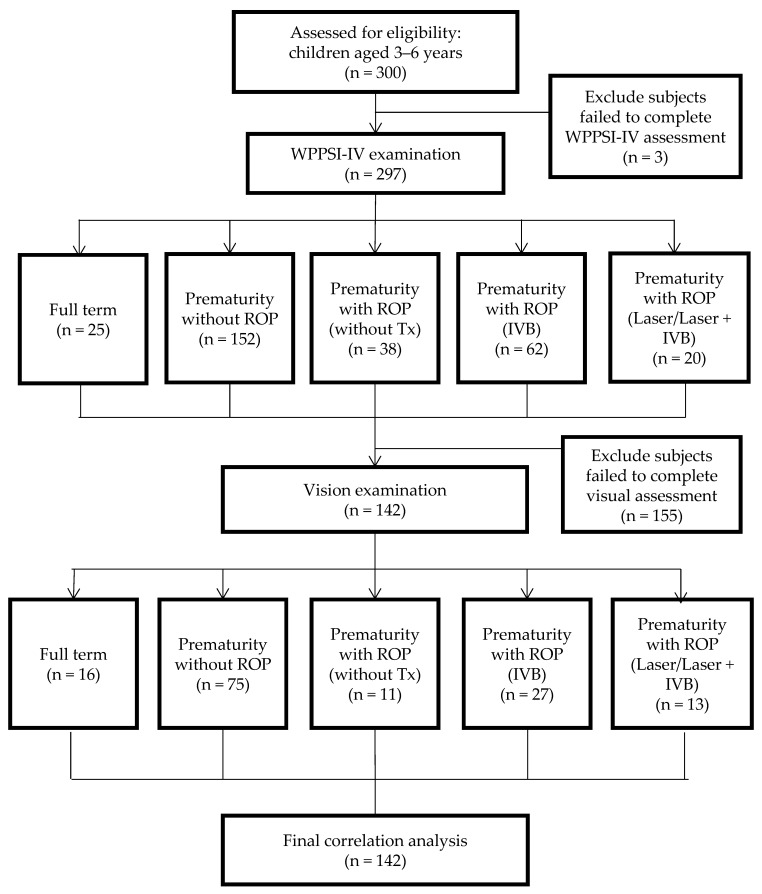
Materials and methods: This is a nonrandomized, cross-sectional, observational study in a pediatric cohort with five groups: (1) full-term (n = 25), (2) prematurity without ROP (n = 154), (3) prematurity with ROP but without treatment (n = 39), (4) prematurity with ROP and with bevacizumab (IVB) treatment (n = 62), and (5) prematurity with ROP and with laser/laser + IVB treatment (n = 20). Neurocognitive function was evaluated by the Wechsler Preschool and Primary Scale of Intelligence, Fourth Edition (WPPSI-IV) around the age of 4 years. Visual acuity (VA) and refractive errors were tested. Correlations between WPPSI parameters and visual outcomes were analyzed across five groups.
Results: Among the 300 recruited children (mean age = 4.02 + 0.97 years, male = 56.3%), 297 were assessed by WPPSI-IV and 142 were assessed by vision tests. The Full-Scale Intelligence Quotient (FSIQ) index was worse in the premature groups. After adjusting for covariates, seven items, including FSIQ-Index (p = 0.047), fluid-reasoning index (p = 0.004), FR-percentile ranking (p = 0.008), object assembly (p = 0.034), picture concept (p = 0.034), zoo locations (p = 0.014) and bug search (p = 0.020), showed significant differences between groups. The better the best corrected VA (BCVA), the higher the scores on Verbal Comprehension Index (VCI), VCI-PR, and the subtest of information.
Conclusions: Specific cognitive dysfunctions are related to the BCVA in this large cohort. Subtest performance profiles in WPPSI can be affected by prematurity, ROP treatment, and different ROP treatment. FSIQ is generally lower in premature children and even lower in children with ROP.
Keywords: Wechsler Preschool and Primary Scale of Intelligence; cognitive function; premature infants; retinopathy of prematurity; vision.
Conflict of interest statement
The authors declare that they have no financial arrangements or connections with regard to this study. This research did not receive any specific grant from funding agencies in the public, commercial, or not-for-profit sectors. The authors declare that they have no conflicts of interest with regard to this study.
Figures
References
-
- Blencowe H., Cousens S., Oestergaard M.Z., Chou D., Moller A.B., Narwal R., Adler A., Vera Garcia C., Rohde S., Say L., et al. National, regional, and worldwide estimates of preterm birth rates in the year 2010 with time trends since 1990 for selected countries: A systematic analysis and implications. Lancet. 2012;379:2162–2172. doi: 10.1016/S0140-6736(12)60820-4. - DOI - PubMed
-
- Preterm Birth. [(accessed on 31 March 2023)]. Available online: https://www.who.int/news-room/fact-sheets/detail/preterm-birth.
-
- Chawanpaiboon S., Vogel J.P., Moller A.B., Lumbiganon P., Petzold M., Hogan D., Landoulsi S., Jampathong N., Kongwattanakul K., Laopaiboon M., et al. Global, regional, and national estimates of levels of preterm birth in 2014: A systematic review and modelling analysis. Lancet Glob. Health. 2019;7:e37–e46. doi: 10.1016/S2214-109X(18)30451-0. - DOI - PMC - PubMed
Grants and funding
LinkOut - more resources
Full Text Sources
Research Materials
